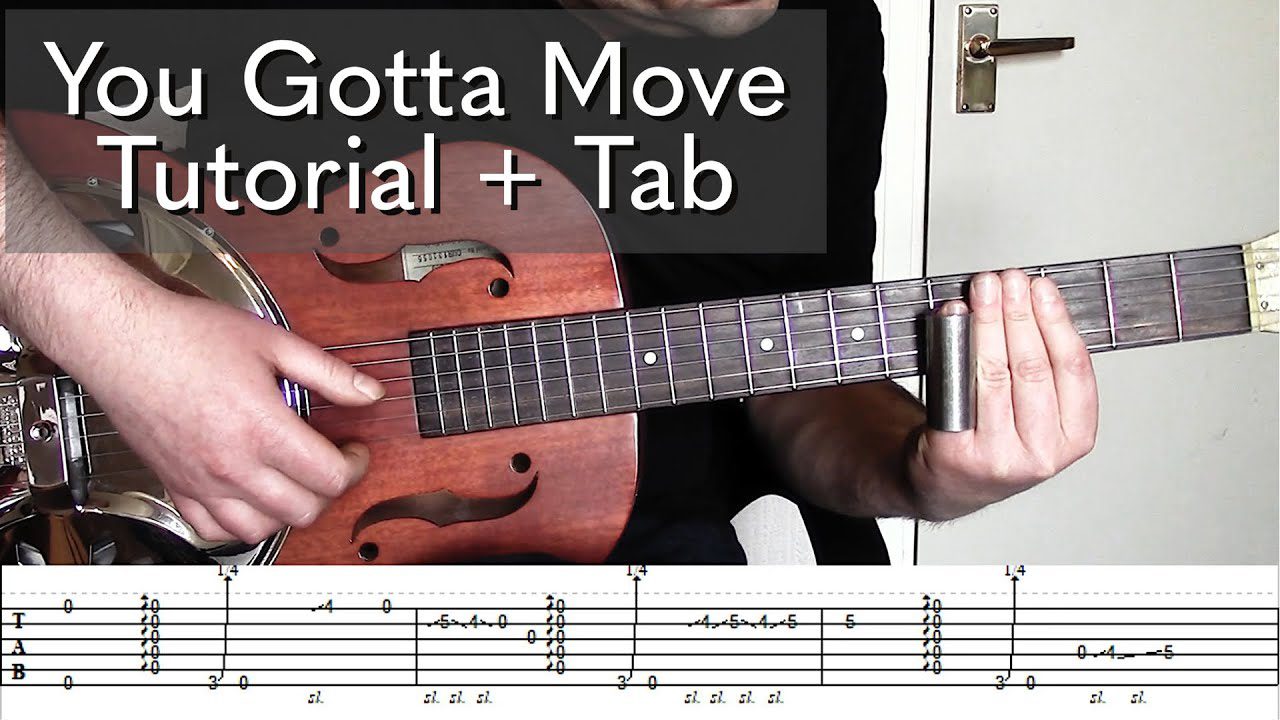
You’ve heard it. That low, thumping bass line and the piercing slide that feels like it’s cutting right through the room. If you’re looking for a you gotta move tab, you aren't just looking for a sequence of numbers on a line; you’re hunting for the soul of the Mississippi Delta. This isn't some complex jazz fusion piece with seventeen chords you can’t pronounce. It’s basically two or three chords, a slide, and a whole lot of "attitude."
But here is the thing. Most tabs you find online for this song are actually wrong. Or, at the very least, they're dangerously incomplete.
The song is a traditional spiritual, but it was immortalized by Fred McDowell—Mississippi Fred McDowell, to be exact. Later, The Rolling Stones took a crack at it on Sticky Fingers, and suddenly every kid with a Sears catalog guitar was trying to figure out how Mick Taylor got that greasy, vocal-like slide tone. To play it right, you have to throw out half of what you know about "standard" guitar playing.
The Open D Mystery (And Why Your Tab Might Suck)
If you pull up a you gotta move tab and it tells you to stay in standard tuning (E-A-D-G-B-E), close the tab. Just close it. You're wasting your time. Fred McDowell famously said, "I do not play no rock and roll," but he also didn't play in standard tuning for this kind of heavy, droning blues.
You need to drop into Open D Tuning. That means tuning your strings to D-A-D-F#-A-D.
When you do this, the guitar becomes a different animal. You can lay your finger—or better yet, a heavy glass or brass slide—across all the strings at once and get a perfect major chord. This is the foundation. If you try to play those slide riffs in standard tuning, you’ll be jumping all over the fretboard like a caffeinated squirrel, and it will sound thin. Weak. Not like the Delta.
The real "secret" that most tabs miss is the thumb. Your thumb has to be a metronome. It hits that low D string on almost every beat. Constant. Thumping. It’s the heartbeat. While your thumb is doing that blue-collar work, your fingers (and the slide) are singing the melody on the higher strings. It’s a "call and response" happening on a single instrument.
Breaking Down the Fred McDowell Style
Fred didn’t use a pick. He used his bare fingers and a slide, usually on his ring or pinky finger. If you look at a high-quality you gotta move tab, it should indicate a lot of "vibrato" on the notes.
When you hit a note with a slide, you don't just sit there. You shake it. Gently. It’s like a singer’s voice trembling on a long note.
Specifically, the "main" riff usually revolves around the 12th fret, the 5th fret, and the open strings. In Open D, the 5th fret is your IV chord (G), and the 7th fret is your V chord (A). But "You Gotta Move" stays mostly on the I and the IV.
- The Hook: You slide up from the 10th or 11th fret to the 12th on the top two strings.
- The Resolution: You drop down to the open strings, letting that low D ring out so the floorboards vibrate.
Honestly, it’s about the spaces between the notes. If you play it too fast, you kill the tension. The song is about the inevitability of death and judgment—you can’t rush that. You gotta let the notes decay.
The Rolling Stones Version vs. The Original
When Mick Taylor and Keith Richards sat down to record their version for Sticky Fingers, they polished it up, but they kept the grit. If you are looking for a you gotta move tab specifically for the Stones version, you're looking for two distinct guitar parts.
Mick Taylor is playing the "electric" slide. His tone is saturated. He’s using a Gibson through a cranked amp, giving it that sustain that feels like it could last until next Tuesday. Keith is usually holding down the rhythmic fort.
The Stones version is a bit more structured than McDowell’s. Fred would change the length of a measure whenever he felt like it. If he wanted to stay on the G chord for an extra two beats because he wasn't finished singing the line, he did. That’s "country blues" logic. The Stones, being a rock band with a drummer (the legendary Charlie Watts), had to keep it in a strict 4/4 time.
If you're a beginner, start with the Stones' timing. It’s easier to follow. But if you want to be a master, go back to the Fred McDowell recordings. Listen to how he ignores the "rules" of bars and measures.
Equipment: Does the Slide Matter?
People argue about this in forums until they're blue in the face. "You need a glass medicine bottle!" "No, use a heavy brass slide for sustain!"
Here is the truth: use what feels heavy enough to move the strings but light enough not to clatter against the frets. If you use a thin glass slide, you might find the sound too "bright" for a deep blues song like this. A heavy brass slide gives you that "thud" and growl that fits the lyric "you may be high, you may be low."
Also, your action matters. If your strings are too close to the neck, the slide will keep hitting the frets, making a metallic "clink" sound that ruins the vibe. Most blues guys who specialize in this stuff raise their string height specifically so they can dig in with the slide.
Common Mistakes Beginners Make
Most people treat the you gotta move tab like a grocery list.
- Hit 12th fret.
- Hit 5th fret.
- Go home.
That’s not music; that’s data entry.
The biggest mistake is "over-sliding." You don't need to slide from the 1st fret all the way to the 12th every time. Sometimes a half-step slide—moving just one fret up into the target note—is much more effective.
Another huge error is the "intonation." Because you aren't pressing the string down to the fret, you have to aim the slide directly over the metal fret wire. If you're a fraction of an inch off, you’re out of tune. And in the blues, being out of tune in a "bad" way (instead of a "soulful" way) just sounds like a dying cat.
Actionable Steps for Mastering the Song
To actually get this song under your fingers, don't just stare at a PDF.
First, tune your guitar to Open D ($D-A-D-F^{#}-A-D$). Don't skip this. If you're worried about your strings snapping, go slow.
Second, practice your "steady thumb." Mute the strings with your left hand so they don't ring, and just hit that low D string with your thumb on every beat. 1, 2, 3, 4. Do it until you can watch TV and not think about it.
Third, find the melody. On the high D string (the 1st string), the melody for "You gotta move" usually goes:
- Open (You)
- Open (got-)
- Open (-ta)
- 3rd fret slide to 4th (move)
Fourth, incorporate the slide. Place it on your finger. Don't press down to the wood. Just let the weight of the slide rest on the string.
Fifth, record yourself. You’ll think you sound like a legend, but when you listen back, you’ll hear all the little clinks and buzzes. That’s okay. The blues is supposed to be a little messy, but it shouldn't be noisy.
Focus on the dampening. Use your fingers behind the slide (closer to the nut) to touch the strings lightly. This kills the unwanted overtones and makes your notes sound "clean" and focused. If you don't dampen the strings behind the slide, you get a ghostly, dissonant ringing that competes with the melody.
The song is a journey. It’s been covered by everyone from Sam Cooke to Aerosmith. Each version adds a little something, but the core—that haunting, rhythmic drive—never changes. Once you get that thumb moving and the slide singing, you aren't just playing a tab anymore. You're playing history.



