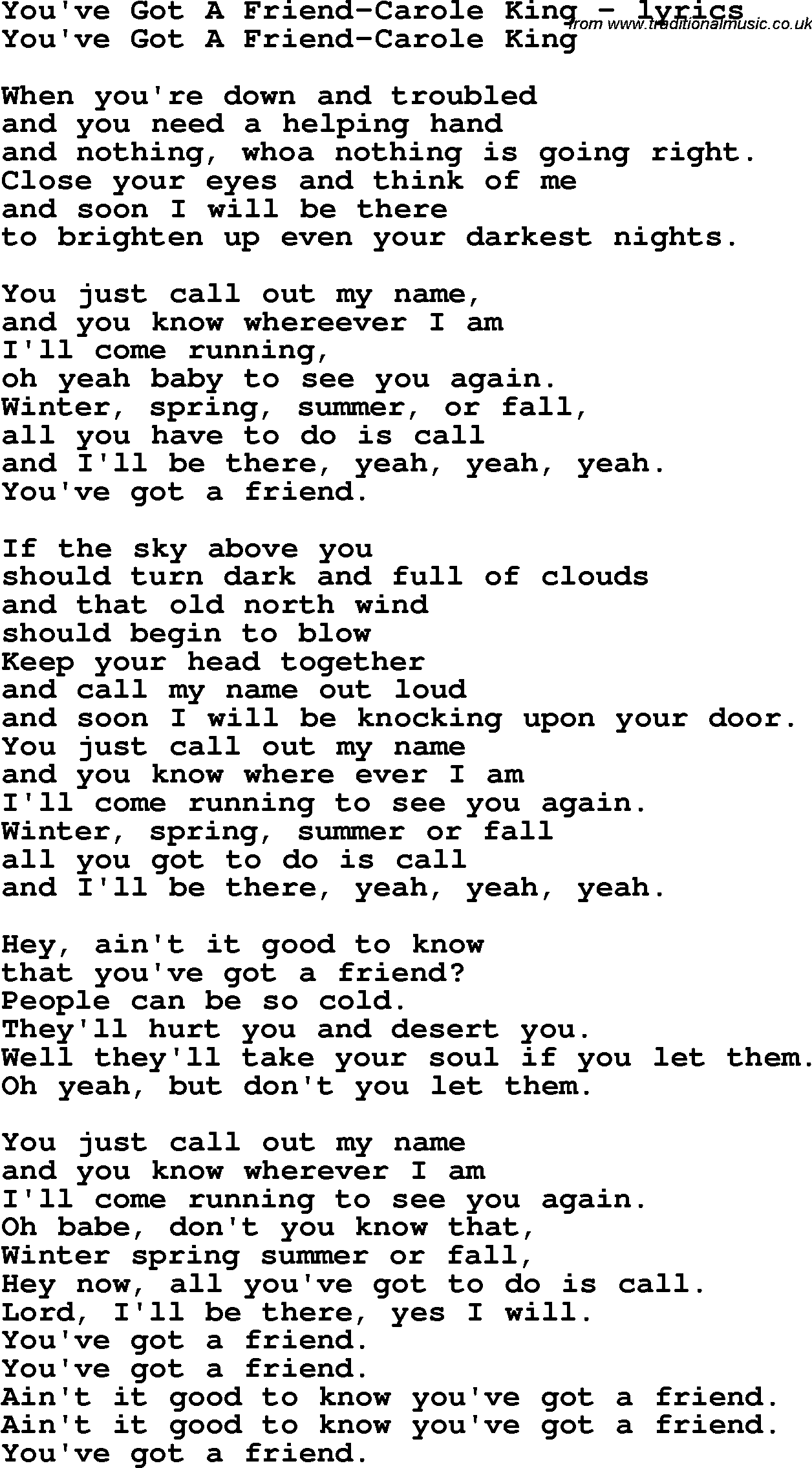
It starts with a soft, rolling piano. No synthesizers. No heavy production. Just a woman at a keyboard telling you that if you're down and troubled, you can just call out her name. Most people think they know the You Got a Friend lyrics by heart because they’ve heard them at every graduation, funeral, and summer camp campfire since 1971. But there’s a specific, almost supernatural weight to these words that most modern songwriting just can’t touch.
Carole King wrote it. James Taylor made it a number-one hit.
Yet, the song almost didn't happen the way we remember it. It wasn't some calculated commercial play. Honestly, King has famously said the song "wrote itself." It was a moment of pure, unadulterated inspiration that happened while she was recording her landmark album, Tapestry. She sat down, and the words just flowed out like she was transcribing a message from somewhere else.
The Raw Philosophy Behind the Words
When you actually look at the You Got a Friend lyrics, they aren't complicated. That’s the magic. King doesn't use metaphors about storms or mountains to be poetic; she uses them because they are the most direct way to talk to someone in pain. "Close your eyes and think of me / And soon I will be there." It's an invitation. It is a literal contract of emotional availability.
There’s a famous story about the "winter, spring, summer, or fall" line. James Taylor, who was close friends with King and playing on her sessions, heard her play the song and was floored. He eventually recorded his own version at the same time she was doing hers—using the same musicians. If you listen to both versions back-to-back, you’ll notice something. King’s version feels like a personal manifesto. Taylor’s version feels like a soothing balm.
People often get the sentiment wrong. They think it’s just a "nice" song. It’s actually a very heavy song about the reality of isolation. The lyrics acknowledge that the sky can turn "dark and full of clouds" and that "that old north wind begins to blow." It admits that the world can be "cold" and "desert you." It isn't sunshine and rainbows. It’s a survival guide for when things go south.
Why James Taylor Thought the Song Was About Him
James Taylor has mentioned in interviews that when he first heard the You Got a Friend lyrics, he felt like Carole was responding to a line in his own song, "Fire and Rain." In that track, Taylor sings, "I've seen lonely times when I could not find a friend."
Carole, hearing that vulnerability from her friend, sat down and wrote the ultimate rebuttal.
It’s one of the greatest "musical conversations" in history. Think about that for a second. One of the most famous songs of all time was basically a "reply guy" moment in the best way possible. She was telling James, and by extension the rest of us, that the lonely times didn't have to be the end of the story.
The structure of the song is actually quite unusual for a pop hit of that era. There’s no real "bridge" in the traditional sense. It doesn’t build to a massive, screaming crescendo. It stays intimate. It stays right in your ear. That’s why it works. When you're depressed, you don't want a marching band; you want a friend sitting on the edge of your bed talking in a low voice.
Breaking Down the Most Misunderstood Lines
"You just call out my name / And you know, wherever I am / I'll come running."
Nowadays, we’re all "connected" 24/7. We have Blue Bubbles and DMs and Slack notifications. But the You Got a Friend lyrics describe a type of presence that transcends digital noise. In 1971, "calling out a name" meant something physical. It meant distance was a real obstacle that only love could bridge.
- The "Ain't it good to know" Hook: This isn't just a catchy phrase. It’s a rhetorical sigh of relief. It shifts the perspective from the person suffering to the shared experience of the friendship itself.
- The "North Wind" Metaphor: This is a direct nod to the harshness of life. King knew that friendship isn't about preventing the wind from blowing; it’s about being there when it does.
- The Piano Cues: While not "lyrics," the way the notes fall under the words "brighten up even your darkest night" acts as a literal translation of the sentiment.
The Cultural Impact and the "Cover" Phenomenon
You can't talk about these lyrics without mentioning Donny Hathaway and Roberta Flack. Their 1972 version turned the song into a soulful anthem of Black excellence and communal support. While King’s version was folk-pop and Taylor’s was acoustic-leaning, Hathaway and Flack brought a gospel-infused gravity to the words.
When they sang "You've got a friend," it sounded like a promise from an entire community.
Then you’ve got Dusty Springfield, Michael Jackson (as a kid!), and even Aretha Franklin putting their stamp on it. Every time a new artist tackles the You Got a Friend lyrics, they find a new layer. Why? Because the core truth is universal. It’s one of the few songs that doesn't feel dated. You could release this song today as a stripped-back indie track and it would still go viral on TikTok because everyone—literally everyone—is lonely sometimes.
The Technical Brilliance of Carole King’s Writing
Carole King wasn't just a singer; she was a professional songwriter for the Brill Building. She understood the "math" of a hit. But with this song, she threw out the math.
The rhyme scheme is deceptively simple.
- Name / running / again / friend.
- Fall / call / all.
She isn't trying to impress you with her vocabulary. She's trying to reach you. Most writers overthink things. They try to find the "perfect" unique metaphor. King realized that the most "perfect" thing you can say to someone who is hurting is: "I'll be there."
Actionable Insights for Music Lovers and Songwriters
If you’re looking to truly appreciate or even learn from the You Got a Friend lyrics, don't just read them off a screen. Do these things to get the full experience:
- Listen to the "Tapestry" version with headphones. Pay attention to the way King’s voice cracks slightly. That’s the sound of honesty.
- Compare the James Taylor version immediately after. Notice the difference in the guitar arrangement (played by Danny Kortchmar and Taylor himself). It changes the "temperature" of the lyrics.
- Check out the live 2010 Troubadour Reunion version. Watching two legends in their 60s/70s sing this to each other proves that the lyrics aren't just for young people in love; they are for lifelong companions.
- Write down the lyrics by hand. It sounds cheesy, but when you physically write "You've got a friend," you realize how much power is packed into those four small words.
The legacy of this song isn't just in its chart positions or Grammy wins. It’s in the millions of times someone has sent these lyrics to a person who felt like giving up. It’s a piece of emotional infrastructure. As long as people feel isolated, these words will remain some of the most important ever written in the English language.
Go call someone you haven't talked to in a while. Tell them you're there if they need you. That's the only way to truly honor what Carole King put on paper all those years ago.
Next Steps for Deep Diving: Explore the Tapestry album in its entirety to understand the context of 1971 singer-songwriter culture. Research the "Brill Building" era of songwriting to see how Carole King’s background as a professional hit-maker for other artists (like The Shirelles) informed her ability to write such tight, impactful lyrics for herself.



