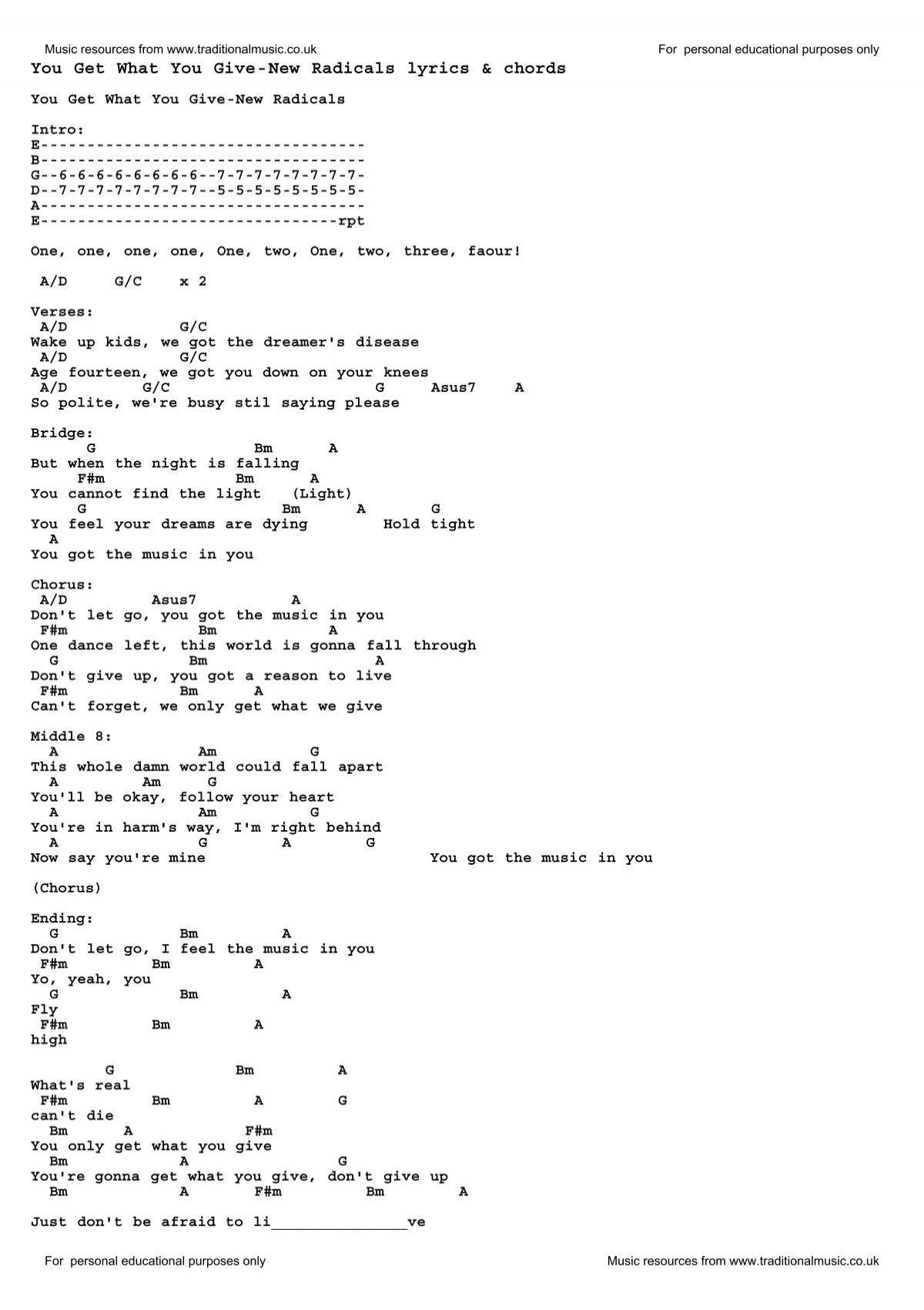
If you were alive in 1998, you remember the bucket hat. You remember the chaotic energy of a bunch of teenagers taking over a Staten Island shopping mall. And you definitely remember that piano riff. Honestly, You Get What You Give New Radicals is one of those rare tracks that feels like it belongs to everyone and no one at the same time. It’s a song about hope, but it’s also a song about "kicking the ass" of Marilyn Manson.
It’s weird. It’s brilliant. And it almost didn't happen.
Gregg Alexander, the mastermind behind the band, wasn't some corporate-groomed pop star. He was a guy who had already flopped twice with solo albums. By the time he formed New Radicals, he was basically over the industry. He was cynical, tired, and ready to treat the entire project like a giant experiment. That’s probably why the song resonates so much even decades later; it has a "nothing left to lose" energy that modern, hyper-polished pop often lacks.
The Secret "Social Experiment" in the Lyrics
Most people think of this song as a feel-good anthem. You know, the "don't give up / you've got the music in you" part. But if you actually listen to the end, it gets dark. Or at least, it gets very specific. Alexander famously calls out health insurance companies, the FDA, and big bankers.
Then he pivots to the celebrities.
"Fashion shoots with Beck and Hanson, Courtney Love and Marilyn Manson. You're all fakes, run to your mansions. Come around, we'll kick your ass in."
Here’s the thing: Alexander later admitted this was a total trap. He wanted to see if the media would focus on the serious stuff—like the FDA and corporate greed—or the petty celebrity gossip. Guess what? Everyone talked about the celebrity "diss." It proved his point perfectly. We are obsessed with the superficial.
Why the New Radicals Disappeared at Their Peak
You’d think after having one of the biggest songs in the world, you’d want to make a second one. Not Gregg Alexander. He disbanded the group in mid-1999, right before the second single "Someday We'll Know" even had a chance to breathe.
Why? Because he hated the "hanging and schmoozing."
He was tired of the three hours of sleep, the endless radio interviews, and the "boring" promotion. He basically decided he’d rather be the guy behind the scenes. And honestly, it worked out for him. He went on to write "Murder on the Dancefloor" for Sophie Ellis-Bextor and "The Game of Love" for Santana. He won a Grammy. He got an Oscar nomination for "Lost Stars" from the movie Begin Again.
He achieved the ultimate industry dream: he got the money and the respect without having to wear the bucket hat in public anymore.
The 2021 Reunion and the Biden Connection
For 22 years, the New Radicals were dead. Alexander turned down every offer to reunite. Coachella, festivals, nostalgia tours—he said no to all of them.
Then came the 2021 Inauguration.
It turns out "You Get What You Give" was a favorite of Beau Biden, Joe Biden’s late son. During his battle with brain cancer, the family used the song as a sort of theme for resilience. When the Biden team reached out, Alexander finally said yes. It wasn't about the money or the fame; it was a tribute. Seeing a middle-aged Alexander perform that song one last time felt like a full-circle moment for a generation that grew up on his "dreamer's disease" philosophy.
Impact and Legacy by the Numbers
While we aren't doing tables, let's just look at the raw reach of this song. It hit the Top 5 in the UK. It was huge in Canada and New Zealand. Even the legends were jealous. The Edge from U2 once said it’s the song he’s "most jealous of." Joni Mitchell—yes, that Joni Mitchell—praised it.
When Joni Mitchell likes your pop song, you’ve basically won music.
What Most People Get Wrong
People often label the New Radicals as a "one-hit wonder" in a derogatory way. But that implies they tried and failed to have a second hit. The truth is much more interesting: they had a hit and then intentionally quit.
It was a choice.
Alexander didn't want to be a celebrity; he wanted to be a songwriter. By walking away, he preserved the song's purity. It never got watered down by a mediocre third or fourth album. It remains frozen in time as this perfect, 1998 explosion of optimism and anger.
How to Apply the "Radical" Mindset Today
If you’re looking for a takeaway from the story of You Get What You Give New Radicals, it’s probably about boundaries. In a world where everyone is trying to be an "influencer" and keep the cameras rolling 24/7, Alexander’s exit is a masterclass in knowing when you’ve had enough.
- Focus on the craft, not the clout. Alexander realized he loved writing songs, not being a "pop star." Figure out which part of your job you actually like and lean into that.
- Don't be afraid to leave. If a situation is draining your soul—even if it's successful—it's okay to walk away.
- Ignore the "Celebrity Diss" noise. People will always focus on the drama. Keep your eyes on the "health insurance and FDA" stuff—the things that actually matter.
- Remember you've got the music in you. It sounds cheesy, but the core message holds up. Don't let the "fakes" in their "mansions" dictate your worth.
The next time you hear that opening "One, two... one, two, three, four!" on the radio, don't just dance. Remember that it was a protest song hidden inside a pop hit. It was a guy telling the world exactly what he thought, then walking into the sunset before they could tell him what to do next.
Actionable Next Steps: To truly appreciate the depth of the New Radicals, go back and listen to the full album Maybe You've Been Brainwashed Too. Tracks like "Mother We Just Can't Get Enough" and "I Hope I Didn't Just Give Away The Ending" show a much funkier, soul-influenced side of Alexander that the radio edits missed. If you’re a songwriter, study the bridge of "You Get What You Give"—the way it builds tension before that final explosion is a masterclass in pop structure. Finally, check out Alexander’s later work for other artists to see how his "Radical" DNA continued to shape the charts for the next two decades.



