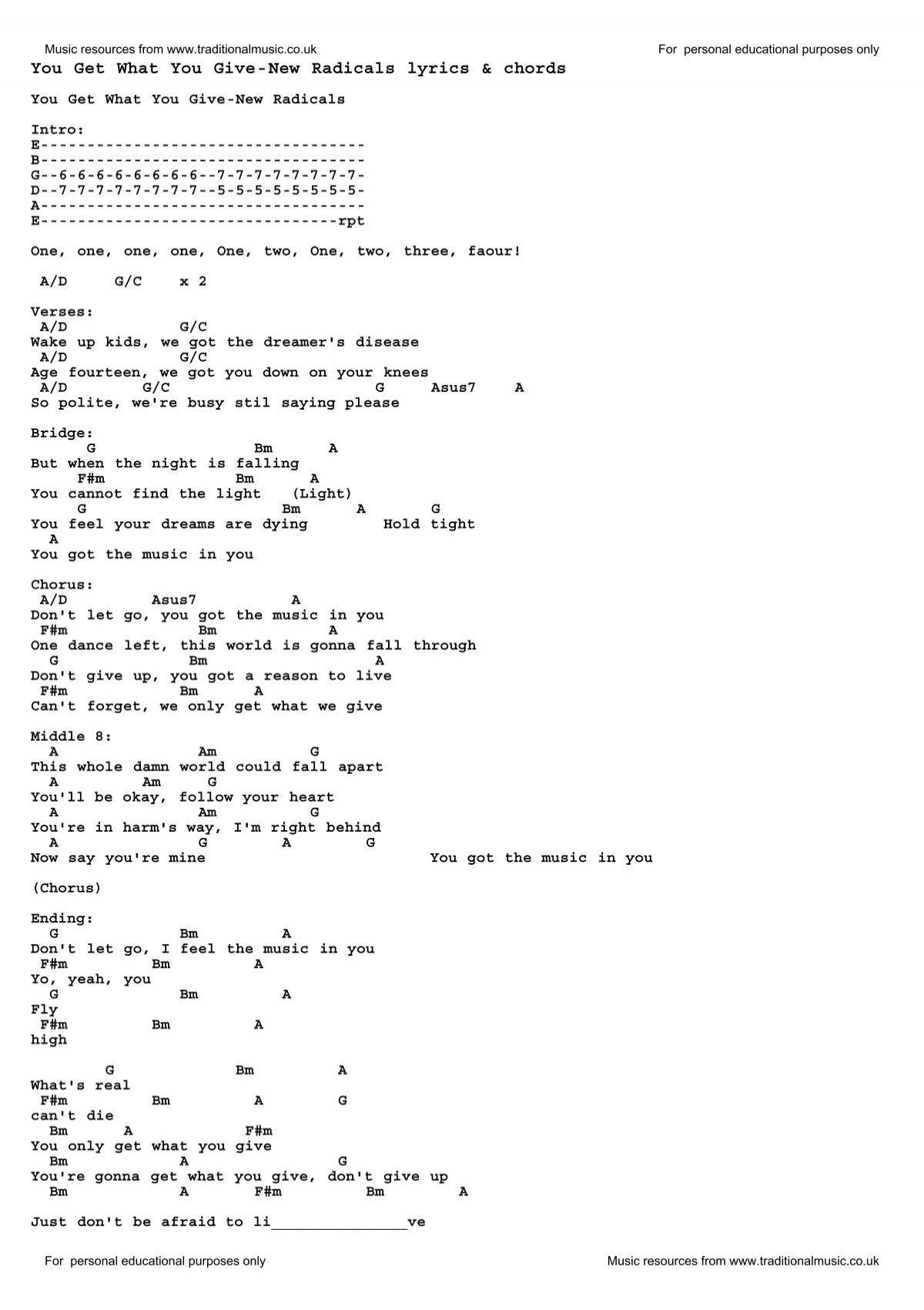
If you were alive in 1998, you couldn't escape it. That bright, jangly piano intro. The bucket hat. The kids causing absolute chaos in a shopping mall. You Get What You Give by the New Radicals wasn’t just another pop song on the radio; it felt like a manifesto wrapped in a catchy-as-hell melody.
It’s one of those rare tracks that everyone knows, even if they can't remember the name of the band. Honestly, it’s the definition of a "lightning in a bottle" moment. Gregg Alexander, the mastermind behind the project, basically wrote a perfect song, watched it conquer the world, and then decided he was done with being a rock star. Like, literally. He disbanded the group while the song was still climbing the charts.
Most people remember the "celebrity diss" at the end—the part where he threatens to kick the asses of Marilyn Manson and Courtney Love. But if you actually listen to the verses, it’s way heavier than that. It’s a song about corporate greed, the "dreamer's disease," and the soul-crushing nature of modern life.
The Story Behind the Music
Gregg Alexander wasn't exactly a newcomer when he formed the New Radicals. He’d already released two solo albums that went nowhere. By the time he sat down with co-writer Rick Nowels to write "You Get What You Give," he was leaning into a blue-eyed soul vibe that felt massive.
The production is incredibly dense. If you listen closely, there are layers of percussion, keyboards, and acoustic guitars that make it feel like it’s vibrating. It’s got that Mick Jagger-esque swagger, but with a weirdly optimistic 90s twist. Alexander has said the song was about remembering to "fly high" in a world where you can’t control anything.
The track peaked at #36 on the Billboard Hot 100, which is funny because it felt like a #1 hit. Internationally, it actually did reach the top spot in Canada and New Zealand. In the UK, it hit #5. It was everywhere. It was in movie trailers (like Pushing Tin), it was in commercials, and it was the soundtrack to every teen's graduation that year.
The Verse That Scared the Label
You’ve gotta remember the context of the late 90s. Music was getting a bit manufactured. Then comes this guy in a fisherman's hat screaming about "health insurance rip-offs" and "FDA big bankers."
The famous final verse was actually a test. Alexander wanted to see if the media would focus on his political complaints or the petty celebrity name-dropping.
"Fashion shoots with Courtney Love, 40 million helpings of, / Rock stars and their freedom with, / Marilyn Manson, we're all fakes, / Run to your mansions, come around, we'll kick your ass in."
Guess what? The media only cared about the "kick your ass" part.
Marilyn Manson reportedly said he’d "crack [Alexander's] skull open" if he ever saw him, while Courtney Love was surprisingly chill about it, later joking that she was just glad to be mentioned in such a good song. But for Alexander, the reaction proved his point: the industry was shallow.
Why Did the New Radicals Quit?
This is the part that still boggles people’s minds. In July 1999, right when the second single "Someday We'll Know" was hitting the airwaves, Alexander pulled the plug. He issued a press release saying he was tired of the "promotional lifestyle" and the constant touring.
He didn't want to be the "hat guy" forever.
Instead, he went behind the scenes. And honestly? He became one of the most successful songwriters in the world. He co-wrote "The Game of Love" for Santana and Michelle Branch, which won a Grammy. He wrote "Lost Stars" for the movie Begin Again, which got an Oscar nomination. He even co-wrote "Murder on the Dancefloor" for Sophie Ellis-Bextor.
He proved he wasn't a one-hit wonder as a creator; he just didn't want to be the one on the poster.
The Biden Connection and the 2021 Reunion
For over 20 years, the New Radicals didn't exist. They turned down every offer to reunite. Coachella, Glastonbury, huge paydays—it didn't matter. Gregg wasn't interested.
That changed because of Joe Biden.
It turns out You Get What You Give by the New Radicals was a favorite of the President's late son, Beau Biden. During his battle with brain cancer, the family used the song as an anthem. At Beau’s funeral, his sister Ashley recited the lyrics in her eulogy.
When Joe Biden won the 2020 election, the band agreed to reunite for a one-off performance at the virtual inauguration in January 2021. They played the song from Alexander's home base, fisherman's hat and all. It was a genuinely moving moment that reminded everyone why those lyrics—don't let go, you've got the music in you—still hit so hard.
Actionable Insights for the "Dreamers"
If you’re looking to capture the spirit of this song today, there are a few things you can actually take away from the New Radicals' brief moment in the sun:
- Audit your "Giving": The central philosophy is that the energy you put into the world is what comes back. If you're feeling stuck, look at where you're investing your time. Are you giving to things that matter?
- Reject the "Dreamer's Disease": Alexander used this phrase to describe the paralysis of having big goals but no action. The cure is simple: move. Start the project. Write the song.
- Prioritize Creative Integrity: Alexander’s exit is a masterclass in knowing your limits. Success is only valuable if it doesn't cost you your sanity. If the "hustle" is killing your love for the work, change the way you work.
- Listen to the Full Album: Maybe You've Been Brainwashed Too is actually a fantastic, weird, funky record that goes way beyond the hit single. Songs like "Mother We Can't Get Enough" show a range that most 90s pop-rock bands couldn't touch.
Go back and watch the music video at the Staten Island Mall. It’s a perfect time capsule. It reminds us that even when the "bad rich" are in charge and things feel hopeless, you still have the music in you. And that’s something they can’t take away.
Check out the "Maybe You've Been Brainwashed Too" 25th-anniversary vinyl or high-res remasters to hear the production details that made this song a classic.



