Elvis Presley stood on a stage in Honolulu in 1973, draped in a white jumpsuit that practically glowed under the television lights. The world was watching Aloha from Hawaii Via Satellite. He wasn't just singing; he was fighting. When he launched into You Gave Me a Mountain, it wasn't just another track on a setlist. It felt like a confession.
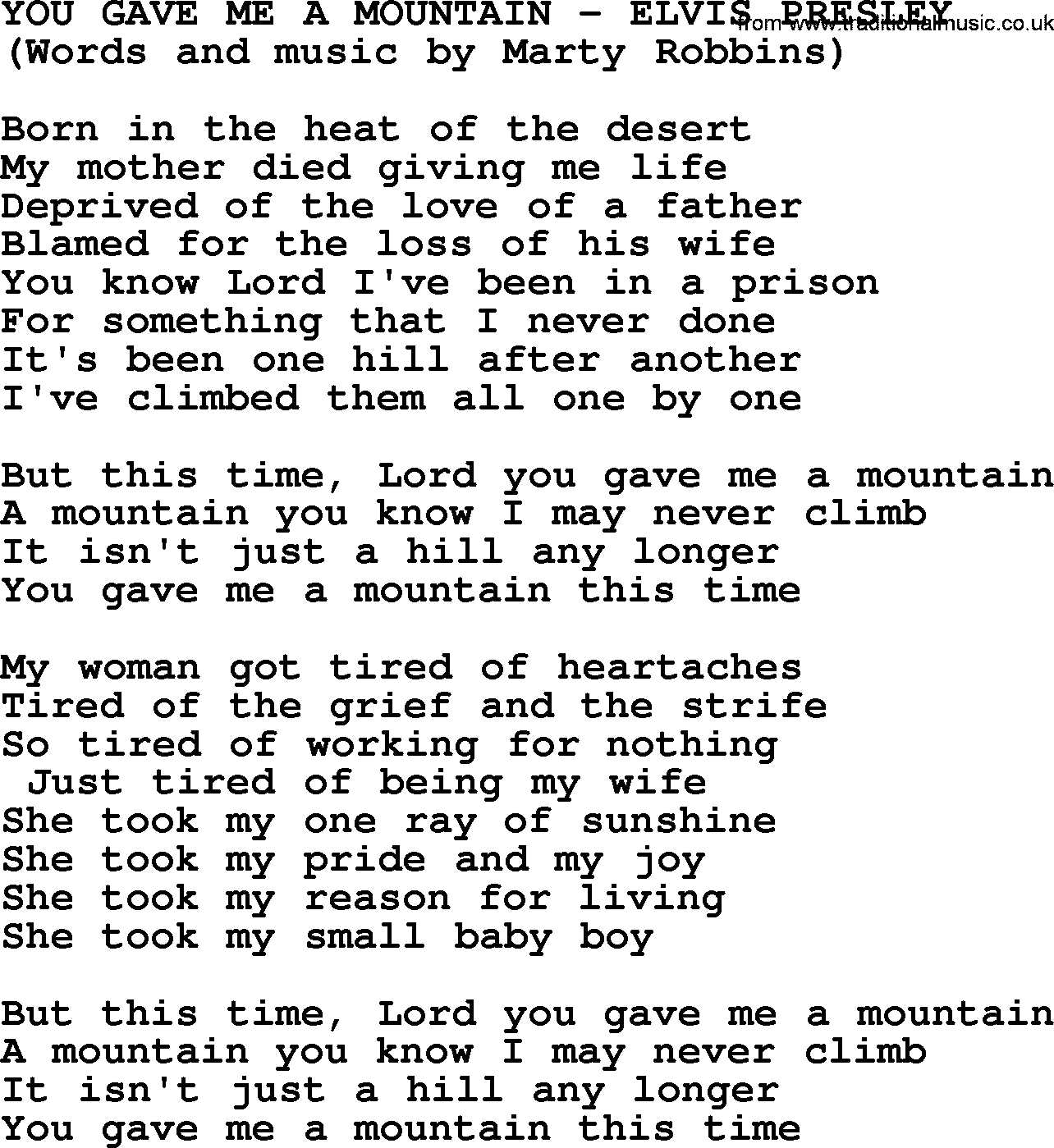
The song is heavy. It deals with a man who has lost his mother, his wife, and his child, blaming a series of insurmountable "mountains" placed in his path by a higher power. Written by Marty Robbins, the track is a country-pop epic, but in the hands of Elvis, it became something much more visceral. People still argue about which version is the "best," but if you're looking for raw, unfiltered emotion, the 1970s "concert years" are where the real story lives.
The Story Behind the Song
Marty Robbins wrote "You Gave Me a Mountain" in the late 1960s. Robbins was a master storyteller, a guy who could turn a three-minute song into a cinematic experience. But when Elvis picked it up, the lyrics started to mirror his own life in a way that was almost uncomfortable to witness.
Think about the timeline. By the time Elvis was regularly performing this in the early-to-mid 70s, his marriage to Priscilla was fracturing or already over. He had lost his mother, Gladys, years prior—an event that many biographers, like Peter Guralnick in Careless Love: The Unmaking of Elvis Presley, cite as the turning point from which he never truly recovered. When Elvis sings the line about his mother being "gone," he isn't acting. He's remembering.
It’s easy to dismiss 70s Elvis as a caricature. The jumpsuits, the capes, the scarves—it’s a lot. But listen to the breath control. In You Gave Me a Mountain Elvis showcased a vocal range that most rock singers would kill for even today. He hits these massive, soaring notes that feel like they’re going to burst out of his chest, and then he drops down to a whisper. It’s dynamic. It’s theatrical. It’s 100% Elvis.
Why the Aloha from Hawaii Version Hits Different
If you go on YouTube right now and search for this song, the first thing you'll see is the Aloha performance. It was a massive deal. Over a billion people were estimated to have watched it. Elvis was thin, tanned, and arguably at his peak for the 1970s era.
But there’s a tension in that performance. You can see it in his eyes. He’s focused. He’s professional. Yet, when he gets to the bridge of the song, he leans into the microphone with a sort of desperation.
The lyrics talk about a woman leaving and taking a child. In 1973, Elvis was dealing with the reality of his divorce. His daughter, Lisa Marie, was the center of his world. Singing those words in front of a global audience wasn't just a career move. It was a public exorcism of his private grief.
Vocal Mastery and the "Big Finish"
A lot of singers try to "over-sing" this song. They think it’s about volume. It’s not. It’s about the build-up. Elvis starts it almost like a conversation. He’s telling you a story about his childhood. The band—the legendary TCB Band—keeps it steady. James Burton’s guitar work is subtle here, letting the orchestration take the lead.
Then, the horns kick in.
The arrangement used by Elvis was designed for a full orchestra. It’s "The Vegas Sound." Big, brassy, and unapologetic. When he hits the final "Mountain," he holds the note while the brass section swells behind him. It’s a sonic wall. It’s designed to make the listener feel the weight of the mountain he’s talking about.
Comparing Robbins and Presley
Marty Robbins’ original version is excellent. It’s a cowboy’s lament. It’s dusty and sincere. Frankie Laine also had a massive hit with it in 1969, bringing a more traditional pop-vocalist approach to the material. Laine’s version is technically perfect, but it lacks the personal stakes that Elvis brought to the table.
Elvis didn’t just cover songs; he colonized them. Once he sang "You Gave Me a Mountain," it became his. He stripped away the "country" veneer and turned it into a gospel-adjacent power ballad. He understood that the song wasn't really about bad luck. It was about a man pleading for a break.
The Darker Side of the Performances
As we move into 1974, 1975, and 1976, the performances of this song changed. They became longer. Sometimes, they became heavier.
In some of the later soundboard recordings—those unofficial or semi-official releases from the later tours—you can hear the physical toll on Elvis’s voice. He would sometimes struggle with the lyrics or breathe heavily between phrases. Strangely, this almost makes the song more effective. When a man who is clearly struggling sings about being given a mountain he can't climb, the art and the reality blur.
Critics often point to the June 1977 performances, just weeks before he died, as difficult to watch. But even then, his voice remained a powerful instrument. He could be barely able to speak one moment, and then he’d stand up and deliver a version of You Gave Me a Mountain Elvis fans still cite as heartbreakingly beautiful. It was his anchor.
Technical Nuance: The Arrangement
If you’re a musician, take a second to listen to the drum fills by Ronnie Tutt during the live versions. Tutt was a powerhouse. He knew exactly when to crash the cymbals to emphasize Elvis’s hand gestures.
The song is structured in a way that mirrors a climb.
- The verses are the struggle.
- The chorus is the realization.
- The ending is the exhaustion.
Elvis used his body to sell the song. He would lunged forward, hand outstretched, as if he were trying to push the music toward the back of the arena. This wasn't just for show. It was a physical manifestation of the lyrics. He was pushing against his own mountains.
What Most People Get Wrong
People think Elvis was just a "singer." He was actually a brilliant uncredited producer of his own live sound. He chose the setlists. He directed the band with a nod of his head or a flick of his wrist.
When he performed "You Gave Me a Mountain," he was in total control of the dynamics. He knew that if he sang the first verse too loud, the ending wouldn't matter. He had to earn that big finish. He had to make the audience believe he was a broken man before he could show them he was still a king.
The Gospel Connection
You can't talk about Elvis without talking about the church. Even though this isn't a traditional hymn, Elvis sings it like one. The phrasing is pure Southern Gospel. The way he slides into notes, the vibrato at the end of long phrases—that’s all learned from the nights he spent watching quartets like The Statesmen or The Blackwood Brothers.
In his mind, the "Mountain" wasn't just a metaphor for a bad day. It was a divine test. That’s why the song resonated so deeply with his audience. Everyone has a mountain. Everyone feels like they’re being tested.
The Legacy of the Song
"You Gave Me a Mountain" isn't as famous as "Suspicious Minds" or "Hound Dog." It doesn't get played on oldies radio every hour. But for the "Elvis faithful," it’s a top-five track. It represents the "Cinematic Elvis" period—the era of the big voice and the big emotions.
It’s also a reminder of what was lost. When you listen to the 1973 version, you hear a man who is still the greatest entertainer on the planet. You hear the power. You hear the potential for a whole second career that he never quite got to fulfill.
Actionable Insights for Music Lovers
If you want to truly appreciate this song and the performance, here is how you should dive in:
- Listen to the 1973 "Aloha" version first. It’s the gold standard. Watch the video if you can, because Elvis’s physical presence is half the performance.
- Compare it to the Marty Robbins original. Notice how Robbins tells a story while Elvis delivers a sermon. It’s a great lesson in how different artists interpret the same lyrics.
- Track down a 1977 version. It’s tough to hear, but it provides context. It shows the grit and the determination Elvis had to keep performing even when the mountains were winning.
- Pay attention to the TCB Band. Don’t just listen to Elvis. Listen to the bass lines by Jerry Scheff and the way the backing vocalists (The Stamps and The Sweet Inspirations) create a cushion of sound for Elvis to land on.
The song serves as a perfect entry point for anyone who thinks Elvis was "just a rock and roller." He was a stylist. He was an interpreter of pain. And in "You Gave Me a Mountain," he found the perfect vehicle to tell the world exactly how he felt, without ever having to give an interview. He just sang it.
The mountain was there. He climbed it every night on stage. And through these recordings, we can still see the view from the top.



