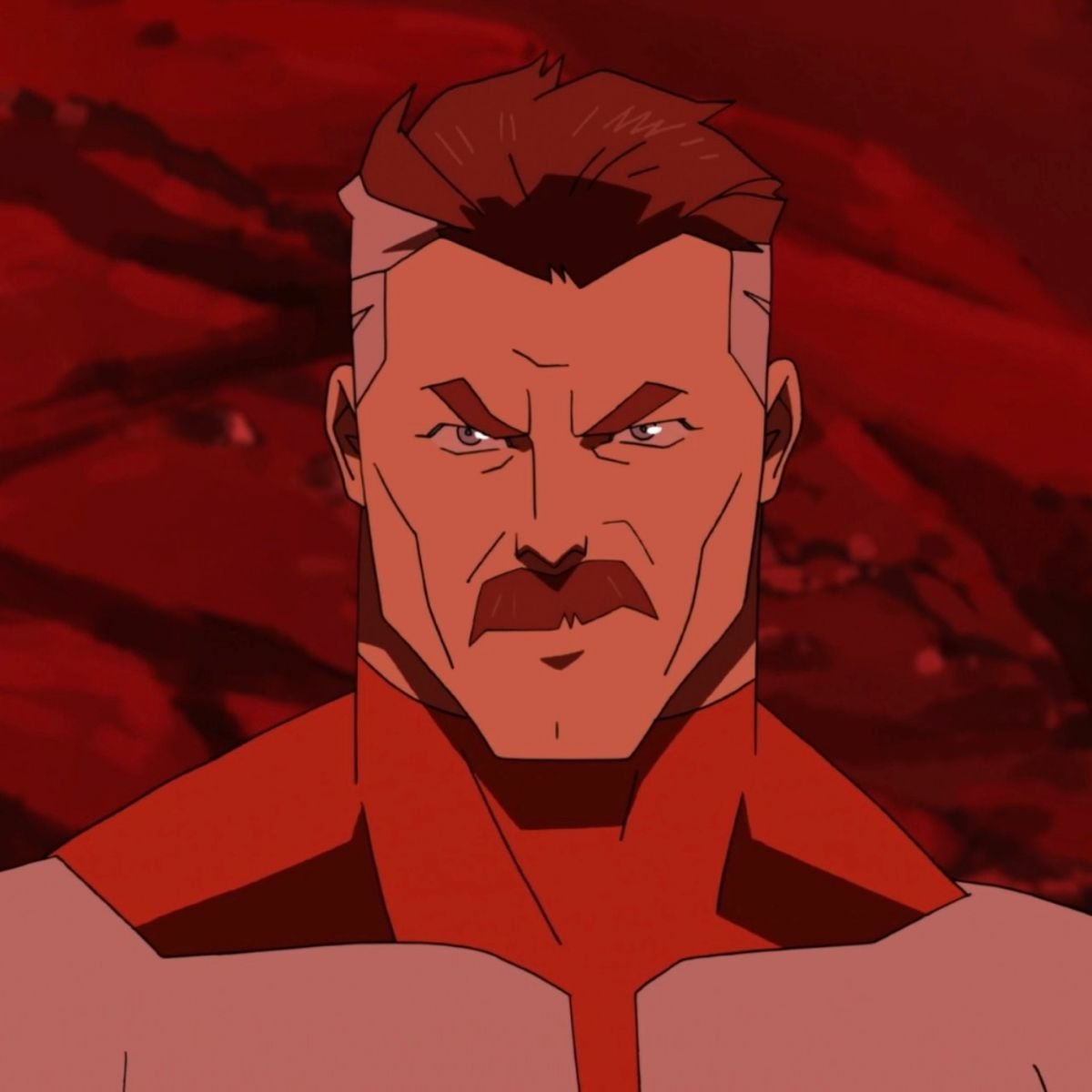
Nolan Grayson isn't a villain.
He's also not a hero. At least, not in the way we usually talk about capes and cowls. When people toss around the phrase you don't seem to understand Omni-Man, they are usually quoting that brutal, blood-soaked finale of Invincible Season 1, but they’re also accidentally describing the audience's own confusion. We want him to be a redeemed dad. We want him to be a mustache-twirling conqueror.
The truth is way messier.
Robert Kirkman, the mind behind the comics, didn't just write a "bad Superman." That’s a lazy take. He wrote a man who had to unlearn thousands of years of biological and cultural indoctrination in the span of a single afternoon on a mountain top. If you think Nolan's journey is a simple redemption arc, you’re missing the point of what makes Viltrumites so terrifying—and so deeply human.
The Immortal Logic of Viltrum
To get Nolan, you have to get Viltrum.
Imagine living for thousands of years. Civilizations rise, fall, and turn to dust while you’re still in your physical prime. To a Viltrumite, a human life is a blink. It’s a weekend. Nolan’s "pet" comment wasn't just a cruel jab to hurt Mark; it was a mathematical reality from his perspective. If you owned a hamster that you loved deeply, but you knew it would die in two years while you lived for eighty, you’d still love it, but you wouldn't view its "politics" or "societal contributions" as equal to your own.
That is the core of why you don't seem to understand Omni-Man if you view him through a human moral lens.
Viltrumite society is built on a brutal meritocracy. The weak are culled. The strong expand the empire. It’s social Darwinism taken to a galactic scale. When Nolan arrived on Earth, he wasn't a sleeper agent in the traditional sense; he was a pioneer. He was convinced he was bringing "enlightenment" to a backwater planet. In his mind, the thousands he killed in Chicago were a necessary "down payment" for peace and longevity under the Viltrum Empire.
It’s horrific. It’s also, from a certain skewed perspective, logical.
The Guardians of the Globe and the Burden of Love
Why did he wait twenty years to kill the Guardians?
Some fans think he was just biding his time, waiting for Mark’s powers to manifest. That’s part of it. But the real reason is more heartbreaking. Nolan was stalling. He was happy. For two decades, he got to play house. He got to feel what it was like to be "lesser" and, ironically, that made him feel more.
When he finally butchered the Guardians in that dark satellite headquarters, it wasn't an act of hatred. It was an act of duty over desire. He was trying to force himself back into the Viltrumite mold. He had to kill his friends to prove to himself that he was still the soldier he was born to be.
If you watch his face during that fight—especially in the animated series—he isn't enjoying it. He’s struggling. He’s fast, he’s efficient, and he’s miserable.
Why the "Pet" Quote Still Stings
"What will you have after five hundred years?"
Mark’s answer—"You, Dad"—is the turning point of the entire franchise. It’s the moment the Viltrumite logic failed. Nolan realized that even if Mark was "small" and "short-lived" by Viltrumite standards, the connection they had was more durable than an empire.
Honestly, the reason you don't seem to understand Omni-Man if you call him a monster is that monsters don't fly away crying. A monster finishes the job. Nolan’s departure from Earth wasn't a retreat; it was an admission of defeat. Not a physical defeat, but a philosophical one. He couldn't justify the empire anymore because the "pet" had more humanity than the conqueror.
The Problem With Redemption
Can a man who used his son as a physical battering ram to kill a train full of commuters ever be "good"?
In the comics, Nolan’s path takes him to a planet called Thraxa. He tries to start over. He finds a new wife, has another son (Oliver), and tries to be a leader. But he’s always haunted. The nuance here is that Kirkman doesn't let him off the hook easily. Even when he becomes an ally to Earth later, the people of Earth don't forget. Cecil Stedman doesn't forget.
Redemption in Invincible isn't about being forgiven by others. It’s about the grueling, often failing effort to be better than your nature.
The Voice of J.K. Simmons
We have to talk about the performance. J.K. Simmons brings a weight to Nolan that makes the character work. In the recording booth, Simmons often plays Nolan with a strange, detached calmness. It’s the sound of a man who has seen everything and felt nothing, until suddenly, he feels everything at once.
When he screams at Mark, "Think, Mark!", it’s not just a meme. It’s a plea. He’s trying to save Mark from the inevitable execution the Viltrumites will carry out if Mark doesn't fall in line. He’s trying to beat the "humanity" out of his son to save his life.
It’s twisted parental love.
Actionable Insights for Fans and Writers
If you’re trying to wrap your head around characters like Nolan, or if you’re a writer trying to create a "gray" antagonist, keep these points in mind:
- Scale of Time: Consider how longevity changes morality. If a character lives for millennia, their priorities won't align with a 70-year human lifespan.
- Indoctrination vs. Identity: Nolan isn't inherently evil; he is a product of a culture that views empathy as a genetic defect. His "villainy" is actually conformity.
- The Cost of Change: True change requires losing everything. Nolan lost his home, his reputation, and his son’s trust to find his conscience.
- Avoid the Binary: Stop trying to fit Omni-Man into "Hero" or "Villain" boxes. He is a soldier who went AWOL from his own soul.
To truly grasp the character, you have to look past the gore. Look at the silence. Look at the moments where Nolan is just staring at the horizon, wondering if he can ever really belong on a world he was sent to destroy. That’s where the real story lives.
Read the comics from issue #13 through #25 to see the immediate aftermath of his departure. It’s the most crucial stretch for understanding his psychological breakdown. Watch the show with the subtitles on during the Chicago fight; the subtle cues in the dialogue reveal a man who is trying to convince himself of his own lies just as much as he’s trying to convince Mark.



