Pop music is usually obsessed with the "I love you." It's the gold standard, the finish line, the big payoff at the end of the rom-com. But in 1966, a British woman with raccoon-thick eyeliner and a beehive that defied gravity sang something much more desperate. You Don't Need To Say You Love Me wasn't just a hit song; it was a psychological breakdown set to an orchestral swell.
Dusty Springfield didn't write it. She basically stole it from the Italians, but we’ll get to that. What matters is how she breathed a specific kind of agony into it. Most love songs are about possession or mutual affection, but this one? This is about the hollowed-out remains of a relationship where one person is willing to trade their dignity just to keep the other person in the room for one more night. It’s dark. It’s honest. Honestly, it’s kind of pathetic in a way that feels uncomfortably human.
The Sanremo Origin Story
The song started its life as "Io che non vivo (senza te)." It was written by Pino Donaggio and Vito Pallavicini. Donaggio performed it at the 1965 Sanremo Festival, which was—and still is—the absolute pinnacle of Italian song competitions. Dusty was there. She heard it, and even though she didn't speak the language, the melody floored her.
She reportedly had tears in her eyes. She knew.
It took a year for the English lyrics to materialize. Vicki Wickham and Simon Napier-Bell wrote them on a napkin or a scrap of paper—the legends vary—after seeing Donaggio perform. They didn’t even try to translate the Italian words. Instead, they captured the vibe. They captured that frantic, clinging feeling of a love that's already halfway out the door.
When Dusty got into the studio at Philips Records in London, she wasn't happy with the acoustics. She ended up standing in a stairwell to get that specific, echoing resonance for the vocal track. That's the thing about Dusty; she was a perfectionist to the point of obsession. She did 47 takes. Forty-seven. Most singers today would lose their minds after five. She pushed until her voice had that raw, jagged edge that makes the chorus feel like a physical blow.
Why the Production Still Slaps
If you listen to the opening brass—those sharp, dramatic stabs—it feels like a curtain rising on a Greek tragedy. It’s "Baroque Pop" at its finest. The 1960s were full of this wall-of-sound approach, influenced heavily by Phil Spector, but "You Don't Need To Say You Love Me" feels more intimate despite the massive orchestration.
The pacing is everything. It starts with a whisper.
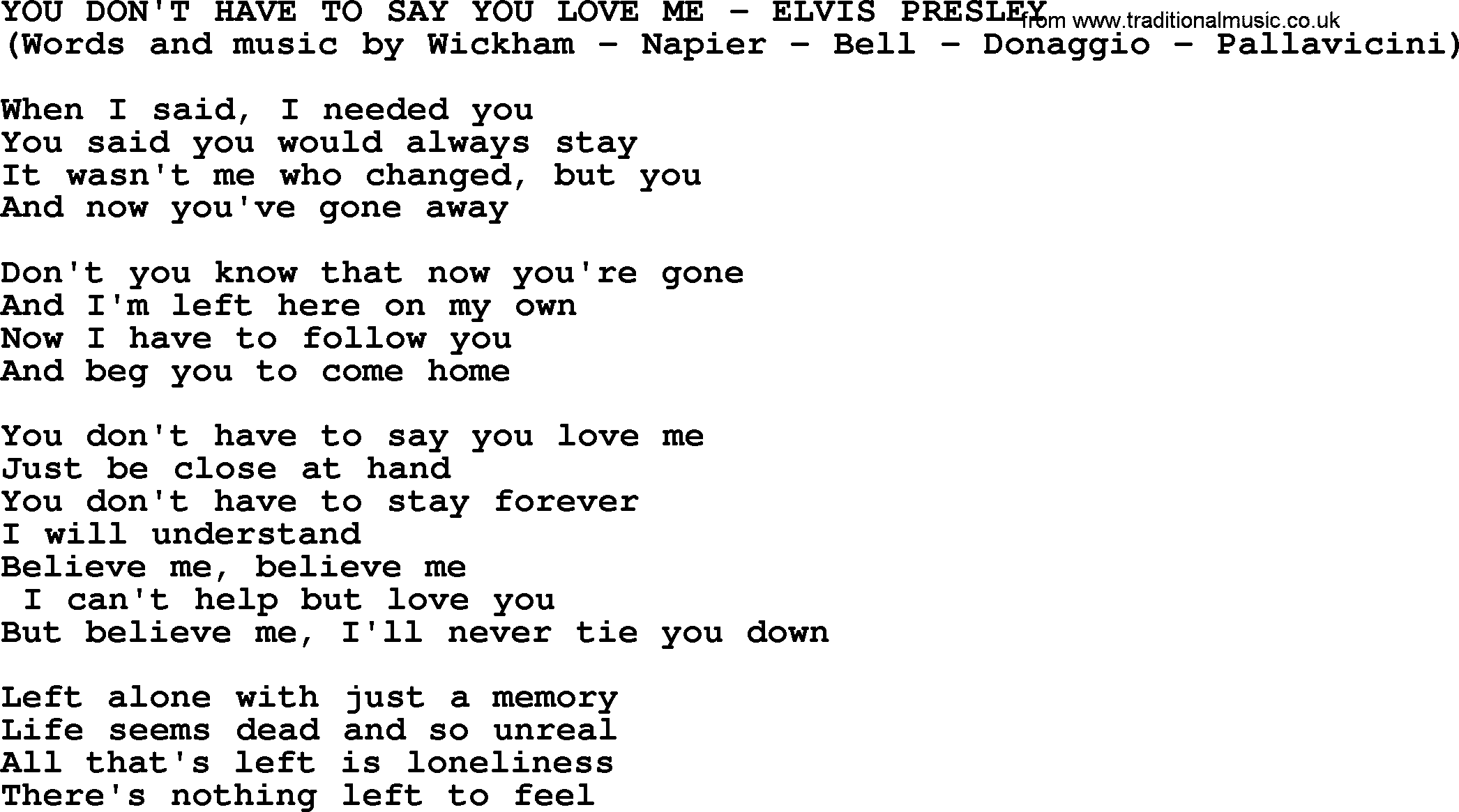
“When I said I needed you, you said you would always stay...”
Then the drums kick in. The strings start to swirl. By the time she hits the chorus, the arrangement is crashing around her like waves. It mimics the internal logic of an argument or a panic attack. It builds and builds until there’s nowhere left to go but a sudden, sharp silence.
The Lyrics of Desperation
Let's look at what's actually being said here.
"You don't have to say you love me, just be close at hand. You don't have to stay forever, I will understand."
That is a lie. The narrator is lying to themselves. Anyone who has ever been in a "situationship" or a dying romance knows this exact lie. You tell the other person they’re free to go, you tell them there are no strings attached, all while white-knuckling the relationship. It’s a song about a power imbalance.
The Elvis Factor
You can’t talk about this song without talking about Elvis Presley. In 1970, he covered it for his That’s the Way It Is era. Elvis loved big, dramatic ballads—the kind where he could sweat through a jumpsuit while hitting a high note.
His version is good. It’s powerful. It’s Vegas. But it lacks the specific vulnerability Dusty brought to it. When Elvis sings it, it sounds like a command. When Dusty sings it, it sounds like a plea. Elvis is the king asking for a favor; Dusty is a woman drowning.
Other people tried it, too. Cher, Shelby Lynne, even The Floaters. But nobody quite matched that 1966 recording. It became Dusty's signature, reaching number one in the UK and the top ten in the US. It solidified her as the "White Queen of Soul," a title she was always a little bit nervous about because she respected Motown and Stax artists so deeply.
Technical Nuance: The 1966 Session
The session was produced by Johnny Franz. If you look at the credits of 60s British pop, his name is everywhere. He knew how to handle Dusty's temperament. She was notorious for being difficult in the studio, but "difficult" is usually just code for "a woman who knows exactly what she wants the snare drum to sound like."
She wanted the vocals to be front and center, dry and punishing. The orchestration was recorded separately, which was standard, but Dusty's vocal performance was tracked in a way that felt like she was standing right next to your ear.
- Key: D Major / B Minor (shifts for dramatic tension)
- Time Signature: 4/4
- Release Date: March 25, 1966
The shift from the verses to the chorus involves a dramatic lift. It’s not just a volume change; it’s a tonal shift. The verses are sung with a breathy, almost jazz-like restraint. The chorus is pure R&B belt. This duality is why the song is a staple for televised singing competitions. It’s a "voice" song. If you can’t nail the transition, you shouldn't be singing it.
The Cultural Weight of the Song
In 1966, the world was changing. The Beatles were getting weird with Revolver. The Beach Boys were doing Pet Sounds. Music was becoming experimental and psychedelic.
In the middle of all that, Dusty Springfield released a classic, dramatic ballad that felt like it belonged in the 1950s but sounded like it came from the future. It bridged the gap between the old-school crooners and the new-school soul singers.
It also gained a second life in the LGBTQ+ community. Dusty’s own complicated relationship with her sexuality—she once told the Evening Standard in 1970 that she was "as perfectly capable of being swayed by a girl as by a boy"—added layers of meaning to her lyrics about hidden pain and unconventional love arrangements. When she sings about not needing a public declaration of love, it resonated with a generation of people who literally couldn't have their love acknowledged publicly.
Common Misconceptions
People often think this is a "sad girl" anthem. It’s not. It’s a "strong person losing their grip" anthem. There’s a difference.
Another misconception is that the song is about a breakup. It's actually about the terrifying moment before the breakup. It’s the negotiation phase. It’s the "let’s just watch a movie and not talk about it" phase of a failing relationship.
Also, many listeners assume Dusty wrote the lyrics because they fit her persona so well. But as mentioned, she was an interpreter. Her genius wasn't in the pen; it was in the delivery. She could take a lyric written by two guys on a napkin and make it sound like her own diary entry. That is the definition of a great stylist.
Actionable Insights for Music Lovers
If you want to truly appreciate the depth of "You Don't Need To Say You Love Me," you have to do a little bit of homework. It's worth it.
Listen to the original Italian version. Find Pino Donaggio’s "Io che non vivo (senza te)." Notice the difference in the arrangement. It’s much more "Sanremo"—lots of accordion-style swells and a different kind of vibrato. It helps you see the skeleton of the song before Dusty put the skin and muscle on it.
Compare the Mono vs. Stereo mixes. The 1966 mono mix of Dusty's version is punchier. The drums hit harder. In the 60s, stereo was often an afterthought, and the mono mix is usually what the artist and producer actually intended for you to hear on the radio.
Watch the 1967 live performance. There is footage of Dusty performing this on her TV show. Watch her hands. She’s often fidgeting or clutching the microphone stand. She looks uncomfortable, almost vibrating with nervous energy. It adds a whole new layer to the vocal performance when you see the physical toll it took on her to get those notes out.
Explore the "Dusty in Memphis" album next. If this song hooks you, go straight to her 1969 album Dusty in Memphis. It’s a more subdued, soulful evolution of the sound she pioneered with this track. It features "Son of a Preacher Man," which is her other massive pillar of pop history.
The song remains a masterclass in tension. It teaches us that pop music doesn't always have to be about the "happily ever after." Sometimes, the most resonant art is about the messy, desperate, "please don't leave me yet" middle ground. It’s not a pretty sentiment, but it’s a real one. Dusty Springfield knew that better than anyone.
To fully grasp the impact of this track, your next step should be listening to the 1966 Philips single on a decent pair of headphones—skip the phone speakers for this one. Pay attention to the way the backing vocals (The Breakaways) provide a ghostly cushion for Dusty’s lead during the second verse. Then, look up the lyrics to the original Italian version to see just how much the meaning shifted when it crossed the English Channel.



