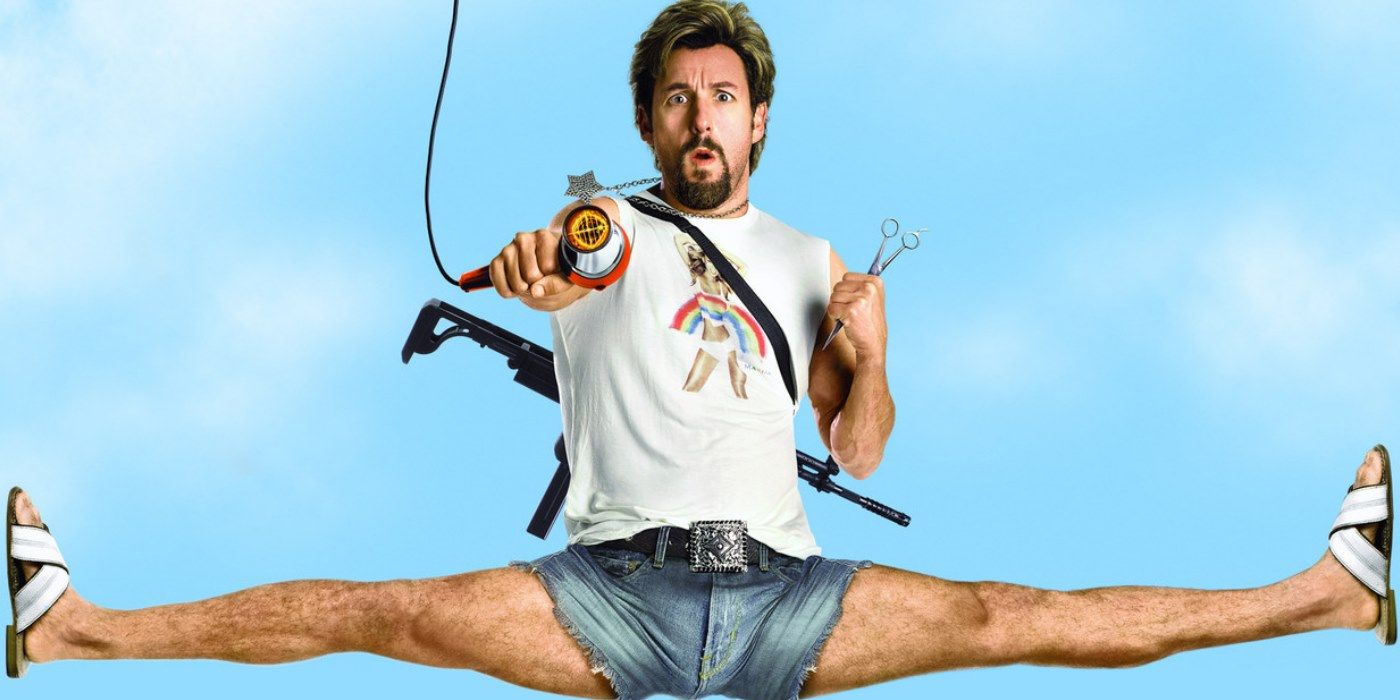
Honestly, if you haven't seen it lately, go back and watch the opening scene where Adam Sandler catches a fish with his butt cheeks. It's absurd. It's crude. It’s exactly what you’d expect from a Happy Madison production in 2008. But here’s the thing about the You Don’t Mess with the Zohan movie that most people completely gloss over: it’s actually one of the most daring political satires of the 21st century.
I know, I know. Calling a movie where a guy uses hummus as toothpaste "daring satire" sounds like a stretch. But bear with me.
At its core, Zohan is a story about the exhaustion of conflict. It’s about a Mossad commando who is so incredibly good at killing that he’s bored out of his mind. He doesn't want to fight anymore. He wants to cut hair. He wants to make people "silky smooth." That premise—taking one of the most intractable, violent geopolitical conflicts in human history and resolving it through the medium of mid-2000s hair styling—is kind of brilliant in its stupidity.
The Weird Genius of the Zohan Script
Most people assume Adam Sandler movies are just improvised riffs between friends. While there’s plenty of that, the You Don’t Mess with the Zohan movie had a heavy-hitting writing team. You had Sandler, sure, but you also had Robert Smigel (the mind behind Triumph the Insult Comic Dog) and Judd Apatow. This was Apatow right in his prime, fresh off The 40-Year-Old Virgin and Knocked Up.
The script does something very specific. It refuses to take sides in the Israeli-Palestinian conflict by making fun of everyone with equal aggression. The jokes aren't about the religion or the "rightness" of either cause. Instead, the jokes are about the shared cultural absurdities. Both sides love hummus. Both sides are obsessed with electronics stores. Both sides are tired of their mothers calling them every five minutes.
It’s a "both sides" argument that actually works because it’s rooted in the humanity of the diaspora. When Zohan gets to New York, he finds a neighborhood where Israelis and Palestinians live right across the street from each other. They yell. They argue. They trade insults. But they also exist in the same ecosystem. They are united by the struggle of being immigrants in America, which turns out to be a much more powerful force than the ancient grudges they left behind.
Paul Mitchell and the Dream of "The Silky Smooth"
Zohan Dvir isn't just a soldier; he’s a superhero. He can outswim a jet ski. He can catch bullets with his nostrils. Yet, his ultimate goal is to work for Paul Mitchell.
There's a specific kind of pathos in watching a man who can literally do anything choose to do something "frivolous." It’s a subversion of the hyper-masculine action hero tropes that dominated the 80s and 90s. Instead of Arnold or Sly, we get a guy who uses his superhuman agility to give elderly women the best haircuts—and "servicing"—of their lives.
The movie treats Zohan’s dream with a strange amount of respect. Even when the jokes are at his expense, the narrative never suggests he’s wrong for wanting peace. He fakes his own death just to escape the cycle of violence. He literally lets his rival, the Phantom (played with incredible energy by John Turturro), think he’s won just so he can go to Manhattan and buy a "scrappy" outfit.
Why the Phantom is the Perfect Foil
John Turturro’s performance as Fatush "The Phantom" Hakbarah is legendary. Usually, in these types of comedies, the villain is a cardboard cutout. But the Phantom is just as tired as Zohan. He uses his fame as a "terrorist hunter" to sell Muppet-themed fast food.
The scene where Zohan and the Phantom finally confront each other in the back of an electronics store is the turning point of the You Don’t Mess with the Zohan movie. They realize they are being played. The real villain isn't the guy on the other side of the border; it’s the corporate developer (played by Michael Buffer) who wants to stir up a race war so he can bulldoze the neighborhood and build a mall.
It’s a classic "Scooby-Doo" reveal, but in the context of Middle Eastern politics, it’s a biting critique of how outside interests often profit from keeping old wounds open. When the Israelis and Palestinians realize they’ve been tricked, they don't just stop fighting—they team up. They use their collective skills (and some very questionable martial arts) to save their community.
The Hummus of it All
We have to talk about the hummus.
In this movie, hummus is everything. It’s food. It’s fire extinguisher foam. It’s skin cream. It’s a recurring gag that never really gets old because of how committed the actors are to the bit. There’s a scene where they’re eating it out of a bowl with crackers, and it looks like the most unappealing substance on earth, yet they treat it like gold.
This represents the shared DNA of the characters. In New York, the specific brands of hatred they carried back home start to feel ridiculous when they’re all just trying to sell cameras to tourists. The movie suggests that the "melting pot" of America doesn't erase your culture; it just makes the violent parts of it feel unnecessary.
A Product of its Time (For Better or Worse)
Looking back from 2026, some of the humor in the You Don’t Mess with the Zohan movie definitely feels like a relic of 2008. The gender politics are... well, they're "Sandler-esque." The way Zohan "pleases" his elderly clients is played for big, uncomfortable laughs that might not fly as easily in a modern production.
However, the film’s willingness to tackle the Israeli-Palestinian conflict at all is something you rarely see today. Most studios would be way too terrified of the PR backlash to even attempt a comedy about a Mossad agent. Sandler and his team dove in headfirst. They hired actors from both backgrounds. They leaned into the stereotypes so hard that the stereotypes eventually shattered under their own weight.
Is it high art? No. But is it more thoughtful than Grown Ups 2? Absolutely.
The Legacy of the Fizzy Bubblech
If you mention this movie to anyone who grew up in the late 2000s, they’ll probably quote the "Fizzy Bubblech" or the "No, no, no, no, no" line. It has a sticky quality.
It also marked a shift in Sandler’s career. Before this, he was the "man-child" (Billy Madison, Happy Gilmore). After this, he started leaning into more character-driven, though still broad, comedies before eventually transitioning into the "Serious Actor" era we see with Uncut Gems. Zohan was the peak of his high-concept, high-budget physical comedy phase.
The movie cost about $90 million to make—which is a massive budget for a comedy—and it grossed over $200 million worldwide. It was a genuine hit. People responded to the weird mix of superhero action and salon drama.
What You Can Learn from Zohan Today
There’s a practical takeaway here, surprisingly. The movie teaches us about the power of "re-branding" yourself. Zohan Dvir was the greatest soldier in the world, but he was miserable. He had to shed his entire identity—his name, his country, his career—to find what actually made him happy.
If a guy who can stop a grenade with his feet can pivot into hair styling, you can probably handle that career change you've been thinking about.
Actionable Insights for Movie Buffs and Satire Fans:
- Watch for the Cameos: The movie is packed. Keep an eye out for Chris Rock, Mariah Carey, Kevin James, and even George Takei. It’s a "who’s who" of 2008 pop culture.
- Look Beyond the Slapstick: If you’re a student of film or politics, pay attention to the scenes in the "Tel Aviv" and "Palestine" neighborhoods of NYC. The production design deliberately makes them look nearly identical to show the common ground between the two groups.
- Analyze the Soundtrack: The music is a fantastic mix of Middle Eastern pop and 80s dance hits. It’s used to bridge the gap between Zohan’s past and his American dream.
- Contextualize the Conflict: To really appreciate the satire, it helps to understand the 2008 political climate. This was the era of the Bush administration’s final years, and the "War on Terror" was still the dominant global narrative. Zohan was a rare piece of media that tried to humanize people on all sides of that tension.
The You Don’t Mess with the Zohan movie isn't going to win any posthumous Oscars for its nuance. But it remains a fascinating example of how comedy can be used to process trauma and political gridlock. It’s loud, it’s gross, and it’s frequently stupid. But beneath all that hummus, it’s got a surprisingly big heart and a genuine wish for a world where we can all just be "silky smooth."
Go back and give it another look. Skip the parts that make you cringe, and focus on the parts that make you think. You might be surprised at what you find.
To truly appreciate the film's impact, your next step should be to look up Robert Smigel's interviews regarding the writing process. Understanding how they navigated the sensitive subject matter while maintaining the "Happy Madison" brand provides a masterclass in balancing commercial appeal with subversive commentary. Additionally, comparing the film's reception in the United States versus the Middle East reveals a lot about how different cultures perceive their own stereotypes on the big screen.



