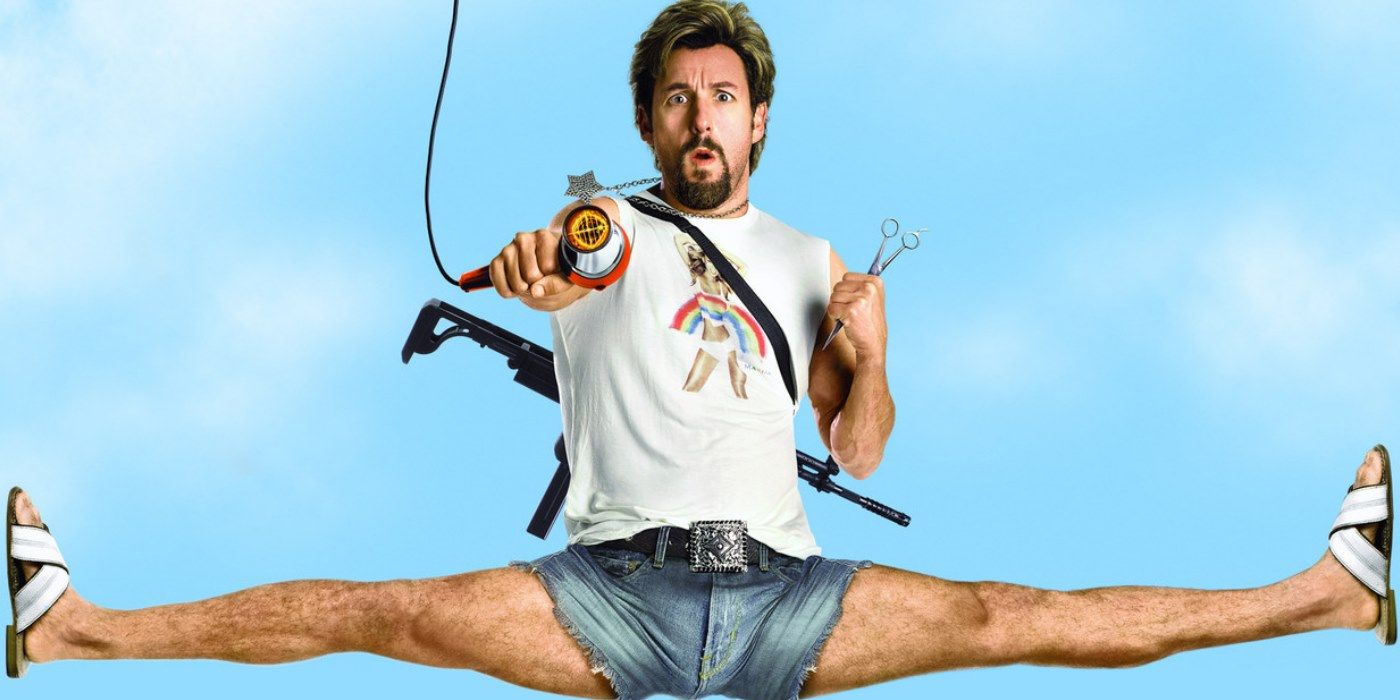
It is 2026, and we are still talking about the guy who catches bullets with his nostrils. Honestly, it’s a bit wild. When you look back at the massive library of Adam Sandler movies, Zohan—officially titled You Don’t Mess with the Zohan—sits in this weird, neon-colored bubble of its own. It’s not just another "Sandler goes on vacation" flick like Grown Ups. It’s a high-concept, $90 million satirical gamble that tried to solve the Middle East conflict with hair gel and hummus.
Does it hold up? Sorta. It depends on who you ask and how much "Fizzy Bubbly" you’ve had to drink.
The Secret History of the Zohan Script
Most people think this was just a random idea Sandler had while eating a kebab, but the reality is much more interesting. The script was actually written back in 2000. It was a heavyweight collaboration between Sandler, Robert Smigel (the genius behind Triumph the Insult Comic Dog), and Judd Apatow. They had a first draft ready to go, but then 9/11 happened.
Suddenly, a comedy about a counter-terrorist faking his death to become a New York hairstylist felt... well, a bit too soon. The project sat on a shelf for years. Apatow eventually moved on to direct The 40-Year-Old Virgin, but the DNA of that early 2000s "frat-pack" humor stayed in the Zohan’s bones.
When it finally hit theaters in 2008, the world was a different place. We were deep into the George W. Bush era, and Sandler decided it was finally time to unleash Scrappy Coco on the public.
Real Inspiration Behind the Character
Believe it or not, Zohan Dvir wasn't just pulled out of thin air. The character was partially inspired by a real guy named Nezi Arbib. He was a former Israeli soldier who actually moved to Southern California to open a hair salon. Sandler didn't just read about him; he spent two weeks training with Arbib to learn how to handle shears and talk to clients like a pro.
Why Zohan is the Weirdest Adam Sandler Movie
If you watch it today, the sheer physicality of the performance is what jumps out. Sandler actually got ripped for this role. He didn't use a body double or CGI for those abs; he trained like a legit athlete to look like a Mossad agent.
The movie is a relentless assault of sight gags.
- Using hummus as toothpaste? Check.
- Using hummus to put out fires? Check.
- Playing hacky sack with a live cat? (Okay, that one was a bit much).
But beneath the "disco-disco" energy, there’s a surprisingly earnest message about the immigrant experience. Zohan moves to New York and finds that the Israelis and Palestinians living there have more in common with each other than they do with the "real" Americans who look down on them. They all just want to run their electronics stores and salons without being harassed by corporate developers or racist skinheads (played, quite bizarrely, by Dave Matthews).
The Casting Controversy
We have to talk about the casting because, in 2026, it looks pretty dated. You’ve got John Turturro playing "The Phantom" and Emmanuelle Chriqui as Dalia. Chriqui was raised in an Orthodox Jewish household playing a Palestinian woman, and Turturro is, well, John Turturro. In 2008, Hollywood didn't think twice about this. Today, it’s the kind of thing that generates endless "problematic" threads on social media.
Interestingly, the film was a massive hit in Israel but was banned in several Arab countries. It tried to walk a tightrope of being a "liberal Zionist manifesto" (as The Times of Israel once called it) while also humanizing the Palestinian characters—specifically Rob Schneider’s Salim, who is obsessed with getting his goat back.
Box Office: By the Numbers
People love to hate on Sandler’s critical scores, but the man is a walking ATM. You Don’t Mess with the Zohan was no exception.
- Production Budget: $90 million (huge for a comedy at the time).
- Domestic Opening: $38.5 million.
- Worldwide Gross: Over $204 million.
It wasn't his biggest hit—movies like Grown Ups and Hotel Transylvania would eventually dwarf it—but it proved that Sandler’s brand of "idiot-savant" humor had global legs. It made just as much money in international markets as it did in the US.
The Legacy of "Fizzy Bubbly"
Why does this movie keep popping up in the "Adam Sandler movies Zohan" search results two decades later? It’s the memes. Before memes were even a thing, Zohan was designed to be quoted. "So silky smooth" and "No, no, no, no, no" became part of the early internet lexicon.
There have been rumors of a sequel for years. In early 2026, whispers of a Zohan 2 started circulating again on industry blogs, suggesting Sandler might return to the character for a Netflix special. While nothing is officially greenlit, the "Sandman" has a massive deal with Netflix that allows him to basically do whatever he wants. If he wants to bring back the silk-soft hair and the platform shoes, he can.
Actionable Takeaways for the Ultimate Rewatch
If you're planning to revisit this classic of 2000s cinema, here is how to actually enjoy it without cringing too hard:
- Look for the Cameos: This movie is a "who's who" of 2008. Watch for Henry Winkler, Kevin James, Mariah Carey, John McEnroe, and even George Takei.
- The "Going Out of Business" Gag: Pay attention to the Israeli electronics stores. The jokes about everything always being "on sale" because they are "going out of business" are a direct lift from Robert Smigel’s SNL sketches from the 90s.
- The Soundtrack: It’s actually a banger. From Ace of Base to Mariah Carey, the music perfectly captures that "unironic disco" vibe Zohan lives for.
- Skip the "Cobra" Robot: If you find the deleted scenes, there was an entire subplot involving a robot soldier named Cobra that was cut for being "too weird." Yes, even for this movie.
The Zohan remains one of the most polarizing entries in the Sandler canon. It’s loud, it’s offensive, it’s sweet, and it’s deeply, deeply weird. It represents a time when a major studio would hand a comedian $100 million to make a movie about a man who dreams of cutting hair like Paul Mitchell. We might never see a movie quite like it again.
To get the most out of your Sandler marathon, start with Happy Gilmore to see the rage, then hit Punch-Drunk Love to see the range, and finish with Zohan to see the sheer, unadulterated absurdity.



