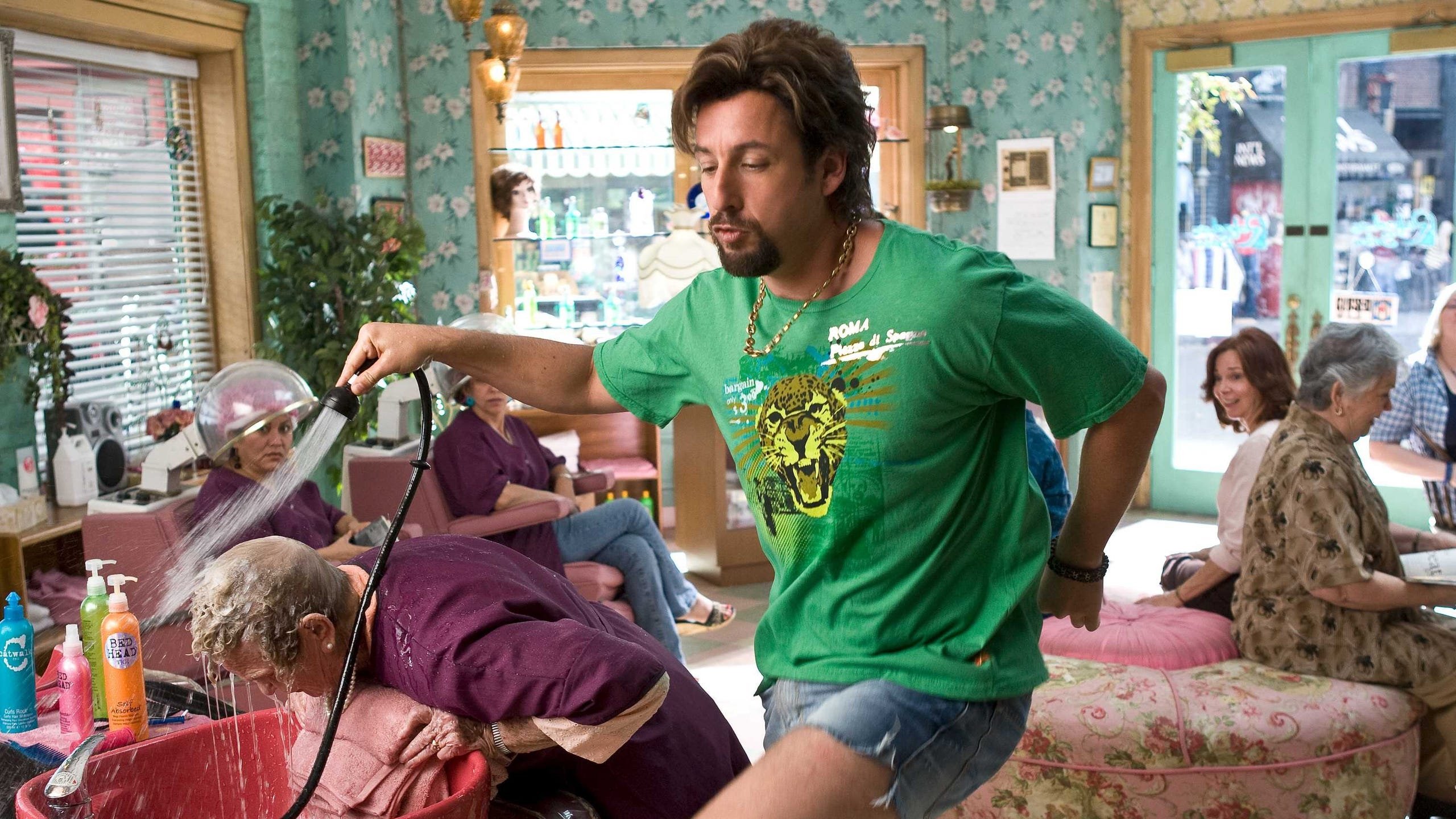
Let’s be real for a second. In the mid-2000s, Adam Sandler was essentially a walking mint for Sony Pictures. He could do no wrong. But when he decided to play an Israeli counter-terrorist who fakes his own death to become a hairstylist in New York City, people were... confused. Honestly, the You Don't Mess with the Zohan movie shouldn't have worked. It’s a film where a guy catches bullets with his nostrils and uses hummus to put out fires.
It’s ridiculous. It’s loud. It’s peak Happy Madison.
Yet, looking back from 2026, the film has aged in a way that’s actually kinda fascinating. While many comedies from that era feel dated or just plain cringey, Zohan manages to touch on middle-eastern tensions through a lens of pure, unadulterated absurdity. It’s a movie that somehow balances the Palestinian-Israeli conflict with jokes about "fizzy bubblech" and elderly women’s hair.
The Weird Genius of the You Don't Mess with the Zohan Movie
The script wasn't just some slapdash effort. It was written by Sandler, Robert Smigel (the man behind Triumph the Insult Comic Dog), and Judd Apatow. You can feel that DNA. You've got Apatow’s character-driven heart mixed with Smigel’s surrealist bite. Sandler plays Zohan Dvir, a superhuman soldier tired of the endless "stop and go" of war. He wants to be silky smooth. He wants to work at Paul Mitchell.
He ends up in New York, calling himself "Scrappy Coco."
The comedy relies heavily on physical gags. Zohan is essentially a live-action cartoon. He swims like a dolphin. He kicks people in the head with his feet behind his back. But the real meat of the story—and why it actually has some E-E-A-T value in the world of film criticism—is how it portrays the immigrant experience. It’s about two groups of people who are told they have to hate each other back home, realizing that in Manhattan, they’re just neighbors trying to pay rent.
It's basically a peace treaty disguised as a fart joke.
Cast Dynamics and Surprisingly Good Chemistry
John Turturro is a legend, but his performance as Fatoush "The Phantom" Hakbar is something else entirely. He’s Zohan’s rival, but instead of being a cold-blooded killer, he’s a guy who loves Muppets and runs a kebab shop. The chemistry between Sandler and Turturro works because they both lean 100% into the bit. They aren't winking at the camera. They are playing it straight, which makes the lunacy even funnier.
Then you have Emmanuelle Chriqui as Dalia. She’s the heart of the film. As the Palestinian salon owner who hires Zohan, she provides the grounded reality that the movie desperately needs so it doesn't spin off into total chaos.
- Lainie Kazan brings the overbearing mother energy.
- Rob Schneider pops up as a Palestinian taxi driver with a grudge over a stolen goat.
- Nick Swardson plays the awkward New Yorker who takes Scrappy Coco in.
Why the Humor Polarized Audiences
Some people hated it. They thought it was too much. The "hump" jokes, the constant references to Zohan's prowess with older clients, the sheer volume of hummus on screen—it's a lot to process. But if you look at the box office, it pulled in over $200 million. People were watching.
The You Don't Mess with the Zohan movie doesn't care about being subtle. It uses stereotypes to mock the idea of stereotypes. By making everyone look equally insane, it levels the playing field. It suggests that the animosity between the two groups is fueled by old guys in offices, while the people on the ground just want to live their lives.
Is it sophisticated? No. But it's honest in its own weird way.
The Production Grind
The film was shot largely in Los Angeles and New York, but they actually went to Tel Aviv for those opening beach scenes. That wasn't green screen. That was the real Mediterranean. Sandler reportedly trained for months to get into "Zohan shape," working with Navy SEALs to handle the stunt work, even though most of it was enhanced by wire-work and CGI to make it look superhuman.
The hair styling was another thing. The production had to hire actual stylists to teach Sandler how to handle shears, though I doubt any professional would recommend the "Zohan technique" of using your teeth.
The Cultural Impact of Fizzy Bubblech
You can't talk about this movie without talking about the "Zohan-isms." The film created its own vocabulary. "Silky smooth." "No, no, no, no, no." "Discovery Card."
It’s a cult classic now. It's the kind of movie you find on cable at 11:00 PM and end up watching until the end even though you've seen it ten times. It represents a specific moment in Hollywood when mid-budget, high-concept comedies could take massive risks on being offensive or weird and still find a massive global audience.
Factual Breakdown: What Actually Happened?
People often ask if Zohan was based on a real person. Sorta. The character was partially inspired by Nezi Arbib, a former Israeli soldier who became a hairstylist in San Diego. Arbib taught Sandler how to cut hair and even showed him some of the "flair" used in the film. While Nezi probably wasn't catching grenades with his feet, the transition from soldier to stylist is a real-life path some veterans have taken.
The soundtrack is another sleeper hit. It’s packed with Middle Eastern pop and hip-hop, like "Ma’agalim" and tracks by Hadag Nahash. It gives the film an energy that feels authentic to the region, even when the plot is anything but.
How to Revisit the Zohan Legacy
If you’re planning a rewatch or seeing it for the first time, keep an eye on the background. The movie is full of cameos. From Kevin James to Chris Rock and even Mariah Carey playing herself, the film is a "who's who" of 2008 celebrity culture.
Next Steps for the Zohan Fan:
- Check out the Extended Version: There’s an unrated "Silkier Smooth" edition that adds about 15 minutes of even more absurd gags that were too much for the PG-13 theatrical cut.
- Look for the Nezi Arbib Connection: Watch the behind-the-scenes features to see the real-life "Zohan" training Sandler. It makes the performance feel a bit more grounded.
- Contextualize the Satire: Compare it to other 2000s satires like Team America or Borat. It sits in a weird middle ground where it's more "good-hearted" than Borat but more surreal than a standard rom-com.
- Observe the Cultural Shifts: Note how the film handles the "New York melting pot" theme. It’s a snapshot of post-9/11 optimism that somehow found a way to laugh at things that were usually treated with extreme gravity.
The You Don't Mess with the Zohan movie remains a bizarre artifact of Sandler's career. It’s brave, stupid, heart-warming, and gross all at once. Whether you’re there for the physical stunts or the surprisingly sweet message of following your dreams, it's a film that refuses to be ignored. It’s just too silky smooth for that.



