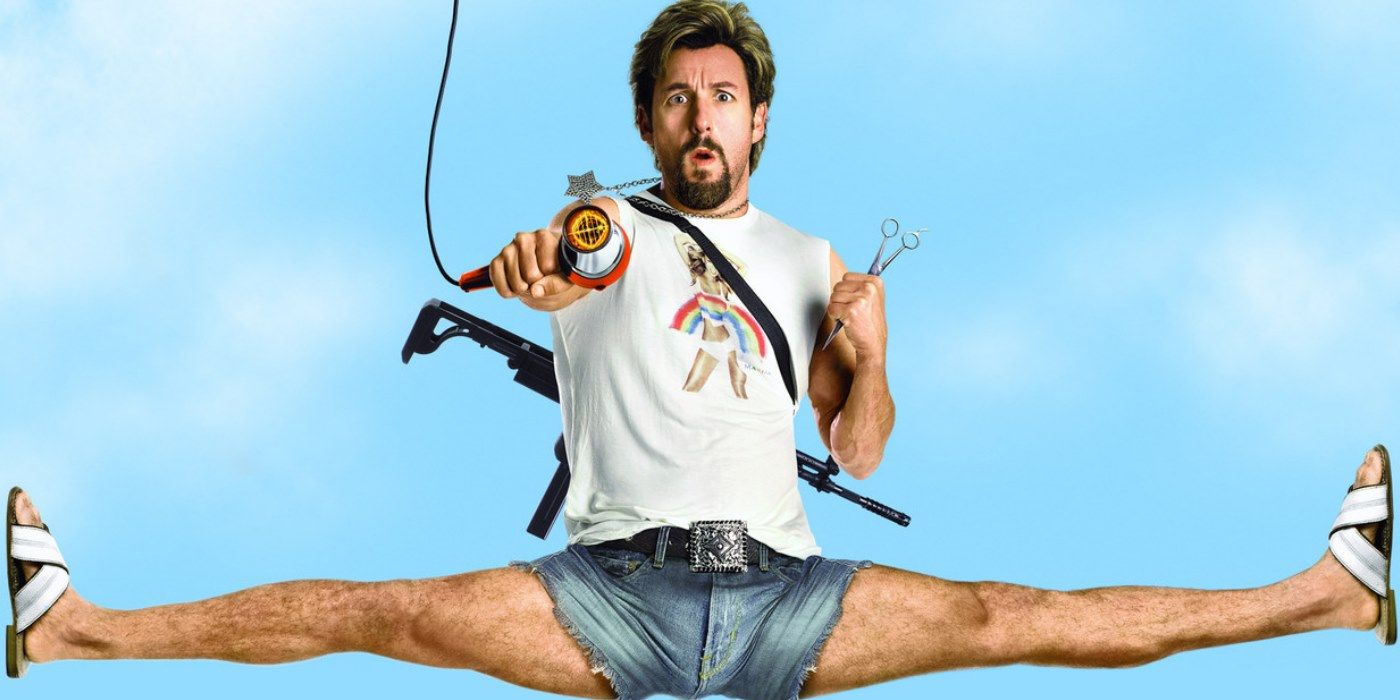
It’s been well over a decade since Adam Sandler decided to play an Israeli counter-terrorist who just wanted to cut hair, and honestly, the world hasn't really seen anything like it since. You Don't Mess with the Zohan is a weird movie. It’s loud, it’s crude, and it features an alarming amount of hummus. But if you look past the jokes about fizzy bubblech and foot-based combat, there is a strangely earnest attempt at a peace treaty buried under the slapstick.
People still quote this movie. Why? Maybe because it was the last gasp of a specific kind of big-budget, high-concept studio comedy that doesn't really get made anymore.
The Weird Origins of Zohan’s Skill Set
Zohan Dvir isn't just a character Sandler dreamt up during a weekend at the beach. The script actually had some serious weight behind it, at least in terms of the writing pedigree. You had Judd Apatow and Robert Smigel—the man behind Triumph the Insult Comic Dog—teaming up with Sandler. That’s a powerhouse trio for 2008. They wanted to tackle the Israeli-Palestinian conflict through the lens of a guy who is tired of the fighting and just wants to make people "silky smooth."
The movie follows Zohan, an IDF commando with superhuman abilities. He can catch bullets with his teeth. He can swim like a dolphin. He can literally beat people up with his feet while his hands are busy. But he’s burnt out. He fakes his own death during a battle with his nemesis, the Phantom (played with incredible energy by John Turturro), and stows away in a dog crate on a plane to New York City.
He changes his name to "Scrappy Coco." It’s a ridiculous name.
Once in New York, he finds that the conflict he tried to leave behind is still simmering in the streets of Manhattan. But here, the Israelis and Palestinians are neighbors. They run electronics stores and hair salons right next to each other. They argue, sure, but they’re also both struggling to survive in America. This is where the movie actually gets kinda deep, even if it’s immediately followed by Zohan doing something unspeakable with a hair dryer.
Why the Comedy Style Polarized Audiences
If you watch You Don't Mess with the Zohan today, some of it feels like a fever dream. The pacing is frantic. One minute he’s styling an elderly woman’s hair—and then providing "extra services" in the back room—and the next, he’s playing hacky sack with a cat.
Critics at the time were split. Some, like Roger Ebert, actually gave it a decent review, noting that Sandler was in top form. Others found the Middle Eastern stereotypes to be way too much. But if you talk to people from the region, there’s a surprising amount of affection for the film. It captures a very specific kind of immigrant energy. The "Going Out of Business" sales that never end, the obsession with specific brands of soda, and the way everyone is related to everyone else.
Sandler actually trained with a real Israeli commando to get the movement right. He wanted the action to look "legit" in its own cartoonish way.
The Phantom vs. Zohan: A Rivalry of Absurdity
John Turturro as the Phantom is arguably the best part of the whole film. He’s a "terrorist" who actually just wants to sell shoes and open a fast-food chain. The rivalry isn't based on hate; it’s based on ego. They are both the best at what they do, and they're both trapped in roles they didn't necessarily choose.
When they finally face off in the third act, the movie shifts from a fish-out-of-water comedy to a weird superhero flick. They realize they have more in common with each other than with the corporate developers trying to tear down their neighborhood. It’s a message of unity delivered via a kick to the face.
The Hummus Obsession and Production Details
Let’s talk about the hummus. It’s everywhere. They brush their teeth with it. They put out fires with it. This became one of the biggest "memes" of the movie before memes were even really a thing.
Production-wise, the film was a massive undertaking. They shot in New York, Los Angeles, and Tel Aviv. Director Dennis Dugan, a long-time Sandler collaborator, had to manage a cast that was incredibly diverse. You had Emmanuelle Chriqui, who is Sephardic Jewish of Moroccan descent, playing the Palestinian love interest, Dalia. This casting caused some conversation, but her chemistry with Sandler actually grounded the movie’s more insane moments.
- The Soundtrack: It’s a mix of Hebrew pop, Arabic tracks, and 80s dance hits. It shouldn't work, but it does.
- The Cameos: Look for Mariah Carey, Kevin James, and even Chris Rock. The movie is stuffed with Sandler’s friends, which is a staple of Happy Madison productions.
- The Action: The fight choreography was handled by some of the same people who worked on major action blockbusters, which is why the stunts look surprisingly crisp.
Is Zohan Still Relevant?
You’d think a movie about Middle Eastern politics from 2008 would aged like milk. Strangely, it hasn't. While some of the humor is definitely "of its time," the core idea—that people just want to live their lives, follow their passions, and not be defined by ancient grudges—is still pretty poignant.
The movie mocks everyone equally. It mocks the American perception of the Middle East, the stubbornness of the older generation, and the corporate greed that tries to exploit ethnic tensions for profit. It’s a loud, colorful, and messy plea for everyone to just get along and get a haircut.
Zohan’s dream of becoming a hair stylist at Paul Mitchell’s salon is played for laughs, but there’s a universal truth there. Most people aren't their jobs. Most people have a "Scrappy Coco" inside them waiting to get out.
Actionable Takeaways for Your Next Rewatch
If you’re going to revisit You Don't Mess with the Zohan, do it with a bit of context. It’s not just a "dumb" comedy. It’s a time capsule of a period where we thought maybe we could laugh our way through the world’s tensest problems.
- Watch the background actors: Many of the people in the salon and electronics store scenes are actually from the Middle East and brought their own improvised lines to the mix.
- Pay attention to the "American" characters: Notice how the movie portrays the Americans as being mostly oblivious to the nuances of the conflict, which is a subtle bit of social commentary.
- Check out the physical comedy: Sandler’s athleticism in this movie is actually impressive. He did a significant amount of the stunt work himself.
- Look for the hidden Smigel humor: If you’re a fan of Saturday Night Live, you can see Robert Smigel’s fingerprints all over the more surreal gags.
The best way to enjoy it today is to accept it for what it is: a chaotic, well-meaning, and occasionally brilliant mess. It doesn't take itself seriously, and you shouldn't either. Just grab some hummus, skip the "fizzy bubblech" if you value your stomach, and appreciate the fact that for two hours, Adam Sandler convinced the world that hair styling could save the planet.
Make sure to look for the "Neistat Brothers" cameo if you’re a fan of early YouTube history—Casey Neistat and his brother Van have a small part as protesters. It’s one of those "if you know, you know" details that makes the movie feel even more like a relic of that specific late-2000s era.



