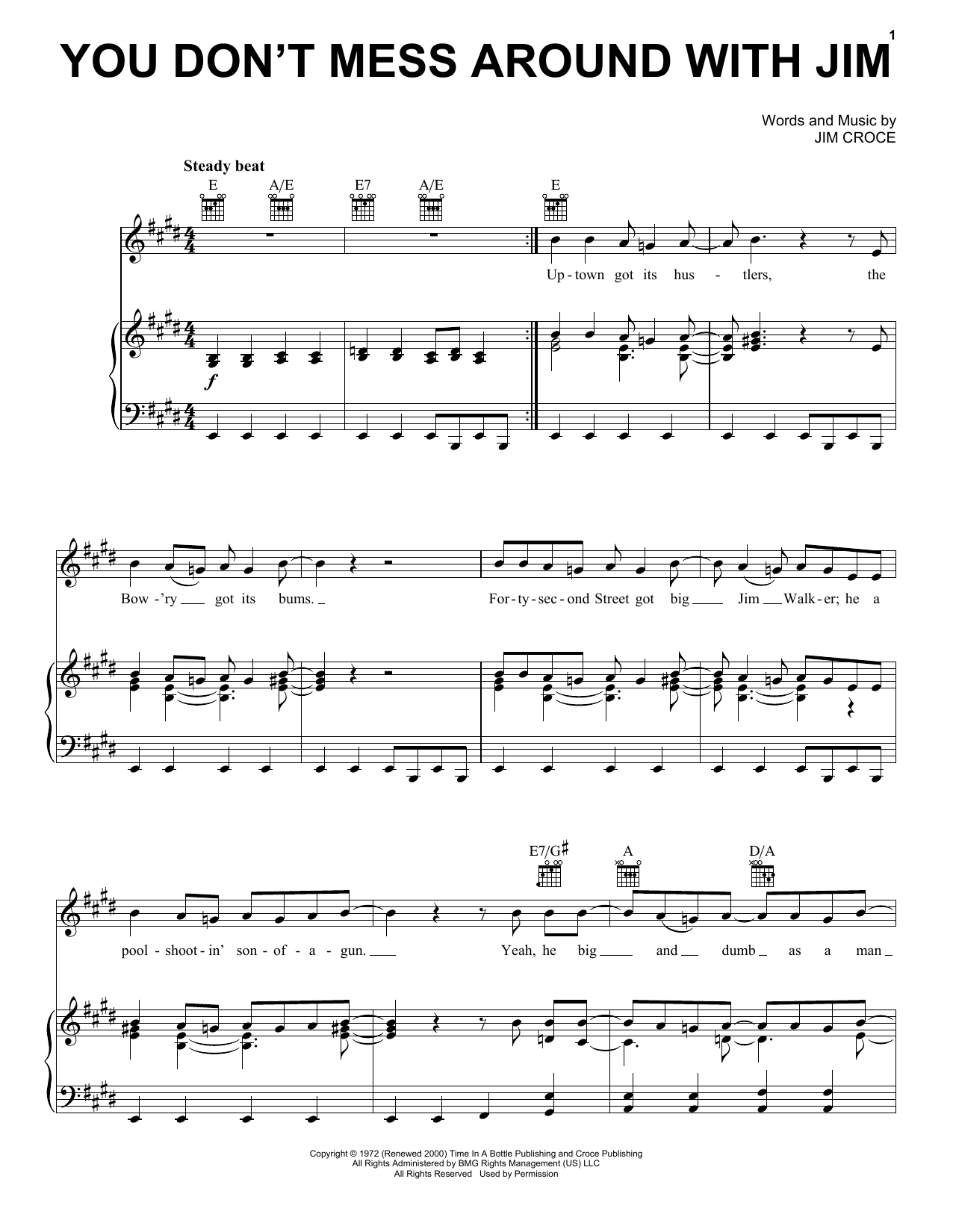
Music is usually about metaphors. Songwriters hide behind flowery language or vague poetry to protect their feelings. Then you have Jim Croce. He didn't do that. When he sang, he was telling you exactly how it was, usually with a smirk or a heavy heart. You don't mess around with a legacy that is built on being that real. Croce’s 1972 hit "You Don't Mess Around with Jim" wasn't just a catchy tune about a pool hall tough guy; it was a masterclass in character writing that few have matched since.
Honestly, the guy was a laborer first and a star second. He spent years driving trucks and doing construction in Pennsylvania. That grit is why his music feels so lived-in. You can almost smell the stale beer and cigarette smoke in the tracks.
The Story Behind the Legend of Big Jim
Most people think Jim Walker was a real person. He was, but not exactly in the way the song depicts. Croce met a guy while he was in the Army who had that kind of reputation. A guy who loomed large and didn't take any lip. But the beauty of the songwriting is how Jim Croce flips the script. You spend three minutes hearing about how terrifying this man is—he’s got a custom pool cue and a "44 gun in his shoe"—only to watch him get flattened by a guy from South Alabama named Slim.
It’s a classic "pride goeth before the fall" narrative.
Croce had this incredible knack for the "tough guy" ballad. He did it again with "Bad, Bad Leroy Brown." But "You Don't Mess Around with Jim" has a sharper edge. It’s faster. The acoustic guitar work, handled by the legendary Maury Muehleisen, is intricate and driving. Muehleisen was a prodigy. People often forget that the "Croce sound" was actually a duo. Without Maury's melodic fills, Jim’s raspy, blue-collar vocals might have felt too heavy. Together, they found this sweet spot where folk met pop-rock in a way that felt dangerous but fun.
Why This Sound Still Matters in 2026
We live in a world of over-produced digital tracks. Everything is tuned. Everything is quantized to a perfect grid. When you go back and listen to those early 70s recordings, you hear the fingers sliding on the strings. You hear the breaths. You realize that you don't mess around with the fundamentals of good storytelling.
Younger artists today, like Zach Bryan or Tyler Childers, are essentially the spiritual descendants of Croce. They realize that people crave authenticity. They want to hear about the "working man's dollar" and the guy who got his heart broken at the local bar. Croce was the blueprint for the modern Americana movement before anyone even called it that.
The Tragedy of the 1973 Crash
It’s impossible to talk about this music without mentioning how it ended. September 20, 1973. Natchitoches, Louisiana. Jim and Maury had just finished a show at Northwestern State University. Their chartered plane hit a tree on takeoff. Just like that, it was over. Jim was only 30. Maury was 24.
They were at the absolute peak of their powers. "I Got a Name" was released shortly after. It’s a haunting song when you realize the person singing it is gone. It makes the line "You don't mess around with Jim" feel like a bittersweet reminder of a guy who was just getting started.
Technical Brilliance in Simplicity
The guitar work on these tracks is deceptive. If you’re a player, you know. It’s mostly open chords, but the rhythm is everything. Jim played a Gibson Dove, and later a D-21 and a D-35 Martin. These are big, booming dreadnoughts. They have a percussive quality.
- The alternating bass lines provide a "thump" that acts as a drum kit.
- Maury’s lead work usually sits in the higher registers to cut through the mix.
- The lyrics use internal rhyme schemes that make them incredibly easy to memorize.
Think about the line: "He's got a custom-made billiard cue / He's got a two-button suit." It paints a picture instantly. You know this guy. You've seen him. Maybe you’ve even been afraid of him. That's the power of the writing. It’s cinematic.
Misconceptions About the "Tough Guy" Persona
Some critics back in the day tried to pigeonhole Croce as a novelty act because of his humorous songs. They were wrong. For every "Leroy Brown," there was an "Operator" or a "Time in a Bottle." The latter was written for his son, A.J. Croce. It’s one of the most tender songs ever put to tape.
It shows the duality of the man. He could write about a pool hall brawl in "You Don't Mess Around with Jim" and then turn around and break your heart with a ballad about wanting to save time in a jar. He contained multitudes. He wasn't a caricature; he was a husband and a father who happened to be a genius at observing the human condition.
He didn't care about being a rock star. He cared about the work.
The Financial Struggle
Before the hits, Jim was broke. Really broke. He and his wife, Ingrid, sold jewelry at flea markets. He worked at a radio station for a while, but he mostly just lived a normal, hard-scrabble life. This is why his lyrics feel so grounded. He wasn't writing from a mansion in Beverly Hills. He was writing from a kitchen table while wondering how to pay the rent.
When fame finally hit, it was like a whirlwind. But he stayed the same guy. He still wore the same denim jackets. He still had that massive mustache. He still talked to fans like they were old friends.
Actionable Insights for Modern Creatives
If you’re trying to build a brand or a creative career today, there are lessons to be learned from how Croce handled his business. You don't have to be flashy to be impactful. In fact, being flashy often gets in the way of the message.
Observe the small things. Jim’s best characters came from people-watching. Pay attention to the way people talk in grocery stores or at the gym. Real life is weirder and more interesting than anything you can make up.
Master your craft. Don't just learn the basics. Jim and Maury practiced until they were a single unit. Their timing was impeccable. Whether you're writing code or songs, that level of polish shows.
Stay authentic to your roots. Don't try to sound like whatever is trending on TikTok. If you’re a country kid, be a country kid. If you’re a city person, own that. People can smell a "fake" persona from a mile away.
Keep it brief. "You Don't Mess Around with Jim" is about three minutes long. It doesn't overstay its welcome. It tells a complete story and then gets out of the way. In a world of short attention spans, brevity is your best friend.
The Enduring Impact
Even now, decades later, you’ll hear these songs in movies and commercials. Why? Because they represent a specific type of American cool. It’s not the flashy, neon-lit cool of the 80s or the grunge of the 90s. It’s a timeless, leather-jacket, dusty-road kind of cool.
Jim Croce proved that you can be a "regular guy" and still be an icon. He didn't need pyrotechnics. He didn't need a massive band. He just needed a story and a guitar. And when you have those two things, you really don't mess around with anything else.
The music remains a testament to what happens when talent meets hard work. It's a reminder that even if your time is short, you can leave something behind that lasts forever. Jim did that. Slim from South Alabama might have knocked Big Jim down, but the song itself is still standing tall.
To truly appreciate the work, listen to the You Don't Mess Around with Jim album from start to finish. Don't skip the deep cuts. Pay attention to the interplay between the two guitars. It’s a masterclass in folk-pop arrangement that hasn't aged a day since 1972.



