Most songs about heartbreak are just a bit of a bummer, but You Don’t Know What Love Is feels like a physical weight. It’s heavy. It’s dark. It basically tells the listener that if they haven't been dragged through the mud of absolute despair, they're essentially a romantic amateur.
Don't let the smooth jazz melodies fool you.
When Don Raye and Gene de Paul penned this in 1941, they weren't trying to write a catchy radio jingle. They were mapping out the anatomy of a shattered soul. Most people recognize it from Billie Holiday’s haunting renditions or Chet Baker’s fragile, breathy trumpet, but the song actually has a bit of a weird origin story. It was written for a comedy! Can you believe that? It was meant for a movie called Keep 'Em Flying, featuring the comedy duo Abbott and Costello. Imagine sitting in a theater expecting a slapstick routine and getting hit with a lyrical sledgehammer about the necessity of tasting tears just to understand affection.
It didn't make the final cut of the film. Good call, probably. It would have sucked the air right out of the room.
The Brutal Truth in the Lyrics of You Don't Know What Love Is
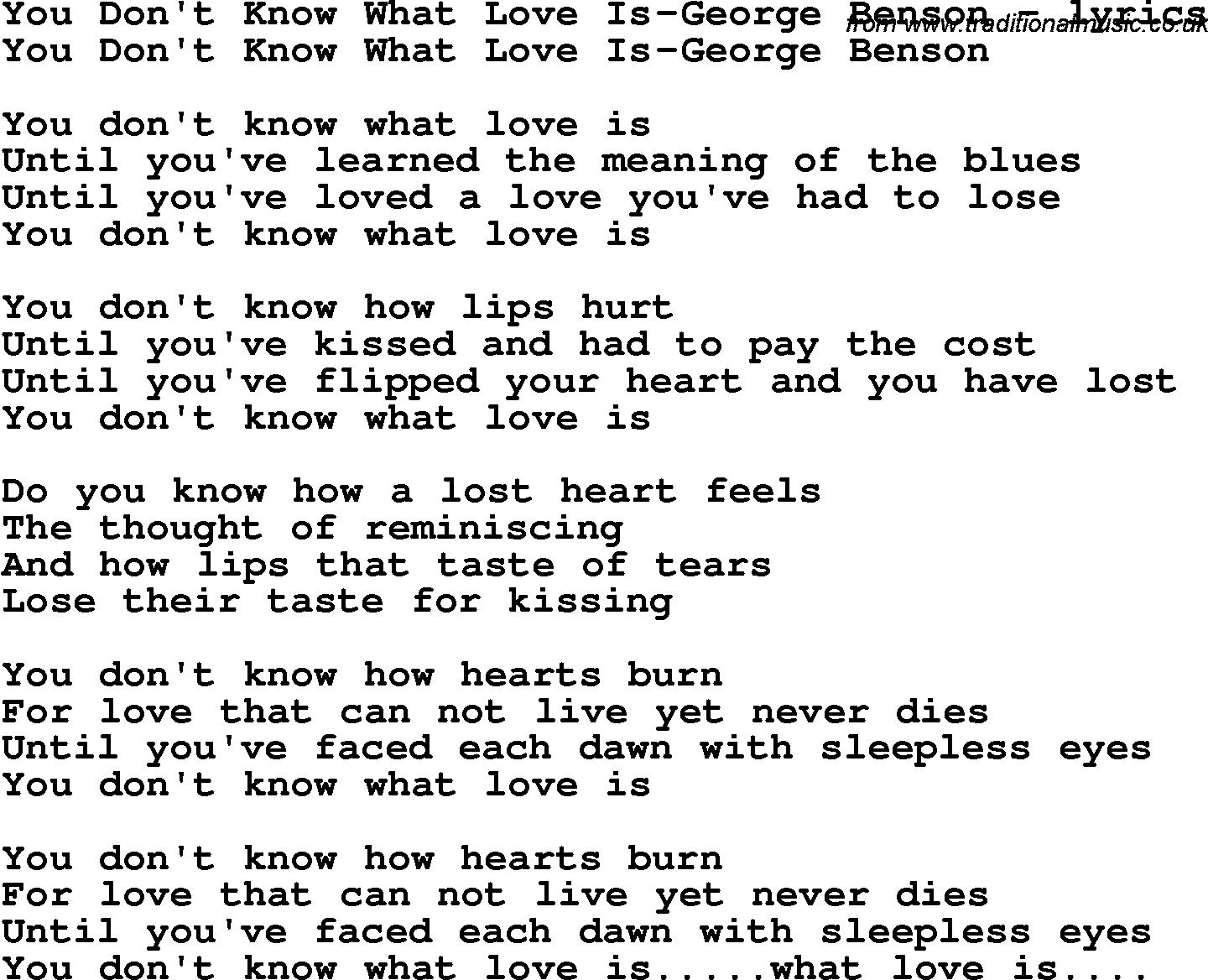
The central premise of the song is pretty elitist, if you think about it. It’s gatekeeping heartbreak. The opening lines are a direct confrontation: "You don't know what love is / Until you've learned the meaning of the blues." It isn't just saying you're sad. It's saying you lack the capacity for true love unless you’ve been thoroughly wrecked.
The lyrics go on to demand a specific set of experiences. You have to feel the "lips that taste of tears." You have to know how "hearts that burn" feel. It’s a checklist of misery. Honestly, it’s a bit masochistic. But that’s why it resonates. Everyone who has sat in a dark room at 3:00 AM wondering why their phone isn't ringing feels like they've finally earned their "love" credentials because of this song.
The imagery is vivid but sparse. "Until you’ve faced each dawn with sleepless eyes." Anyone who has dealt with insomnia fueled by anxiety knows that specific grey light of 6:00 AM. It’s the worst time of day. The song captures that specific, lonely vibration. It’s not just "I miss you"; it’s "I am fundamentally changed by the absence of you."
Why Jazz Singers Obsess Over These Words
You can’t just sing this song. You have to survive it.
Take Dinah Washington’s version. She delivers it with this sharp, bluesy edge that makes the lyrics feel like a warning. Then you have Miles Davis. Miles didn’t even need the words. His 1954 recording on Walkin' uses the trumpet to mimic the human voice’s cracks and sighs. When a musician plays this, they are looking for "soul." In the jazz world, "soul" is often synonymous with "I’ve seen some things I’d rather forget."
There is a technical reason it works, too. The melody often lingers on the "blue notes"—those flat fifths and minor thirds that feel unresolved. When the lyrics say you don't know "how hearts that burn can sincerely tell a lie," the music underlines that dishonesty with a chord that feels like it’s slipping through your fingers. It’s brilliant songwriting.
The Evolution of Heartbreak: From 1941 to Now
It is wild to think about how the meaning of You Don’t Know What Love Is has shifted. In the 40s, it was a sophisticated ballad. In the 50s and 60s, it became the ultimate "torch song" for the Cool Jazz movement.
By the time the 1990s rolled around, Cassandra Wilson was stripping it down to a swampy, acoustic vibe that made the lyrics feel even more ancient. It doesn't age because the core emotion—the feeling that your pain makes your love more "real" than everyone else's—is a universal human ego trap. We all want to believe our sadness is special. This song tells us it is.
Common Misconceptions About the Lyrics
A lot of people think this is a song about a specific breakup. It really isn't. It’s a philosophical argument. It’s saying that love isn't a feeling; it’s a merit badge you get after passing a test of endurance.
Some listeners also confuse the title with other "Love Is" songs. There are hundreds of them. But this one stands out because it starts with a negative. It doesn't define what love is; it tells you what you don't know. It’s an accusation.
- The "Tears" Line: Some modern covers change the phrasing, but the original "lips that taste of tears" is essential. It’s visceral.
- The "Dawn" Imagery: It’s not about being a night owl. It’s about the exhaustion of grief.
- The Conclusion: The song ends on a bit of a "told you so" note. It’s not a resolution; it’s a stalemate.
How to Truly Listen to This Song
If you want to understand why these lyrics have stayed in the public consciousness for nearly a century, don't play it on your phone speakers while doing the dishes. That's a waste.
Wait for a rainy night. Or a night where you’re feeling particularly misunderstood. Put on the Chet Baker version from Chet Baker Sings. His voice is famously thin, almost amateurish in its lack of vibrato, and that’s exactly why it works. He sounds like a man who has run out of breath and hope.
The lyrics of You Don’t Know What Love Is act as a mirror. If you listen to them and think, "Wow, that's a bit dramatic," then you’re lucky. You probably haven’t been there yet. But if you listen and feel a pang of recognition in your chest, congratulations—you’ve officially learned the meaning of the blues.
Modern Interpretations and Why They Matter
Even today, artists like Kurt Elling or Esperanza Spalding keep returning to this well. Why? Because pop music today is often very "direct." It’s "You cheated, I’m mad, I’m moving on."
This song is more complex. It suggests that the "mad" part and the "moving on" part are irrelevant compared to the knowing. There is a certain power in the lyric "how hearts that burn can sincerely tell a lie." It acknowledges that love and deception aren't opposites; they are often roommates. That kind of nuance is rare.
It’s also why the song is a staple for vocal students. You can’t fake the emotional depth required for the bridge. If you haven't lived it, you sound like you're just reciting a grocery list.
Actionable Insights for Music Lovers
If you're looking to dive deeper into the world of "You Don't Know What Love Is," don't just stop at one version. To really see how the lyrics change based on the performer's life experience, try this specific listening order:
- Billie Holiday (1958): Listen to the version from Lady in Satin. Her voice was failing her by then, which makes the line "until you've learned the meaning of the blues" sound like a literal autobiography. It's devastating.
- Miles Davis (1954): Listen to how he "speaks" the lyrics through his horn. You'll hear the questions and the accusations without a single word being uttered.
- George Benson (1989): This is for a more "polished" take. It shows how the song can still be beautiful even when it’s not being sung by someone on the verge of a breakdown.
- Sonny Rollins: Specifically his rendition on Saxophone Colossus. It’s a masterclass in how to take a melancholy lyric and turn it into a sprawling, architectural piece of art.
If you are a musician trying to learn the piece, pay attention to the lead sheet's minor key signatures. The song is typically played in F minor or G minor. The shift to the subdominant in the bridge is where the "story" of the lyrics shifts from personal reflection to a broader observation about human nature.
Stop looking for the "best" version. It doesn't exist. There is only the version that matches your current level of heartbreak. The song is a living thing. It grows with you. The older you get, the more those lyrics start to make sense, which is both a beautiful and a slightly terrifying realization.
Next time you hear it, don't just listen to the melody. Listen to the argument it's making. It's asking you if you've paid your dues yet. If the answer is no, just wait. Life usually takes care of that eventually.
Focus on the phrasing of the "sleepless eyes" section. Notice how different singers choose to breathe during that line. Some rush through it as if they're trying to escape the memory. Others, like Anita O'Day, linger on the syllables, forcing you to sit in the discomfort with them. That is the hallmark of a great lyric—it provides a skeleton that the performer must drape their own skin over.
Go find the 1941 sheet music if you can. Seeing the lyrics printed plainly on a page, divorced from the legends who sang them, reminds you of the craft involved. Don Raye was a master of the "sad-but-true" school of writing. He didn't use big words. He used "tears," "burn," "lie," and "dawn." These are the building blocks of human experience. You don't need a thesaurus to break someone's heart. You just need the truth.
Check out the version by John Coltrane on his Ballads album. It is perhaps the most famous instrumental version of all time. Coltrane plays with a restraint that feels like he’s holding back a flood. It’s the perfect sonic representation of the lyrics: the pain is there, but it’s being carried with a certain weary dignity.



