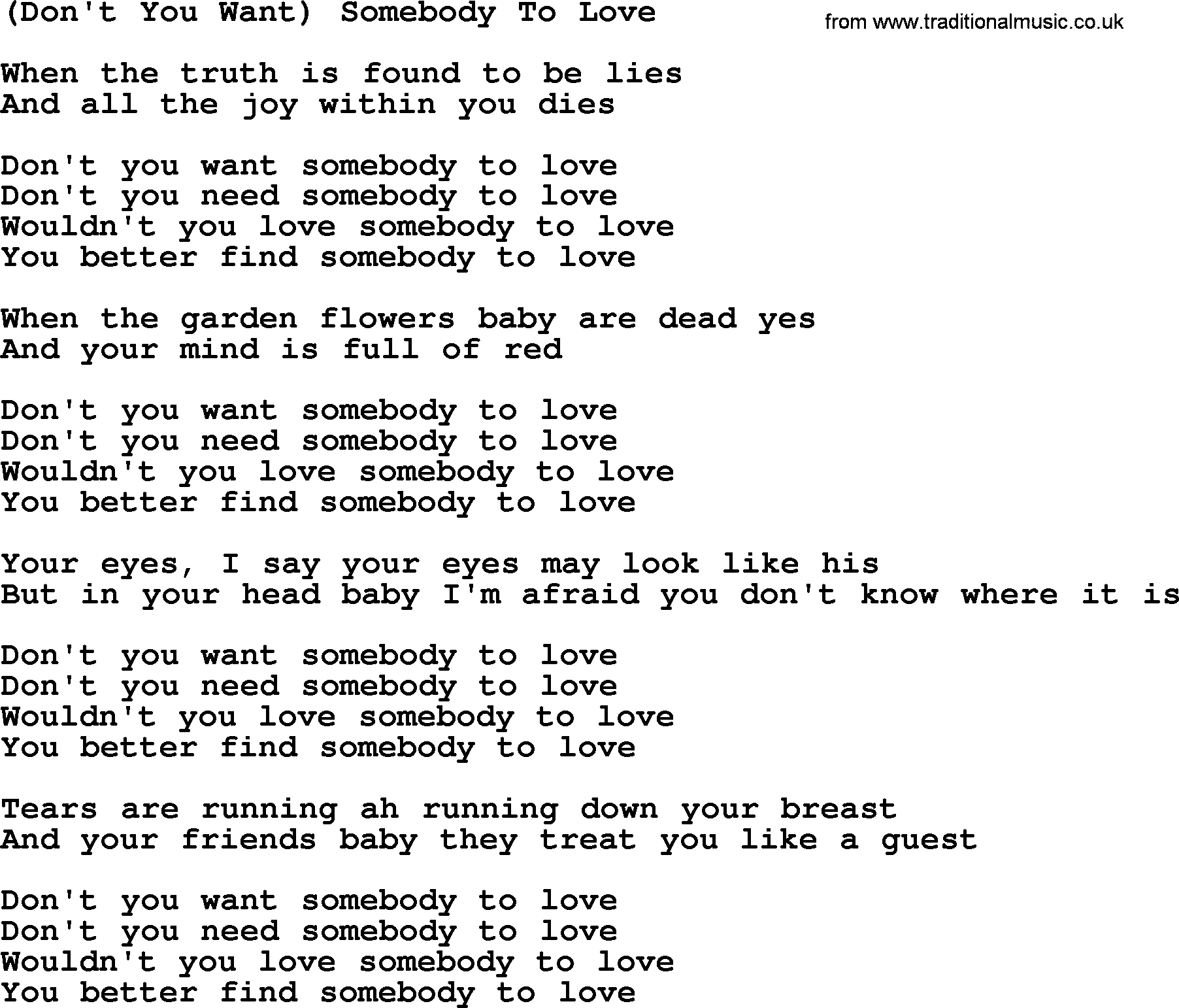
We’ve all heard the Bee Gees crooning it. Or maybe you prefer the Janis Joplin version, where she sounds like she’s literally coming apart at the seams. The line "you don't know what it's like to love somebody" is one of those universal gut punches that hits differently depending on where you are in your life. Sometimes it feels like a literal accusation thrown at an ex during a 2 a.m. argument. Other times, it’s a quiet realization you have while staring at a stranger in a coffee shop.
It’s a weirdly lonely thought.
The idea that your capacity for affection is deeper, more jagged, or more sacrificial than the person standing right in front of you is a heavy burden to carry. But here is the thing: love isn't a standardized metric. We talk about it like it's a fixed point on a map, but science and psychology suggest it’s more like a shifting weather pattern. When you tell someone they don't understand your love, you might actually be right—but not for the reasons you think.
The Science of Why Your Love Feels Different
Biologically speaking, we are all running on the same hardware, but the software is a mess. When we fall in love, our brains are flooded with dopamine, oxytocin, and vasopressin. It’s a chemical cocktail that researchers like Dr. Helen Fisher have spent decades mapping out. She famously used MRI scans to show that the brains of people "in love" look remarkably similar to the brains of people on cocaine.
But here’s the kicker.
Even though the chemicals are the same, the receptors are not. Genetic variations in the OXTR gene—which influences how our bodies process oxytocin—can actually change how intensely a person experiences emotional bonding. So, when you say "you don't know what it's like to love somebody," you might be witnessing a literal neurobiological gap. Some people are wired to feel the "velcro" of attachment more strongly than others. It isn't always a lack of effort; sometimes it's just a different baseline for intensity.
Then you have the psychological layer. Attachment theory, developed by John Bowlby and Mary Ainsworth, tells us that our early childhood experiences dictate our "love map." If you grew up with "anxious" attachment, your love feels like a high-stakes rescue mission. It’s loud, it’s consuming, and it’s constant. If your partner has an "avoidant" style, their love is quiet, guarded, and values autonomy. To the anxious lover, the avoidant person seems like they don’t know how to love at all. In reality, they're just speaking a language with a completely different syntax.
Why the Bee Gees Were Onto Something
The song "To Love Somebody" was originally written by Barry and Robin Gibb for Otis Redding. Think about that for a second. It wasn't meant to be a polite pop ballad; it was meant to be a soul powerhouse. The lyrics are desperate. They aren't about the "happily ever after" version of love. They are about the unrequited, "I am dying over here and you are just breathing" version of love.
"In my brain, I see your face again / I know my frame of mind."
That's the hallmark of limerence. Limerence is a term coined by psychologist Dorothy Tennov in the 1970s to describe that involuntary state of intense romantic infatuation. It’s different from long-term companionate love. Limerence is obsessive. It involves intrusive thoughts and an acute longing for reciprocation. When you are in the throes of limerence, and the other person is just in "like," the gap feels infinite. You look at them and think, "You don't know what it's like to love somebody," because if they did, they’d be as miserable and ecstatic as you are.
The Empathy Gap in Modern Relationships
Social media hasn't helped this. We are constantly fed a curated version of what "real love" looks like—grand gestures, perfect sunsets, and vulnerability that feels suspiciously rehearsed. This creates a "comparison trap."
Honestly, it’s exhausting.
When our real-life relationships don't mirror the high-octane passion we see on TikTok or in movies, we start to doubt the depth of our partner’s feelings. We assume that because they aren't expressing love in our specific dialect, they aren't feeling it. This is what Dr. Gary Chapman was getting at with The 5 Love Languages. While the book has been criticized for being a bit overly simplistic, the core truth remains: we tend to give love the way we want to receive it.
If your "language" is Acts of Service and theirs is Words of Affirmation, you’re going to spend a lot of time feeling misunderstood. You're out there changing the oil in their car to show you care, while they’re waiting for a "thank you" or a "you’re beautiful." Eventually, the oil-changer snaps and says, "You don't know what it's like to love somebody!" simply because their specific effort wasn't mirrored back in the exact same shape.
Is Love a Feeling or a Skill?
We often treat love like a lightning bolt—something that happens to us. But if you talk to couples who have been together for fifty years, they rarely talk about "feelings" in the way twenty-somethings do. They talk about "the work."
The philosopher Erich Fromm argued in The Art of Loving that love isn't a sentiment that anyone can easily indulge in, regardless of the level of maturity they've reached. He viewed love as an art form that requires discipline, patience, and practice.
If love is a skill, then saying "you don't know what it's like" is like a master pianist telling a beginner they don't know what music is. It might be true in terms of depth and complexity, but it doesn't mean the beginner isn't playing the notes they know. Some people are just further along in the practice of empathy and self-sacrifice than others.
The Pain of Emotional Asymmetry
Let's get real for a minute.
Sometimes, the phrase is a cry of pain because you are actually in an asymmetrical relationship. These are the ones where one person is doing the heavy lifting—the emotional labor, the planning, the worrying—and the other person is just... there.
It’s a lonely place to be.
In these cases, "you don't know what it's like to love somebody" isn't a philosophical debate; it's a factual observation of an investment gap. Research on "relational equity" shows that when one partner perceives a significant imbalance in effort, their physical health actually declines. Stress hormones spike. Sleep patterns break. You are literally wearing your body down for someone who is coasting.
In these moments, your love feels like a burden because it is. You are carrying the weight of two people's emotional lives. Of course they don't know what it's like—they haven't had to feel the weight yet.
Moving Past the "You Don't Know" Phase
So, what do you do when you feel like you're loving into a void? How do you bridge the gap when you're convinced your partner—or the person you're pining for—doesn't have a clue what real devotion looks like?
First, you have to stop using your own intensity as the "correct" version of love. Intensity is often just anxiety in a trench coat. Just because someone isn't spiraling doesn't mean they aren't committed.
Second, look for the "quiet" evidence. We focus on the big explosions of emotion, but love is usually found in the boring stuff. It’s in the person who remembers how you like your coffee, or the friend who shows up to move your couch on a Saturday morning without complaining. It’s not cinematic, but it’s durable.
Third, acknowledge that "knowing what it’s like" involves a level of vulnerability that some people genuinely find terrifying. For someone with a history of trauma or abandonment, "loving somebody" feels like handing over a weapon and hoping they don't use it. Their "lack" of love might actually be a very high wall they built to survive.
Actionable Steps for Bridging the Gap
If you are feeling the "love gap" in your own life, here is how to handle it without burning the house down:
- Define your "Love Minimums": Stop looking for them to match your intensity and start looking for them to meet your needs. What are the non-negotiables? If they are meeting those, the fact that they don't "feel" it as loudly as you do might not actually be a problem.
- Audit the "Emotional Labor": Sit down and look at who is doing the invisible work. If you're the only one checking in, planning, and resolving conflicts, it’s time for a conversation about balance, not just feelings.
- Practice "Externalizing": Instead of saying "You don't know what it's like to love me," try saying "I feel lonely in the way we connect." It moves the focus from their character flaw to your shared dynamic.
- Check your "Limerence": If you are obsessed with someone who isn't interested, realize that what you are feeling isn't necessarily a "superior" love. It’s a biological fixation. It’s okay to let it go.
Love isn't a competition to see who can suffer the most. While the song is a masterpiece of longing, living your life in that state of "you don't know" is a recipe for resentment. Real connection happens when we stop grading each other on our "depth" and start meeting each other where we actually are. If the gap is too wide to bridge, it might not be that they don't know how to love—it might just be that they aren't the person meant to love you.



