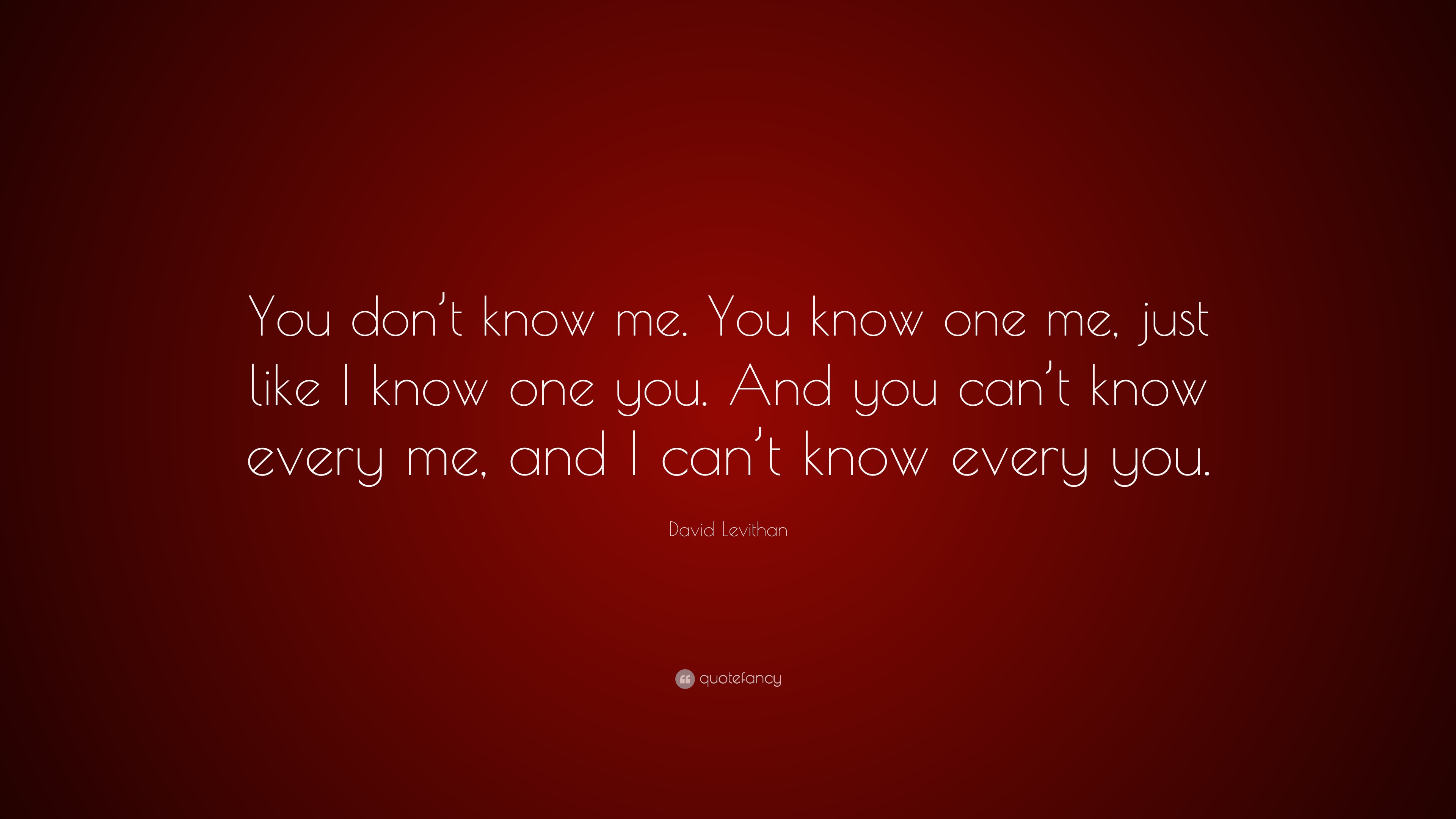
Language moves fast. One minute you're using a phrase to set a boundary with a pushy coworker, and the next, it's the title of a viral TikTok sound or a chart-topping R&B track. You don't know me like that isn't just a sentence. It’s a shield. It is a verbal line in the sand that people draw when someone—whether it’s a stranger on the internet or a distant acquaintance—steps way outside their lane.
Honestly, we’ve all been there. You’re minding your business, and someone assumes a level of intimacy or familiarity that just isn't there. They comment on your life choices, your outfit, or your trauma as if they’ve known you since kindergarten. That’s when the phrase hits hardest. It’s a correction of the social hierarchy.
The Origin of the "You Don't Know Me Like That" Energy
While it’s hard to pin down the exact second this specific string of words became a "thing," its roots are deeply embedded in Black American Vernacular English (AAVE). It’s about gatekeeping your peace. In the late 90s and early 2000s, you’d hear variations of this in hip-hop lyrics and urban dramas. It was the ultimate "check."
Think about the way tension builds in a scene. Two characters are arguing. One makes a personal dig. The other freezes, lowers their voice, and drops the line. It’s effective because it doesn't just say "you're wrong." It says "you haven't earned the right to have an opinion on this."
It’s about proximity. In a world where social media makes us feel like we’re best friends with celebrities because we see their breakfast on Instagram, the reality of "you don't know me like that" is a necessary cold shower. You see the pixels; you don't see the person.
Why the Phrase Went Viral (Again)
Pop culture loves a good clapback. We saw a massive resurgence of this sentiment in the music industry. Look at artists like Bryson Tiller. His 2015 hit "Don't" basically centers on the idea of men overstepping or misreading the room. While the lyrics are specific to a relationship, the vibe is universal. People started using the phrase "you don't know me like that" to describe the phenomenon of parasocial relationships.
What's a parasocial relationship? Basically, it’s when you feel a one-sided bond with a creator or celebrity. You’ve watched 400 hours of their vlogs. You feel like you know their soul. But if you met them in a Target, and you tried to joke about their recent breakup, they’d look at you like a stranger. Because you are.
- Fans feel entitled to information.
- Creators feel invaded.
- The phrase becomes the only way to re-establish a boundary.
It’s a fascinating psychological tug-of-war. We crave connection, but we also need privacy. When those two things collide, "you don't know me like that" is the emergency brake.
The Psychology of Social Presumption
Why do people assume they know us? Psychology suggests it’s a mix of projection and the false consensus effect. We assume others think like we do, or we project our own desires onto them.
When someone says "you don't know me like that," they are breaking that projection. It's a jarring experience for the listener. It forces them to realize they've been talking to a version of you that exists only in their head. That’s why it’s often met with defensiveness. "I was just trying to help!" or "Don't be so sensitive!" are common responses. But the boundary-setter isn't being sensitive. They’re being accurate.
The Power Shift
In a professional setting, this phrase is a bit more dangerous but equally potent. Use it with a boss? You might get fired. Use it with a peer who is taking credit for your work or making assumptions about your "vibe"? It’s a power move. It signals that you are not a character in their story. You are the protagonist of your own.
Music, Memes, and the Digital Legacy
The phrase has been sampled, tweeted, and turned into countless memes. Why? Because it’s rhythmic. It has a cadence.
- The "You" is accusatory.
- The "Don't" is the wall.
- The "Like That" is the nuance—acknowledging that maybe you know my name, but you don't know my story.
There’s a specific kind of TikTok audio trend where people recount a time someone tried to "son" them or talk down to them. The punchline is almost always a variation of this phrase. It’s the "find out" part of "around and find out."
How to Set Boundaries Without Burning Everything Down
If you find yourself needing to use this sentiment, you don't always have to be aggressive. Sometimes, the most powerful way to say "you don't know me like that" is through actions rather than words.
- The Slow Fade: If someone is getting too comfortable, pull back on the personal details you share.
- The Pivot: When someone asks a question that’s too personal, answer with, "Why do you ask?" It puts the spotlight back on their overstep.
- The Direct Approach: Sometimes you just have to say it. "I appreciate the interest, but we aren't quite on that level of familiarity yet."
It’s awkward. It’s uncomfortable. But it’s better than letting someone live in a house they haven't been invited into.
The Reality of Public Personas
Celebrities like Cardi B or Doja Cat have famously lashed out at fans using this logic. They’ve told fans, quite literally, "I don't know you, and you don't know me." The backlash is usually swift—fans feel betrayed. But if we look at it through the lens of mental health, it’s a survival tactic.
Imagine having a million people think they are your best friend. Imagine them giving you advice on your marriage, your parenting, and your mental state every single day. Eventually, you’d scream it from the rooftops: You don't know me like that.
Navigating the Boundary in 2026
As we move further into an era of AI-generated content and even more immersive social media, the lines are going to get even blurrier. We might even find ourselves saying this to algorithms. "You think you know what I want to buy? You don't know me like that."
The phrase is a reminder of our inherent complexity. We are not just data points or "types." We are messy, inconsistent, and private.
Actionable Insights for Protecting Your Space:
- Audit your "inner circle": Periodically check who has "all-access" passes to your personal life. If someone hasn't earned it, downgrade their clearance.
- Practice the "Pause": Before reacting to someone’s overstep, pause. Decide if they deserve a verbal correction or if silence is a louder boundary.
- Validate your own "No": You don't owe anyone an explanation for why they don't know you "like that." Your privacy is a right, not a privilege you have to justify.
- Recognize the signs of over-familiarity: If someone starts a sentence with "I know you better than you know yourself," that is a red flag. Red flags deserve a "you don't know me like that" response.
Protecting your identity in a world that wants to consume it is a full-time job. Be the gatekeeper. Hold the line.



