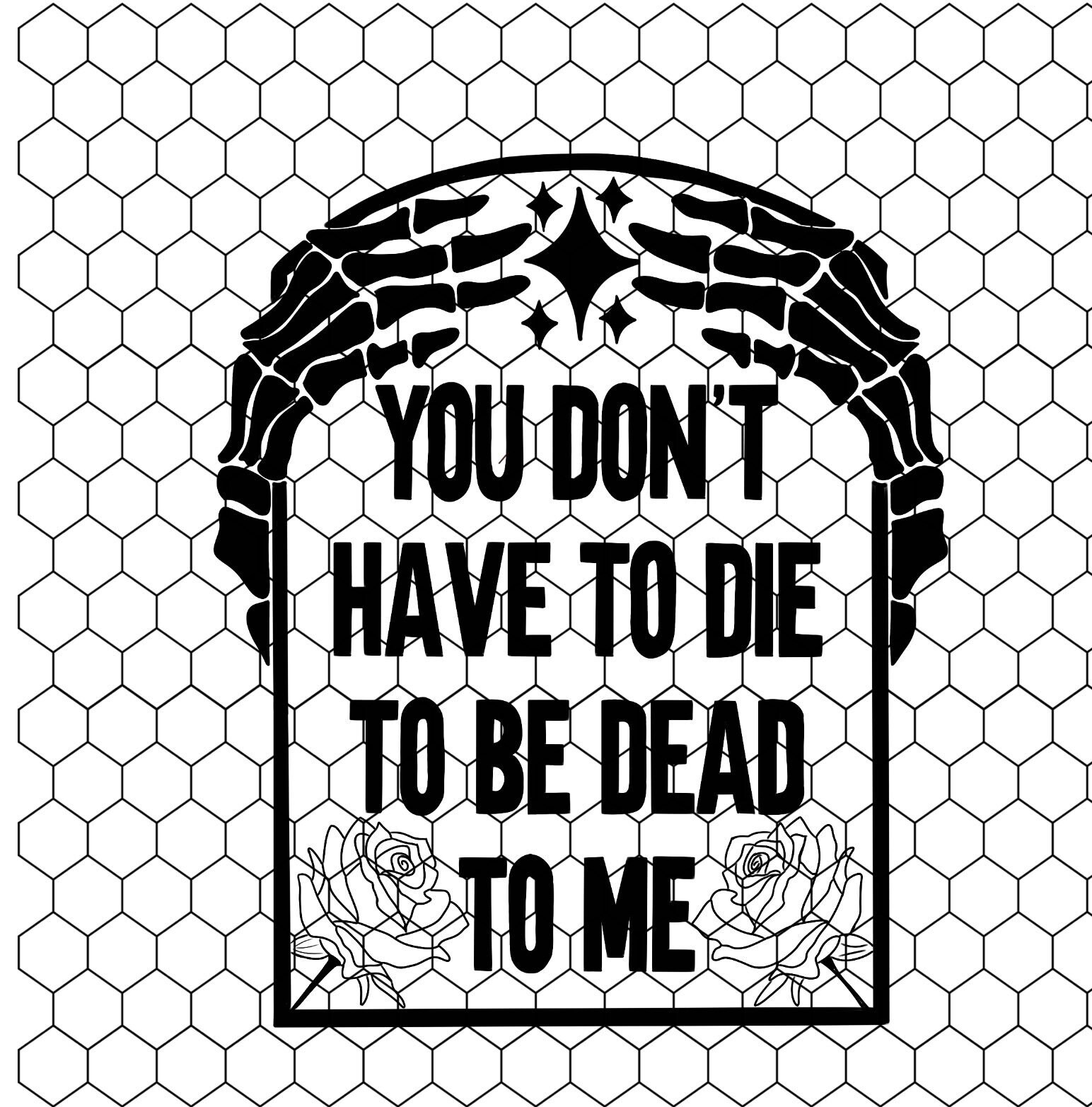
Ever had that moment where you look at someone you used to love—maybe a parent, a best friend, or an ex—and realize they’re just a ghost? They’re breathing. They’re posting on Instagram. They’re buying groceries. But in your world, they’ve ceased to exist. It’s a heavy realization. Honestly, it’s one of the most polarizing things a human being can do. The phrase you don't have to die to be dead to me isn't just a edgy song lyric or a dramatic line from a movie; it is a survival mechanism. It’s a psychological boundary so thick that no light gets through.
We live in a culture that obsesses over "closure." People tell you to forgive and forget. They say "life is short" and "blood is thicker than water." But for some, that advice feels like a cage.
Sometimes, the only way to keep living is to treat someone as if they’re already gone. It sounds cold. It sounds harsh. But if you’ve ever dealt with a narcissistic parent or a partner who systematically dismantled your self-esteem, you know exactly why this happens.
The Brutal Reality of Social Death
In sociology, there’s this concept called "social death." Usually, it refers to people who are marginalized by society to the point where they are treated as non-persons. However, on a micro-level, we do this in our personal lives through "No Contact." When you decide you don't have to die to be dead to me, you are effectively performing a funeral for a living person.
Psychologist Dr. Joshua Coleman, an expert on family estrangement, often discusses how this shift has moved from being a rare tragedy to a more common tool for self-protection. In the past, you stayed with family because you needed them for economic survival. Now, we prioritize psychological safety. If someone is a threat to your mental health, the "death" of the relationship becomes a viable option.
It’s not about hate. Hate is an emotion. Hate requires energy. Being "dead" to someone is about indifference. It is the absolute zero of human connection.
Why We Choose the Nuclear Option
Most people don't just wake up and decide to cut someone out. It’s usually the result of "the 1,000th cut." You’ve tried the talks. You’ve tried the "low contact" dance where you only see them on holidays. You’ve tried setting boundaries that they jumped over like a track star.
Then, one day, the switch flips.
- Betrayal Trauma: This isn't just a lie. It’s a fundamental breaking of the "attachment bond." When the person who is supposed to protect you is the one hurting you, the brain struggles to process the paradox.
- The Cost of Maintenance: Every time you interact with them, you spend three days recovering. You’re anxious before the call. You’re angry after it. You realize the "cost" of the relationship is bankrupting your life.
- Safety: This is the big one. If a person is physically or emotionally abusive, "dead to me" is the only way to stay safe.
I remember talking to a woman who hadn't spoken to her brother in ten years. She said, "I don't wish him ill. I hope he has a nice life. I just don't want to be in it." That’s the nuance people miss. It isn't a curse. It’s a relocation of your energy.
The "Ambiguous Loss" Factor
When someone actually dies, society has rituals. There’s a funeral. There are flowers. People bring you casseroles and tell you they’re sorry for your loss. But when you decide you don't have to die to be dead to me, there is no ritual.
Dr. Pauline Boss coined the term "ambiguous loss" to describe situations where a person is physically present but psychologically absent—or vice-versa. Estrangement is a form of this. You are grieving someone who is still walking around. This can lead to "disenfranchised grief," where you feel like you aren't allowed to mourn because, technically, nothing happened.
You’ll see them at a grocery store and your heart will drop. You’ll hear their name and feel a pang of guilt. This is because our brains aren't naturally wired for this kind of severance. We are tribal animals. Evolutionarily, being kicked out of the tribe or kicking someone out meant death. That’s why it feels so viscerally painful.
The Role of Modern Narcissism and Therapy Culture
We talk about narcissism a lot lately. Maybe too much. But the rise of "therapy speak" has given people the vocabulary to identify toxic patterns like gaslighting or love bombing. When people realize they are being manipulated, the phrase you don't have to die to be dead to me becomes a mantra of empowerment.
Critics say our generation is too quick to "cancel" people. They argue that we lack resilience. Is that true? Or are we just the first generation that realizes we don't have to set ourselves on fire to keep someone else warm?
There’s a difference between a "difficult" person and a "destructive" person. You deal with difficult people. You prune destructive ones.
The Biological Impact of No Contact
Stress isn't just a feeling. It’s cortisol. It’s adrenaline. Constant exposure to a toxic relationship keeps your amygdala—the brain’s alarm system—on high alert.
Over time, this leads to:
- Chronic inflammation.
- Sleep disturbances.
- Hyper-vigilance (waiting for the "other shoe" to drop).
- Weakened immune response.
When you finally go No Contact, your body often goes through a "detox" phase. It’s common to feel physically ill or exhausted. Your nervous system is finally stepping down from a decade-long "fight or flight" state. It’s not just a mental choice; it’s a physiological necessity.
What Happens When the "Dead" Person Tries to Return?
This is where it gets messy. Usually, the person who is "dead" to you doesn't stay quiet. They use "flying monkeys"—a term borrowed from The Wizard of Oz to describe third parties who do the narcissist’s bidding.
"But they're your mother!" "Can't you just move past it?" "They’ve changed, I promise."
When you’ve decided you don't have to die to be dead to me, these flying monkeys feel like a violation. They are trying to resurrect a ghost you’ve already buried. To maintain this boundary, you often have to cut out the people who refuse to respect it. It’s a domino effect. It’s lonely. It’s isolating. But for many, the silence is better than the noise of a toxic relationship.
Navigating the Guilt
The guilt is the hardest part. Society is a relentless pro-family machine. You’ll be at a wedding or a funeral, and people will ask about "them." You’ll have to decide whether to lie or to tell the truth.
"We don't talk anymore" is a complete sentence.
You don't owe anyone the gory details. You don't have to justify your survival. The guilt usually stems from the "fantasy" of who that person could have been, not who they actually are. You aren't mourning the person; you’re mourning the potential.
Actionable Steps for Maintaining This Boundary
If you’re at the point where someone is "dead" to you, or you’re considering it, here is how you actually handle the logistics of a social death.
1. Scrub the Digital Footprint Mute isn't enough. Block. If you’re checking their "stories" from a burner account, they aren't dead to you; they’re haunting you. You need to remove the temptation to see if they’re doing better or worse without you. Indifference requires a lack of data.
2. Script Your Responses Decide now what you will say when mutual friends ask about them.
- Version A: "I'm not in contact with them anymore, and I'd prefer not to discuss it."
- Version B: "We’ve gone our separate ways. How’s your work going?" Stick to the script. Don't get pulled into a debate about your choices.
3. Build a "Chosen Family" The void left by a parent or long-term partner is huge. You can't just leave it empty. Fill it with people who provide the safety the other person couldn't. This is the "corrective emotional experience" that therapists talk about.
4. Allow for the "U-Turns" Grief isn't linear. You might feel totally fine for a year and then see a specific brand of cereal they liked and lose it. That’s okay. It doesn't mean you made the wrong choice. It just means you’re human.
5. Focus on Hyper-Local Joy When you stop spending all your energy managing a toxic person, you’ll have a surplus of time and mental bandwidth. Use it. Start that hobby. Sleep eight hours. The best "revenge"—though revenge shouldn't be the goal—is a life lived so well that you rarely think about the person you cut out.
The decision to say you don't have to die to be dead to me is often the most difficult choice a person will ever make. It is a radical act of self-preservation. It is the acknowledgement that your life has more value than a broken tradition or a harmful bond. It’s okay to stop waiting for them to change. It’s okay to let the dead stay dead.
To move forward, start by auditing your current energy levels after every interaction this week. If one person consistently leaves you drained, anxious, or questioning your reality, document it. Use that data to decide if a "social funeral" is necessary for your own peace of mind. Seek out a therapist who specializes in estrangement or complex PTSD to help navigate the inevitable "guilt spikes" that follow.



