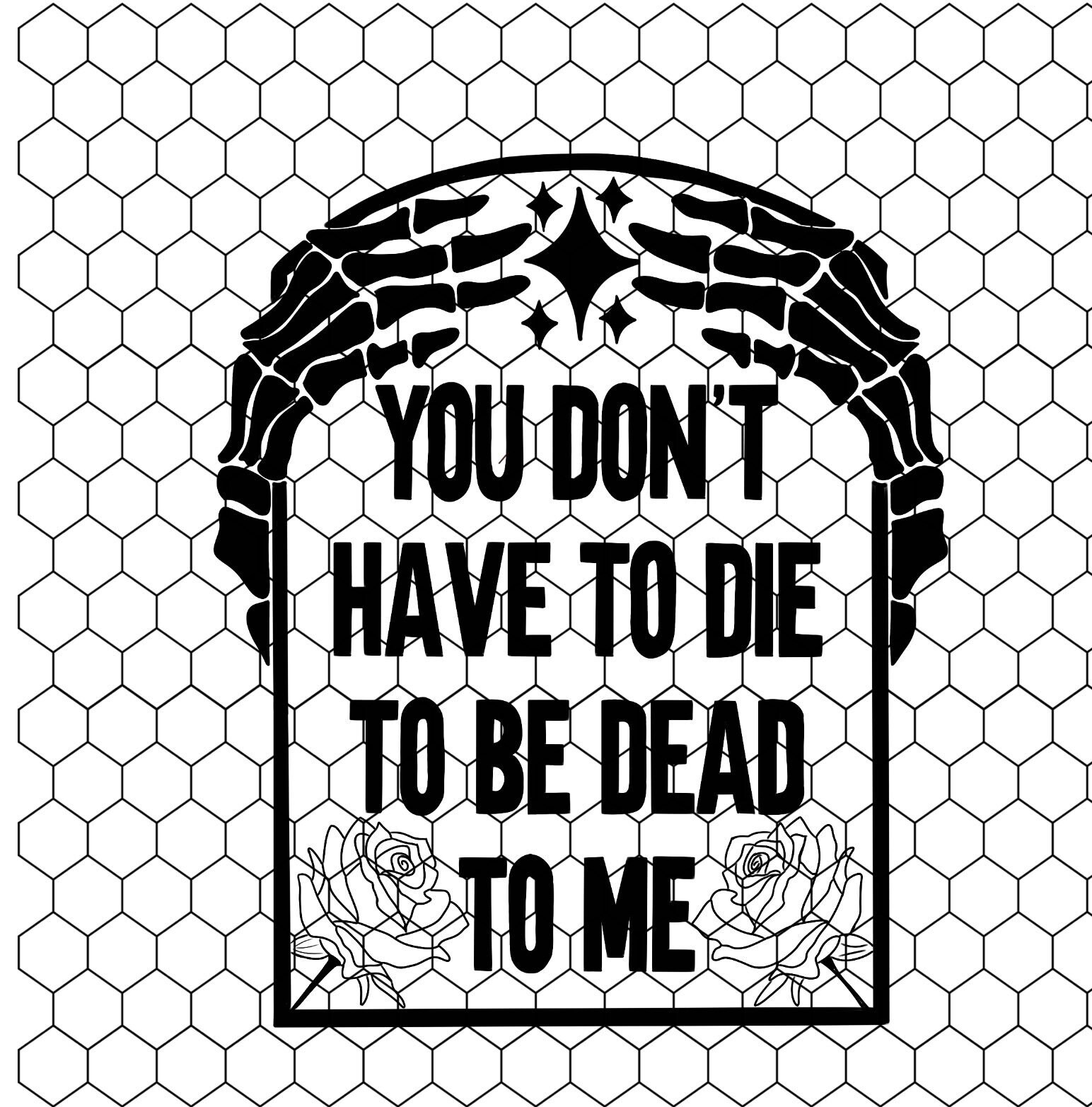
Death is usually a matter of biology, but social death? That’s an entirely different beast. You’ve probably heard the phrase you dont have to die to be dead to me tossed around in movies or vent-sessions with friends, but when you actually live it, the weight is immense. It’s not just a dramatic line; it’s a survival mechanism. It is the definitive end of a relationship where the person is still walking, breathing, and posting on Instagram, but as far as your life is concerned, they have ceased to exist.
Grief is weird when the person is still alive.
When someone passes away, society gives you a script. There are flowers, casseroles, and a funeral. But when you decide that someone is "dead" to you because of betrayal, abuse, or a fundamental break in trust, there is no ceremony. There is only the silence of a blocked number. This phenomenon is often rooted in what psychologists call ambiguous loss. You are mourning someone who is still physically present in the world but emotionally absent from your reality.
The Psychological Mechanics of Cutting Someone Off
Why do we do it? It sounds harsh. It sounds cold. Honestly, it’s usually the last resort of a person who has been pushed to the absolute brink. Dr. Ramani Durvasula, a clinical psychologist who specializes in narcissistic abuse, often discusses the necessity of "Going No Contact." It’s not about punishment. It’s about protection.
When you reach the point where you say you dont have to die to be dead to me, you are essentially performing a radical act of self-preservation. You’ve realized that as long as the door is cracked open, even an inch, the draft is going to keep chilling the entire house.
The brain handles this transition poorly at first. Our neural pathways are literally wired for attachment. When we sever a tie with a parent, a sibling, or a long-term partner, the brain’s "social pain" centers light up in the same way they do for physical injury. You are hurting. It’s a literal ache. But over time, the "ghosting" of a toxic person becomes the only way to let the nervous system settle.
Why Forgiveness Isn't Always the Answer
We live in a culture obsessed with "closure" and "forgiveness." People love to tell you that "life is too short to be angry" or that "family is family."
That’s often bad advice.
Toxic relationships don’t always deserve a second chance, and they certainly don’t require your proximity. You can forgive someone for your own peace of mind while still keeping them permanently "dead" to your daily life. This is the nuance people miss. Making someone "dead to you" is a boundary, not a grudge. It’s a realization that their presence in your life is a net negative that you can no longer afford to pay for.
The Social Cost of the "Living Ghost"
There is a specific kind of awkwardness that comes with this. Imagine you’re at a wedding. You see your "dead" person across the room. They are laughing, eating cake, and talking to your cousins. Your heart rate spikes. This is the reality of you dont have to die to be dead to me in the digital and social age. You can’t always escape the orbit, even if you’ve left the planet.
This is where "Grey Rocking" comes in if you can’t fully go no contact. You become as boring and unreactive as a grey rock. You don't give them information. You don't give them emotion. You treat them with the same level of interest you’d give a stranger at a bus stop.
But for those who can truly walk away, the silence is a gift.
- The Phone Check: You stop bracing yourself every time you get a text.
- The Narrative Shift: You stop trying to explain your side because you realize they aren't listening anyway.
- The New Normal: Your holidays might look different, maybe smaller, but they are significantly quieter.
The Stages of Social Mourning
It’s not an overnight switch. You don't just wake up and decide someone is gone. It’s a slow erosion.
First, there is the Anger Stage. This is where the phrase you dont have to die to be dead to me usually gets shouted. You’re fueled by the injustice of what they did. You want them to feel the weight of your absence.
Then comes The Relapse. You check their Facebook. You ask a mutual friend how they are doing. You wonder if maybe you were too harsh. This is the most dangerous part because it’s where most people get sucked back into the cycle of dysfunction.
Finally, you hit Apathy. This is the goal. Apathy is the true "dead to me" state. You don’t hate them anymore. You don’t want revenge. You just... don’t care. Their name comes up in conversation and it feels like hearing about a character in a book you read ten years ago. They are a ghost in a living body.
The Role of Digital Boundaries
In 2026, you can't talk about social death without talking about the "Block" button. It is the most powerful tool in your emotional arsenal.
Some people think blocking is "immature." They are wrong. If seeing a specific person’s face pop up in your feed sends you into a tailspin of anxiety, blocking them is a medical necessity for your mental health. It’s not about being petty; it’s about curate-ing a digital environment that doesn't trigger your trauma.
When someone is "dead" to you, their digital footprint shouldn't be allowed to step on your toes. This includes:
- Blocking on all socials: No "lurking" on burner accounts.
- Muting mutual friends: If your aunt keeps posting photos of your estranged father, mute her.
- Deleting old threads: Those "good memory" texts are landmines. Clear the field.
When the "Dead" Person Tries to Return
This is the hardest part. Eventually, the person you cut off will likely try to "hoover" you back in. They might send a "thinking of you" text or have a medical emergency.
The phrase you dont have to die to be dead to me is tested in these moments. You have to decide if the "death" was permanent or a temporary exile. Most experts in high-conflict personalities suggest that unless there has been significant, long-term, therapy-backed change, the "resurrection" of the relationship will just lead to the same old patterns.
Realize that you are allowed to stay gone. You are allowed to protect the version of yourself that finally found peace.
Practical Steps for Moving Forward
If you are currently navigating the fallout of making someone "dead" to you, here is how you actually survive it.
Build your chosen family. If you’ve cut off biological family, the "void" can feel massive. You need to intentionally fill those roles with friends and mentors who provide the stability the other person couldn't.
Stop the post-mortem. Don't spend hours analyzing why they did what they did. You wouldn't perform an autopsy on a ghost. Accept that the "why" doesn't matter as much as the "what"—and what happened was enough to make you leave.
Lean into the "Missing." It is okay to miss the person they were supposed to be. You can mourn the "idea" of a sister while still keeping the real sister "dead" to you. Those two things can exist at the same time.
Update your emergency contacts. This sounds small, but it’s a huge psychological step. Make sure your HR department, your doctor, and your "In Case of Emergency" list on your phone reflect your new reality. Nothing resets progress like a hospital calling the person you’ve spent three years trying to forget.
Ultimately, declaring that you dont have to die to be dead to me is an admission of your own value. It's saying that your peace of mind is more important than a toxic connection. It is the hardest "funeral" you will ever attend, but the life you lead afterward is finally yours.
Focus on the living—the people who actually show up, the friends who respect your boundaries, and the version of yourself that is finally free from the weight of someone else's chaos.