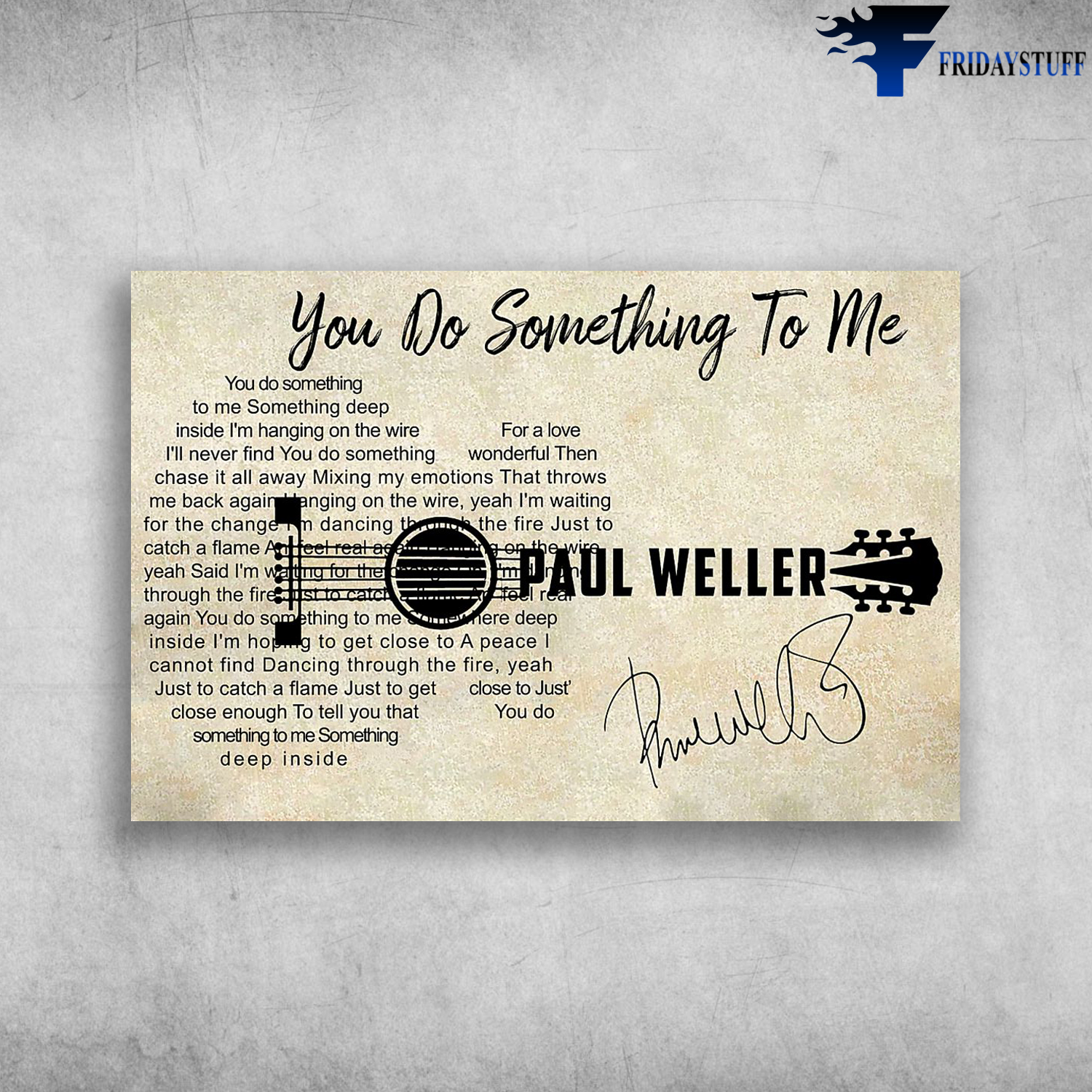
It happens at almost every British wedding. The cake has been cut, the champagne is starting to warm up, and the DJ puts on that familiar, soulful guitar lick. Couples drift to the dance floor, swaying to Paul Weller’s gravelly, vulnerable croon. It feels like the ultimate romantic anthem. But honestly? If you listen to the lyrics, You Do Something To Me is kind of a devastating track.
Released in July 1995, the song was the third single from the landmark album Stanley Road. By that point, Weller was no longer just the "Modfather" or the guy from The Jam; he was the undisputed king of a new, soulful British rock. The song shot to number nine on the UK Singles Chart. It stayed there for weeks, cementing itself in the national psyche.
Yet, there is a massive gap between how we use the song and what Paul Weller actually wrote.
The Meaning Behind You Do Something To Me
People call it a "song for lovers." Weller himself has admitted in interviews that he’s constantly told it was someone’s first dance at their wedding. The irony isn't lost on him. In reality, the song is about unattainable love. It’s not about being with the person you want; it’s about the obsessive, sometimes painful feeling of chasing someone who isn't really there or isn't yours to have.
"I'm told by so many people they had it played at their wedding," Weller noted in a retrospective. "But it's really about unattainable love. You can interpret it whichever way you want, though."
That’s the beauty of his songwriting. He gives you these lush, soulful arrangements—produced alongside Brendan Lynch—that feel like a warm hug, while the lyrics are "dancing through the fire" and "catching a flame." It’s a song about desire that burns rather than provides warmth.
Why Stanley Road Changed Everything
To understand why this track hit so hard, you have to look at where Weller was in 1995. The Style Council years had ended with a bit of a whimper, and his 1992 self-titled solo debut was good, but it didn't set the world on fire. Then came Wild Wood, which was a masterpiece, but Stanley Road was the commercial juggernaut.
The album was named after the street where he grew up in Woking. It was deeply personal. It had Peter Blake—the guy who did the Beatles’ Sgt. Pepper—designing the cover. Everything about it screamed "English classic." You Do Something To Me was the emotional heart of that record.
Musically, it’s a masterclass in restraint.
- Steve White on drums (his long-time collaborator).
- Yolanda Charles holding down a thick, soulful bassline.
- Weller himself on guitar and piano, providing those iconic, bluesy textures.
It doesn't overstay its welcome. It clocks in at just over three and a half minutes. Short. Sharp. To the point.
Breaking Down the Lyrics
The opening line is a killer: "You do something to me / Something that moves me."
It’s simple. Almost too simple. But the weight is in the delivery. When he sings about being "out of my mind," he isn't talking about being "crazy in love" in the Hallmark sense. He’s talking about the disorientation of being hooked on someone.
There’s a line about being "caught in a web." That's not exactly romantic, is it? It’s a song about being trapped by an emotion. If you look at the bridge, he talks about walking on "hollow ground." It’s the sound of a man who knows he’s on shaky territory.
The Critics vs. The Fans
It’s funny to look back at the reviews from 1995. Music critics in the 90s could be notoriously brutal. NME’s Johnny Dee basically called it "the very essence of dullness" and compared it to Chris De Burgh. Smash Hits gave it a one-out-of-five.
They were totally wrong.
The fans didn't care about the "guitar noodles" or the "rock of ages arrangement." They heard the soul. They heard a guy in his late 30s finally finding a voice that resonated with people who had grown up with him. It wasn't about being a punk anymore; it was about the complexities of adult life and the messy feelings that come with it.
Real-World Impact and Legacy
The song has lived a massive life outside of the charts. Beyond the wedding circuit, it has appeared in countless TV shows and films. There’s actually a long-running "tip of my tongue" mystery online about a 90s ITV drama featuring the song. It turns out it was a show called Thief Takers, in an episode titled "The Outcasts." The song was used to underscore a tragic storyline about two teenagers on the run.
It also has a huge life in the cover world.
- Skunk Anansie did an acoustic version that is surprisingly tender.
- Heather Small covered it in 2022.
- The Moon Loungers and various string quartets have made it a staple of their repertoires.
Even in 2026, the song continues to find new audiences. It’s a staple of Weller’s live sets, often played as a mid-set breather or a big encore closer at places like the Royal Albert Hall or Glastonbury.
Actionable Insights for Music Fans
If you're revisiting this track or discovering it for the first time, try these three things to get the full "Weller" experience:
- Listen to the "Days of Speed" version: This is a live, acoustic take from 2001. Without the full band, the "unattainable love" theme feels even more raw. You can hear the crack in his voice.
- Check the B-sides: The original CD single included a cover of William Bell’s "My Whole World Is Falling Down." It shows exactly where Weller’s head was at—deep in the Stax and Motown archives.
- Watch the video: Directed by Sonja Phillips, it’s a moody, atmospheric piece that captures that mid-90s British aesthetic perfectly.
The next time you hear those opening chords, don't just think about weddings. Think about the "Modfather" sitting in a studio in Oxfordshire, trying to capture the feeling of a fire you can't quite put out. That's what makes it a classic.
To really appreciate the depth of this era, you should also dive into the rest of the Stanley Road album, specifically tracks like "Broken Stones" and "The Changingman," which offer a broader look at Weller's mid-90s creative peak.



