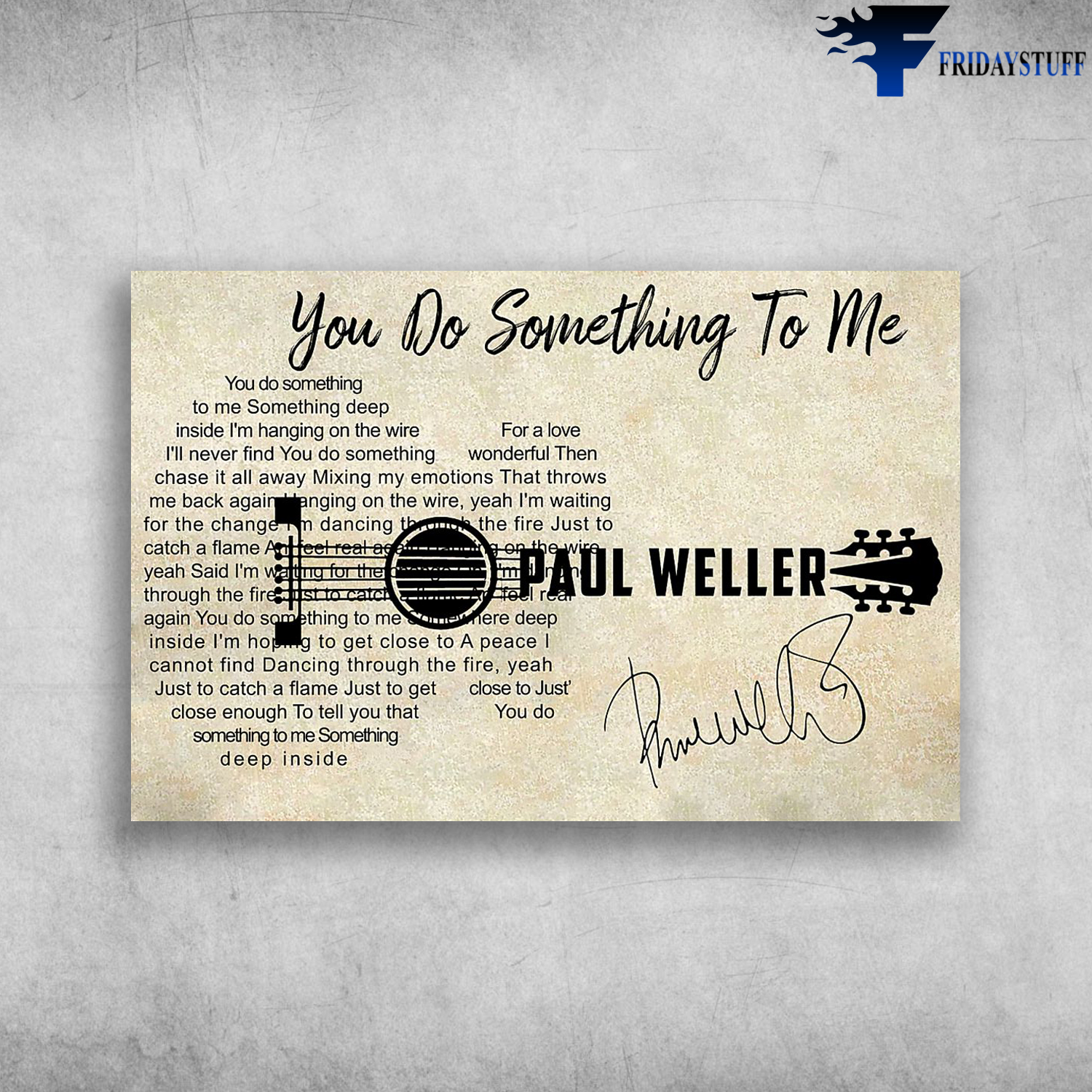
If you’ve ever been to a wedding in the UK or Ireland, there is a roughly 90% chance you’ve seen a slightly tipsy couple swaying to this track. It’s the ultimate "first dance" song. It feels warm. It feels like a hug in a rainy Manchester alleyway. But honestly? If you actually listen to the lyrics, it is one of the most depressing choices for a marriage celebration you could possibly make.
Paul Weller has basically admitted as much.
The Modfather has spent decades dodging the "nostalgia" trap, yet You Do Something To Me remains the gravitational center of his solo career. Released in July 1995 as the third single from the seminal Stanley Road album, it didn’t just chart—it defined an era. It reached number nine on the UK Singles Chart, but its cultural footprint is way bigger than a top-ten spot. It’s the song that turned the former frontman of The Jam and The Style Council from a "legacy act" into the undisputed king of 90s British rock.
The Unattainable Love at the Center of the Flame
Here is the thing most people get wrong. They hear "You do something wonderful / Chase it all away" and they think it’s a sweet tribute to a soulmate. It’s not. Weller has gone on record multiple times saying the song is actually about unattainable love.
Think about that for a second.
When he sings about "hanging on the wire" and "waiting for my change," he’s not describing a happy relationship. He’s describing the torture of wanting something you can’t have. He’s "dancing through the fire just to catch a flame" only to realize the flame won't stay. It’s a song about obsession and the psychological "hook" someone can have over you, even when the situation is hopeless.
"It definitely strikes a chord in people's hearts... Ironically, it's really about unattainable love. But you can interpret it whichever way you want." — Paul Weller
That’s the beauty of great songwriting, I guess. You can take a song about a devastating emotional void and turn it into a soundtrack for cutting your wedding cake.
Why Stanley Road Changed Everything
To understand why You Do Something To Me hit so hard, you have to look at where Paul Weller was in 1995. The early 90s weren't kind to him. The Style Council had ended on a weird note (the label literally refused to release their house-influenced final album), and he was suddenly without a record deal.
He had to start over.
By the time Stanley Road arrived, Weller had found his "Blue-Eyed Soul" groove. He stopped trying to be avant-garde and started writing from the gut. The album featured heavyweight contributors like Steve Winwood and Noel Gallagher, but You Do Something To Me was the track that proved Weller could out-write the Britpop kids at their own game.
The arrangement is deceptively simple. You’ve got that haunting piano riff, the soulful guitar solo (often handled live by the brilliant Steve Cradock), and a vocal performance that sounds like a man who hasn't slept in three days. It’s "balmy," as some critics called it at the time, but it has an edge.
The Players Behind the Sound
The mid-90s "Weller Band" was a powerhouse.
- Steve White: The man on the drums. He’s been Weller’s rhythmic backbone for years and brings a jazz-inflected precision that keeps the ballad from becoming too "schmaltzy."
- Brendan Lynch: The producer. He helped Weller find that specific 90s-meets-60s-soul sound that felt both vintage and immediate.
- Carleen Anderson: Her backing vocals on the album provided that gospel-tinged depth that made the whole project feel spiritual.
The Music Video and the "Smoky" Aesthetic
If you close your eyes and think of the song, you probably see blue smoke and a moody Paul Weller staring into a camera. The video, directed by Sonja Phillips, is the definition of "90s cool." It’s minimalist. It doesn’t try too-hard.
It matches the song’s vibe of being stuck in a moment. Weller looks every bit the "Modfather"—crisp hair, sharp clothes, and an expression that suggests he’s carrying the weight of the world. There’s something about the way it was shot that makes it feel like a private performance in a basement club at 2:00 AM.
Why It Still Matters in 2026
It’s easy to dismiss 90s rock as "Dad Rock" now. People do it all the time. But You Do Something To Me survives because it isn't tied to a specific fad. It doesn't have the loud-quiet-loud distortion of Grunge or the "lads on tour" bravado of lesser Britpop bands.
It’s a soul record.
Soul music is timeless. Whether it's 1965, 1995, or 2026, the feeling of being completely undone by another person is universal. Musicians are still obsessed with it. In 2019, the soul singer Celeste teamed up with Weller for a stripped-back version that proved the song’s bones are indestructible. It didn't need the big 90s production; it just needed the melody.
Common Misconceptions and Trivia
Let’s clear up a few things that tend to get muddled in the comments sections of YouTube:
- Is it about his ex-wife Dee C. Lee? People love to speculate. While Weller’s personal life often bleeds into his lyrics, he has generally kept the specific inspiration for this one close to his chest, preferring the "unattainable" label.
- The "Chris De Burgh" insult: When the song came out, NME critic Johnny Dee famously mocked it, saying you might as well buy Chris De Burgh records if you liked this. It was a classic 90s music-press "hit piece." Time has clearly shown who won that argument.
- Chart Longevity: While it "only" hit #9, it stayed in the charts for weeks and has since become one of his most-streamed tracks, often outperforming The Jam’s biggest hits on digital platforms.
How to Actually Appreciate the Song Today
If you want to get the full effect of You Do Something To Me, stop listening to it on tiny phone speakers.
Go find a copy of Stanley Road on vinyl. Put on a good pair of headphones. Listen to the way the piano and guitar interact during the bridge. Notice the slight grit in Weller’s voice when he hits the word "fire." It’s a masterclass in restrained emotion.
Actionable Insights for Fans:
- Check out the Live Versions: Weller often reinvents his songs live. Look for the Days of Speed (2001) acoustic version if you want to hear the "raw" heartbreak of the lyrics.
- Explore the "Sister" Tracks: If this song is your gateway, listen to Broken Stones and Wings of Speed. They occupy the same emotional space on the Stanley Road album.
- Study the Solo: For guitarists, the solo in this song is a lesson in "playing for the song." It isn't flashy; it’s melodic and follows the vocal line, which is why it sticks in your head.
At the end of the day, whether you think it’s a romantic masterpiece or a dark tale of unrequited obsession, there is no denying the craft. Paul Weller took a simple feeling and turned it into a permanent part of the British songbook. Just maybe... think twice before playing it at your next wedding. Or don't. Sometimes dancing through the fire is exactly what a party needs.



