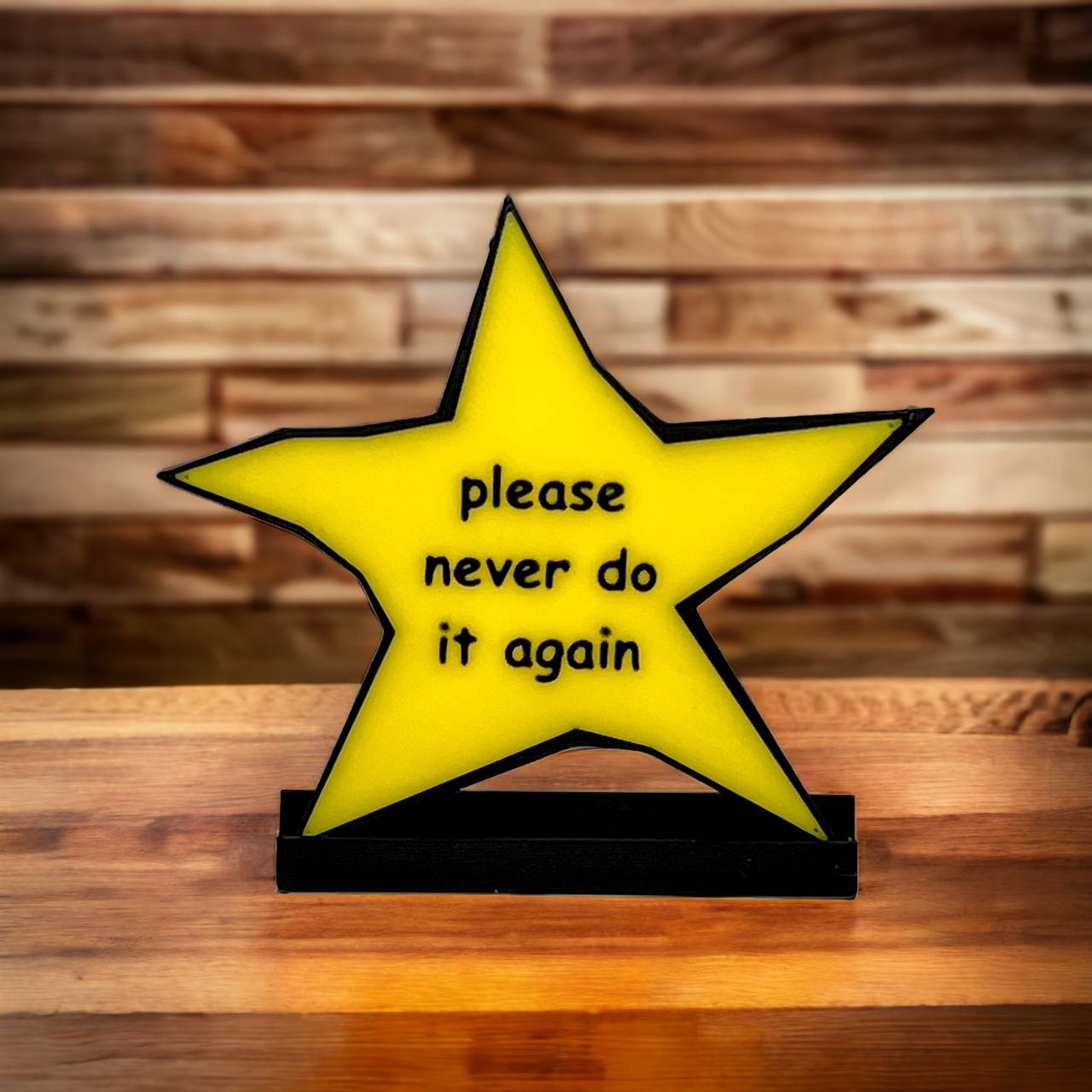
We all remember the smell of a damp elementary school hallway. The squeak of sneakers. That specific, paralyzing anxiety of handing over a spelling test covered in eraser marks and graphite smudges. Then, you got it back. Right there in the top corner, usually slightly crooked, was a shiny gold or neon red circle with a smiling face or a bold font that screamed: You Did It! It wasn't just a piece of adhesive paper. It was validation. It was the "You Did It" star, and honestly, it’s probably the reason half of us are still obsessed with external validation today.
Psychology is a funny thing. You can give a kid a lecture on the intrinsic value of education, and they will stare at you with blank eyes. But hand them a You Did It star, and suddenly they’re ready to climb Everest. Or at least finish their long division.
The Weird Science of Positive Reinforcement
Behaviorism isn't just for lab rats. B.F. Skinner, the father of operant conditioning, basically mapped out our entire childhood through his research on rewards. When a teacher slaps a You Did It star on a worksheet, they are engaging in a "token economy." It’s a simple trade. You provide the labor (correctly identifying state capitals), and the "boss" provides a currency that represents success.
It works because of dopamine. Even as adults, our brains are wired to crave that little hit of "good job." It’s why we feel a tiny spark of joy when we see a green checkmark on a task manager or a "Close Your Rings" notification on an Apple Watch. We haven't outgrown the star; we’ve just digitized it.
The effectiveness of these stickers actually peaked in the late 80s and 90s during the height of the "Self-Esteem Movement." Educators, influenced by people like Nathaniel Branden, believed that fostering a child's sense of worth was the key to academic success. Critics later argued this led to "trophy inflation," where the You Did It star started to lose its punch because everyone got one regardless of effort.
It’s Not Just for Kids Anymore
There is a massive trend on TikTok and Instagram right now called "Adulting Stickers." You can literally buy packs of stickers that say things like "I washed the dishes" or "I didn't spend money today."
It sounds silly. It is silly. But it’s also a very real coping mechanism for burnout. When the world feels like it’s falling apart, getting a You Did It star for simply making a dentist appointment feels like a win. It’s a way to reclaim that childhood feeling of "I am doing okay."
Think about the fitness industry. Strava gives you "Local Legend" trophies. Peloton gives you "milestone" badges. These are just high-tech versions of the You Did It star. We are creatures that need to be told we are moving in the right direction. Without that feedback loop, it’s easy to feel like we’re just shouting into a void.
Why the Design Matters (And Why We Remember It)
Usually, the classic star featured a very specific aesthetic. It wasn't high art. It was usually a Five-Pointed Star, often yellow or gold, with a thick black outline. Sometimes it had a "smiley face" with two dots and a curve.
There’s a reason for that simplicity.
Iconography needs to be processed instantly. In a busy classroom, a child needs to see that sticker from across the room and know exactly what it means. It’s a universal symbol of completion. If you look at the history of the You Did It star, it shares a lot of DNA with military medals and heraldry. We’ve been using star shapes to denote rank and achievement for centuries.
But there’s a dark side to the star, too.
Alfie Kohn, a famous critic of reward-based education, argues in his book Punished by Rewards that things like the You Did It star can actually kill creativity. He suggests that when we focus on the "prize," we stop caring about the task itself. You don't learn the math because math is cool; you learn the math to get the sticker. Once the stickers stop coming—which they do once you hit high school or college—a lot of students hit a wall. They don't know how to motivate themselves without a shiny gold circle.
How to Use "Star Power" Without Ruining Your Motivation
If you want to use the You Did It star philosophy in your adult life without becoming a dopamine addict, you have to be smart about it.
First, use them for the "boring" stuff, not the "creative" stuff. Research shows that rewards work great for algorithmic tasks (like cleaning the garage or filing taxes) but can actually hurt heuristic tasks (like writing a poem or solving a complex business problem).
Second, make them "intermittent." If you give yourself a reward every single time you do something, the reward loses its value. This is called a "variable ratio schedule." It’s why gambling is so addictive—you don't know when the win is coming.
- Audit your "wins": Take a literal look at your to-do list. If it’s all "must-dos" and no "done-its," you’re going to burn out.
- Create a physical visual: Even if it’s just a checkmark in a notebook, make it bold. Make it visible.
- Acknowledge the effort, not just the result: If you worked hard on a project but it failed, give yourself a "You Tried" star. It sounds like a joke, but acknowledging the labor is what keeps you going for the next round.
The You Did It star isn't just a relic of second grade. It’s a tool. It’s a tiny, sticky reminder that you are capable of finishing what you start. In a world that constantly demands more, sometimes you just need to stop, look at what you’ve accomplished, and give yourself the damn star.
To implement this effectively today, start by identifying one "grind" task you’ve been avoiding. Set a timer for 25 minutes. When that timer goes off, regardless of how much you finished, find a way to visually mark that progress. Use a highlighter, a sticker, or a digital badge. The key is to link the completion of the effort to a visual "win" signal. This restarts the dopamine loop and lowers the barrier to entry for the next session.



