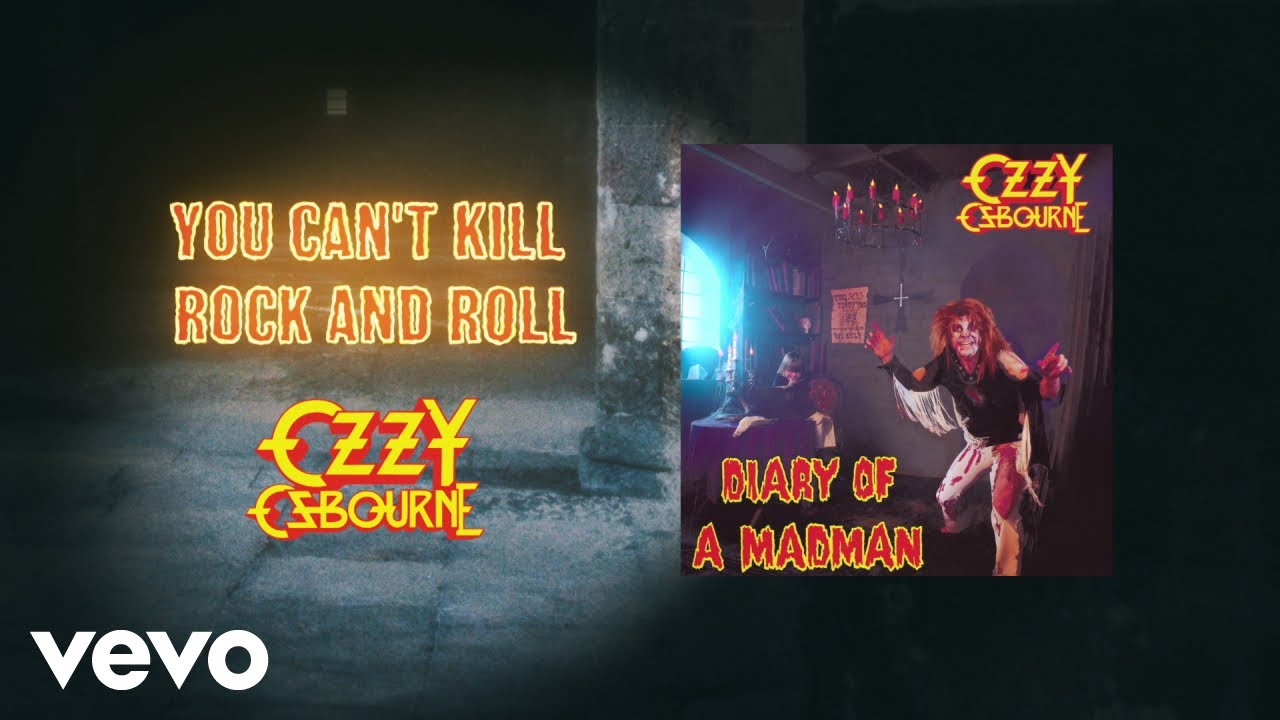
Honestly, if you were to look at Ozzy Osbourne in 1981, you wouldn’t have bet on him being the guy to deliver a philosophical treatise on the endurance of a genre. He was messy. He was mourning the loss of his career in Black Sabbath. He was, by his own admission, a "dyslexic rock 'n' roller" who was mostly famous for doing things that would get anyone else arrested or institutionalized.
But then came Diary of a Madman.
Deep in that tracklist, tucked away between the frantic "Flying High Again" and the sinister "Believer," sits You Can't Kill Rock and Roll. It’s nearly seven minutes long. It’s a power ballad that refuses to stay a ballad. It’s also one of the most honest things Ozzy ever put on tape.
The Song Born from a Media War
You’ve gotta understand the vibe of the early '80s. The "Satanic Panic" wasn't just a catchy phrase back then; it was a real, lived experience for people like Ozzy. Every time a kid got into trouble, the media pointed a finger at the guy with the cross necklace and the eerie vocals.
Ozzy was tired. Basically, he was being hounded by journalists who accused him of everything from devil worship to corrupting the youth. You Can't Kill Rock and Roll was his middle finger to those "empty heads."
The lyrics, largely penned by bassist Bob Daisley but rooted in Ozzy’s own frustrations, take aim at the people who "don’t really know even what they’re talking about." It’s a song about the industry, sure, but it’s mostly about the refusal to let outsiders define who you are. Ozzy calls rock 'n' roll his "religion and his law." That’s not just a cool line—it was a survival strategy.
The Randy Rhoads Magic
You can't talk about this track without talking about Randy Rhoads. If Ozzy provided the soul and the grit, Randy provided the architecture.
The intro is this delicate, neo-classical acoustic piece that feels almost like a prayer. It’s beautiful. Then, the drums kick in, and Randy shifts into these searing, melodic riffs that remind you why he’s still a "guitar god" decades after that tragic plane crash in 1982.
Randy’s guitar work on this track is a masterclass in tension. He’s not just shredding for the sake of it. He’s building a wall. It’s like he’s sonically reinforcing Ozzy’s claim that this music—and this lifestyle—is indestructible.
Why Nobody Talks About the 2002 Controversy
There’s a weird bit of history here that kida gets glossed over. If you bought the 2002 reissue of Diary of a Madman, you weren't actually hearing the original song.
Because of a massive legal dispute over royalties and credits with Bob Daisley and drummer Lee Kerslake, Sharon Osbourne made the executive decision to have the bass and drum tracks re-recorded. She hired Robert Trujillo and Mike Bordin to play over the original master tapes.
Fans hated it. It felt like a betrayal of the original chemistry. It took until 2011 for the original recordings to be restored. It’s ironic, really. A song titled You Can't Kill Rock and Roll almost had its original heartbeat scrubbed out by a lawyer’s pen.
The Lyrics: A "Lone Man Against the World"
Looking back at the verses, they’re surprisingly vulnerable.
- "Tears fill my eyes when I hear all the cries for the reason today."
- "King of a thousand knights, pawn in a table fight losing to you."
It’s about the feeling of being used by an industry that wants the "glory" but doesn't want the person. Ozzy was feeling like a pawn. He was the one on stage, but the "empty heads" in the offices were the ones making the promises.
What Most People Get Wrong
A lot of people think this song is just a generic "rock is cool" anthem. It’s not. It’s actually quite dark.
It’s a song about rejection and the fear of it. "Fear of rejection, I need their protection, I'm making a stand." Ozzy is admitting that he needs the audience, but he doesn't need the critics.
Most fans also don't realize that despite being an absolute fan favorite, the song was almost never played live. There are some disputed setlists from 1981, but for the most part, the complexity of the overdubs made it a nightmare to pull off on stage without a third guitar player. It remains a "studio masterpiece" that lives in the headphones of die-hard fans rather than the pyrotechnics of a stadium tour.
The Lasting Legacy of the Prince of Darkness
So, why does this track still show up on every "essential Ozzy" list?
Maybe it’s because it feels like a prophecy. Since 1981, people have claimed rock is dead at least a hundred times. Grunge was supposed to kill it. Nu-metal was supposed to kill it. Streaming was supposed to kill it.
Yet, here we are. Ozzy is still the Prince of Darkness. Randy’s riffs are still being studied in music schools. And that chorus still feels like a rallying cry for anyone who’s ever felt misunderstood.
Actionable Insights for the Modern Listener
If you want to truly appreciate the depth of You Can't Kill Rock and Roll, here is how to dive in properly:
- Listen to the 2011 Remaster: Avoid the 2002 version. You need to hear Bob Daisley’s original bass lines to get the "swing" of the song.
- Focus on the Outro: The last two minutes of the song are a masterclass in building a "wall of sound." Notice how Rhoads layers the guitars to create a feeling of inevitability.
- Read the Lyrics as a Letter: View the song not as a performance, but as a direct letter from Ozzy to the British tabloids of the 1980s. It changes the entire emotional weight of the vocal delivery.
- Compare to "Suicide Solution": Listen to both tracks back-to-back. One is about the self-destruction of the lifestyle, while the other is about the salvation found in the music. It’s the duality of the Madman himself.
The song isn't just a title; it's a statement of fact. You can sue the band, you can fire the members, and you can bury the history in legal paperwork, but the music stays. It's here to stay.



