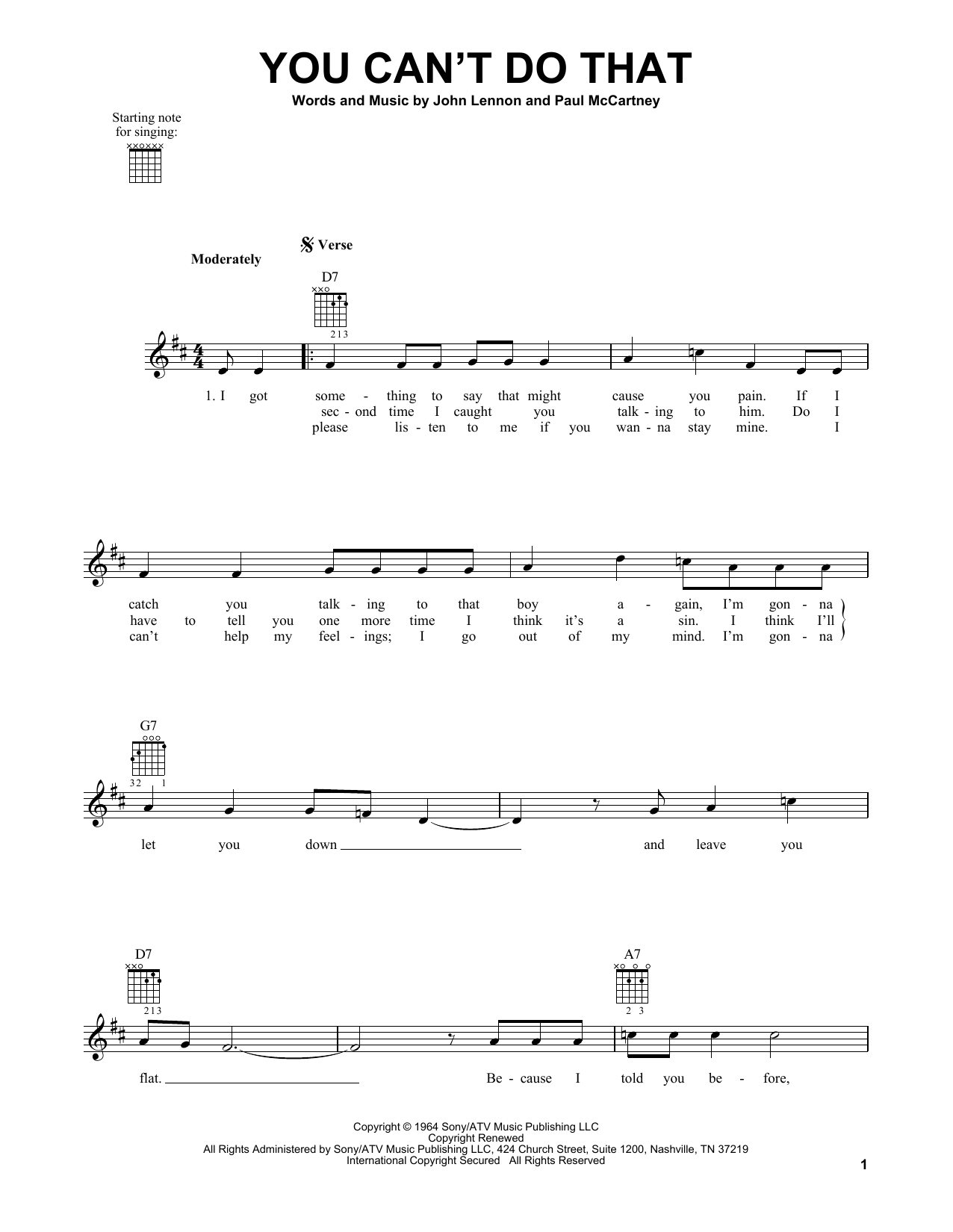
John Lennon was pissed off. It was early 1964, and the Beatles were essentially living in a hurricane of their own making. They were in Paris, staying at the George V hotel, trying to write hits for a movie they hadn't even started filming yet. While everyone remembers "Can't Buy Me Love" as the shiny, upbeat anthem of that era, the song on the flip side—the snarling, cowbell-heavy You Can't Do That—tells a much darker story about where the band was actually at emotionally.
It’s a song about jealousy. Pure, green-eyed, irrational jealousy. If you found value in this post, you might want to check out: this related article.
Most people skip over the B-sides when they talk about the British Invasion, but if you want to understand the transition from "mop-top" pop to the gritty rock that defined the late sixties, you have to start here. This isn't a "please please me" kind of vibe. It’s a threat. Lennon isn't asking for love; he’s demanding compliance.
The Rickenbacker Jangle and the Birth of a Sound
You know that sound. That specific, piercing, twelve-string ring that basically invented the Byrds and half of the 1990s indie-rock scene? It starts right here. George Harrison had just gotten his hands on the Rickenbacker 360/12, and he uses it to anchor You Can't Do That with a riff that feels heavy even though it’s played on a guitar that sounds like falling glass. For another look on this development, refer to the recent update from E! News.
Lennon took the lead guitar part himself. That’s a rarity. Usually, George handled the heavy lifting, but John wanted this one to hurt. He plays the solo with a frantic, staccato aggression that George probably wouldn't have bothered with. It’s messy. It’s loud. It’s perfect.
The song was recorded on February 25, 1964, at Abbey Road’s Studio Two. Interestingly, they nailed it in nine takes. They were a well-oiled machine by this point, but there’s a tension in the recording that feels like it could fly off the rails at any second. Paul McCartney’s bass line is uncharacteristically bluesy, and Ringo Starr is absolutely punishing that cowbell. Seriously, the cowbell in You Can't Do That is the unsung hero of the track. It provides this relentless, driving pulse that makes the song feel more like a workout than a pop tune.
The Lyrics: A Problematic Time Capsule?
Let’s be real for a second. If you wrote these lyrics today, you’d get dragged on social media within thirty seconds. "I'm gonna let you down and leave you flat / Because I told you before, oh, you can't do that." John is literally singing about dumping a girl because he saw her talking to another guy.
It’s possessive. It’s insecure.
But that’s why it’s a great record. It’s honest about a very ugly human emotion. Lennon was never one to hide his flaws behind a "Love Me Do" veneer for long. He was a complicated, often angry young man, and You Can't Do That is the first real glimpse the public got of that "Lennon edge." He’s not playing the hero; he’s playing the guy who’s about to have a meltdown in the middle of a ballroom.
Wilson Pickett eventually covered it. Think about that. A soul legend recognized the inherent grit in this song. It has a rhythm and blues DNA that most of their earlier work lacked. It’s a bridge between the 1950s Chuck Berry influence and the psychological songwriting that would eventually lead to Rubber Soul.
Why it got buried by Can't Buy Me Love
The Beatles were in a weird spot. They had to choose which song would be the A-side of their next big single. "Can't Buy Me Love" was the obvious choice because it was catchy, safe, and screamed "Number One Hit." You Can't Do That was its surly younger brother.
Even the filming for A Hard Day's Night reflected this hierarchy. The band filmed a performance of the song for the movie’s concert finale, but it ended up on the cutting room floor. If you watch the film today, you’ll notice they jump straight from one hit to another, but the live footage of this specific track exists in the archives. It shows John leaning into the microphone with a look of genuine intensity, while Paul and George provide those soaring, "oooh" harmonies that contrast so sharply with the biting lead vocal.
The Technical Brilliance of the "Weak" Beat
If you listen closely to the drums, Ringo is doing something tricky. He’s accentuating the backbeat in a way that feels almost "behind" the guitar. It gives the song a swagger. It’s not just a straight four-on-the-floor beat.
The vocal arrangement is also a masterclass in tension and release.
- Lennon sings the verse solo, sounding isolated and angry.
- The harmonies kick in during the bridge ("Everybody's greeeeen...").
- The resolution returns to that singular, lonely threat.
Critics often point to the influence of Bobby Parker’s "Watch Your Step" on the riff. Lennon was a huge fan of that record. He basically took the DNA of an American R&B track and filtered it through the gray, rainy lens of Liverpool. The result was something that sounded American but felt entirely British.
What Most People Get Wrong About the Recording
There’s a common myth that the Beatles hated their B-sides or saw them as "throwaway" tracks. That’s nonsense. During the mid-sixties, the B-side was where they experimented. It was where they could be "too loud" or "too mean" for radio.
In the case of You Can't Do That, they were actually incredibly proud of it. It was a staple of their live set throughout 1964, including their massive North American tour. They played it at the Hollywood Bowl. They played it on the Ed Sullivan Show. They knew it had a groove that "Can't Buy Me Love" lacked.
How to Listen to It Today
If you want to truly appreciate the song, don't just listen to the standard stereo mix on Spotify. The stereo separation in 1964 was notoriously weird, with the instruments shoved into one ear and the vocals into the other.
Seek out the Mono mix.
In mono, the song hits like a punch to the gut. The Rickenbacker, the bass, and the drums blend into a single wall of sound that supports Lennon’s vocal rather than distracting from it. You can hear the distortion on the guitar more clearly. You can feel the room.
Actionable Insights for Beatles Fans and Musicians
If you’re a songwriter or a producer, there are three major takeaways from this track that still apply to modern music production:
- The Power of the Counter-Melody: Notice how the backing vocals aren't just mimicking the lead. They are responding to it. This creates a "call and response" dynamic that keeps the listener engaged even when the chord progression is simple.
- Limitation Breeds Creativity: The band only had four tracks to work with. Every sound had to earn its place. If you're overwhelmed by 100+ tracks in your DAW, try stripping a song down to just four essential elements: a driving rhythm, a signature riff, a lead vocal, and one "flavor" instrument (like the cowbell).
- Embrace the Flaws: Lennon’s guitar solo isn't technically perfect. It’s jagged. But it has more personality than a thousand perfectly polished studio solos. Sometimes, the "wrong" note is the right one for the emotion of the song.
You Can't Do That remains a pivot point in the Beatles' discography. It’s the moment the boys from Liverpool stopped trying to please everyone and started expressing the darker, more complex realities of their own lives. It’s not a love song. It’s a warning. And sixty years later, that opening riff still sounds like a challenge.
Next time you put on A Hard Day's Night, don't just wait for the title track. Flip the record—metaphorically or literally—and listen to the sound of a band finding its teeth. Focus on that 12-string Rickenbacker. Listen to the way Lennon pushes his voice until it almost cracks. That is the sound of rock and roll growing up.



