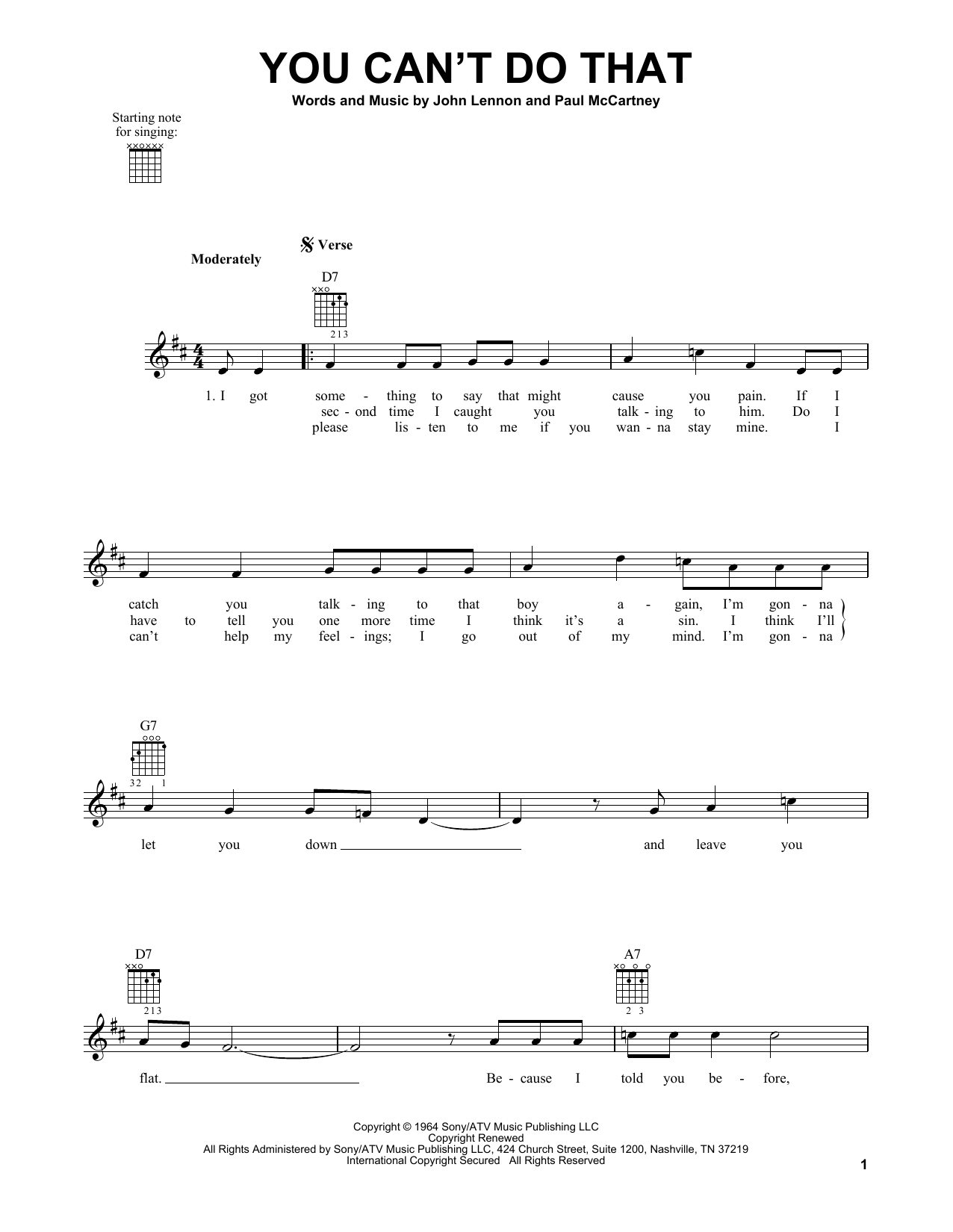
John Lennon was pissed. That’s usually when the best Beatles songs happened. It’s 1964, and the band is caught in the absolute eye of the hurricane of global fame, but back in the studio, Lennon is trying to work through some serious jealousy. That’s how we got You Can't Do That.
Most people think of A Hard Day’s Night as the moment the Beatles became "The Beatles"—the matching suits, the screaming girls, the movie. But if you look at the B-side of "Can't Buy Me Love," you find a track that is way meaner, grittier, and more musically complex than anything they’d done before. It wasn’t just another pop song. It was a warning shot.
The Jealousy Behind the Lyrics
Lennon wasn’t exactly a saint. He knew it, too. You Can't Do That is basically a diary entry about his own possessiveness. He’s telling a girl that if he catches her talking to another guy, he’s out. "I've told you before / Do it no more." It’s blunt. It’s almost uncomfortable if you listen to it today, knowing what we know about John’s personal life and his admitted struggles with a "wicked" temper.
The song captures a specific type of mid-60s tension. It’s not the "I want to hold your hand" innocence. This is "I’m going to embarrass you in front of everyone because my ego is bruised."
Honestly, it’s one of the first times we see the "Cynical John" persona fully take the lead in a song destined for the charts. He isn’t pleading for love here. He’s laying down the law. It’s a power dynamic that felt way more "Rolling Stones" than "Fab Four" at the time.
That Rickenbacker Sound
If you’re a guitar nerd, this song is the Holy Grail. George Harrison had just gotten his hands on a Rickenbacker 360/12—the famous 12-string electric.
While the 12-string defines the "jangle" of A Hard Day’s Night, on You Can't Do That, it provides this heavy, almost ominous drone. It’s thick. It’s sharp. It cuts right through the mix.
What’s wild is that John actually plays the lead guitar solo on this track. George usually handled the tricky stuff, but John wanted a go at it. His solo is jagged and aggressive. It’s not "pretty" by 1964 standards. It’s a series of triplets and staccato notes that sound like he’s actually arguing with the person he’s singing to.
Paul McCartney’s bass line is doing some heavy lifting here, too. Instead of just walking up and down the scales, he’s locking in with Ringo’s cowbell. Yes, the cowbell. It’s the secret sauce of the rhythm track. It gives the song a Latin-adjacent, almost R&B groove that makes it impossible not to nod your head.
Why the B-Side Status Matters
In the UK, "Can't Buy Me Love" was the A-side. It was the smash hit. But in the US, Capitol Records saw the potential in You Can't Do That and gave it its own life.
Back then, the B-side wasn't just "filler." It was a statement of depth. If the A-side was for the radio, the B-side was for the fans who actually bought the vinyl and listened to it on repeat in their bedrooms.
It showed the world that the Beatles weren’t a one-trick pony. They could do the "mop-top" charm, but they could also do the moody, bluesy, aggressive rock and roll that would eventually evolve into Rubber Soul and Revolver.
The Recording Session: February 25, 1964
They nailed it in four takes. Four.
Think about that for a second. Most modern bands spend three days just trying to get the drum snare to sound right. The Beatles walked into Abbey Road on George Harrison’s 21st birthday and knocked out one of the most influential rhythm tracks of the decade before lunch.
They were tight. They had been playing eight hours a night in Hamburg for years, and it showed. There was no "fixing it in the mix" back then. What you hear on the record is the sound of four guys standing in a room, playing loud, and feeling every bit of it.
Wilson Pickett eventually covered it. So did Nilsson. It’s a "songwriter’s song." It has a 12-bar blues structure, but they twist it. They add that minor-key bridge that makes your stomach drop just a little bit. It’s a sophisticated piece of pop architecture disguised as a simple rocker.
What Most People Get Wrong
People often lump this era of The Beatles into one big "Mop Top" bucket. They assume everything before 1966 was just simple love songs.
That’s a mistake.
If you listen closely to the lyrics of You Can't Do That, you’re hearing the beginnings of the psychological complexity that would define the late 60s. This isn't a song about a crush. It’s a song about insecurity. It’s a song about the fear of losing face.
"Everybody's green / 'Cause I'm the one who won your love."
He’s not even talking about the girl there—he’s talking about the other guys looking at him. It’s all about status. It’s incredibly honest, even if the honesty is a bit ugly.
The Visual Impact
The song also featured heavily in the A Hard Day's Night film, specifically during the concert sequence at the end. Even though the song was technically cut from the final theatrical version of the performance scene, the footage survived.
Seeing John snarl those lyrics into a shared microphone with George and Paul is the definitive image of early Beatlemania. They look like they’re having the time of their lives, even though the song is essentially a breakup threat. That’s the magic of the band—the ability to wrap dark themes in infectious melodies.
Why It Still Matters Today
Music changes. Gear changes. But the raw emotion of You Can't Do That doesn't age because jealousy doesn't age.
When you hear that opening Rickenbacker riff today, it still sounds modern. It’s been sampled, imitated, and covered a thousand times, but nobody quite captures the "sneer" that Lennon put into the original vocal.
It reminds us that The Beatles were, first and foremost, a rock band. Before the sitars, before the orchestras, and before the studio experimentation, they were a group of guys who knew how to make a guitar sound like a weapon.
Next Steps for the Ultimate Listen
- Find the Mono Mix: If you really want to feel the punch of the drums and the grit of John’s guitar solo, skip the stereo version. The mono mix is where the power is. The stereo separation of the 60s often placed the vocals in one ear and the instruments in the other, which kills the "room feel" of this specific track.
- Watch the 'Ready Steady Go!' Performance: Search for the live-to-tape TV performances from 1964. You’ll see Ringo absolutely punishing the drums and the cowbell, proving he was the heartbeat of that sound.
- Compare to 'Run For Your Life': To see the evolution of John’s "jealousy" songwriting, listen to this song back-to-back with the closing track of Rubber Soul. You’ll see how a simple 1964 B-side paved the way for the much darker themes he explored just a year and a half later.



