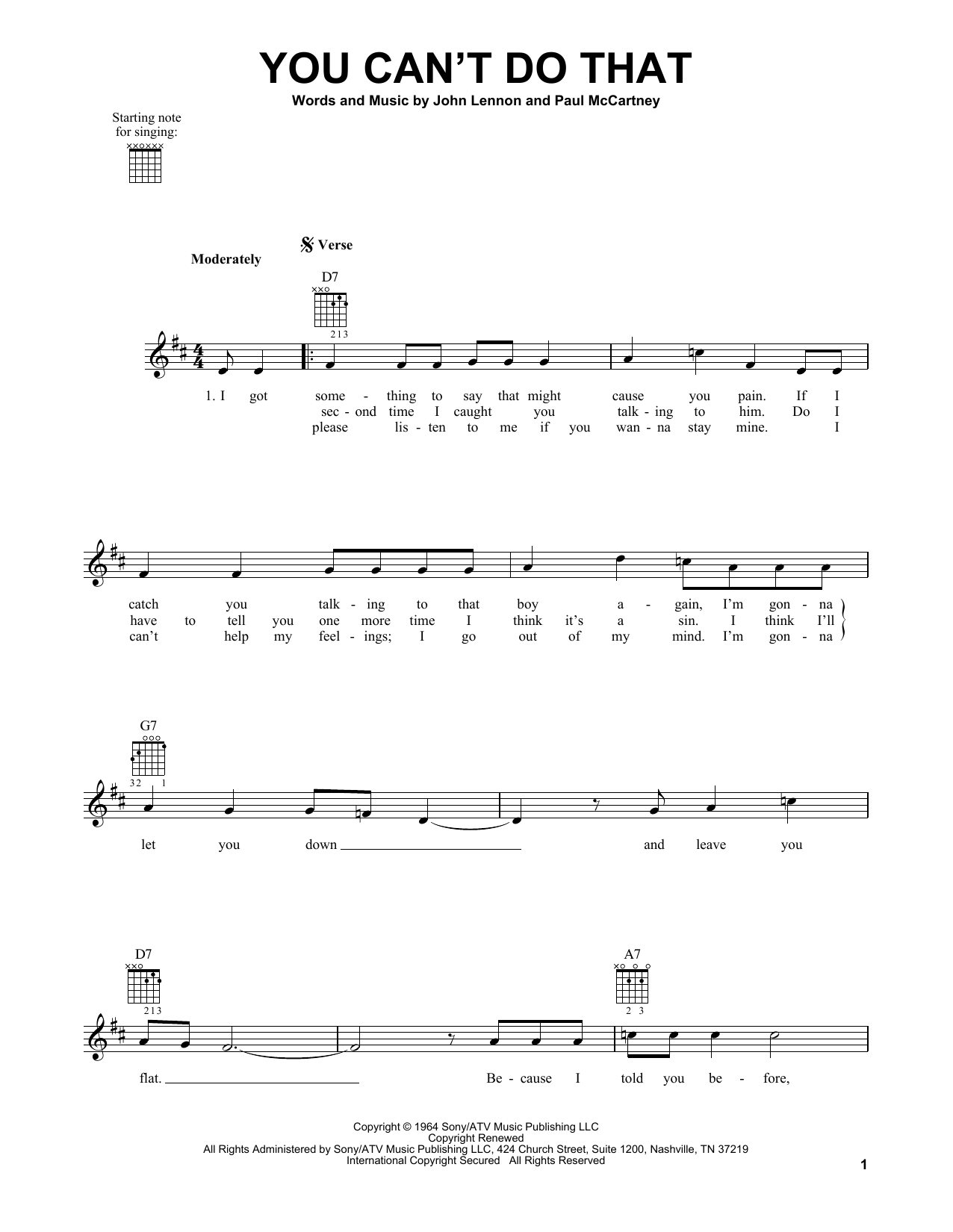
John Lennon was pissed off. Or at least, he sounded like it. When you drop the needle on the B-side of the "Can't Buy Me Love" single, you aren't met with the polished, boy-next-door charm of "I Want to Hold Your Hand." Instead, you get a cowbell. Then, a nasty, distorted Rickenbacker riff that feels like a warning. The You Can't Do That the Beatles lyrics don't just tell a story of teenage jealousy; they represent a fundamental shift in how the band handled tension, power, and the evolving sound of the 1960s.
It’s aggressive. It’s possessive. It’s arguably one of the most "Lennon" songs Lennon ever wrote before he went full-on experimental.
The Cowbell and the Contradiction
recorded in February 1964 at EMI Studios, this track was a bridge. It bridged the gap between the "mop-top" era and the more cynical, weary tone of Beatles For Sale. You’ve got George Harrison playing his brand-new Rickenbacker 360/12—the guitar that basically invented the 12-string jangle of the 60s—but John is the one driving the bus here. He’s playing the lead solo. It isn’t pretty. It’s choppy and sharp.
The lyrics start with a threat. "I got something to say that might cause you pain / If I catch you talking to that boy again."
There's no metaphor. No "sugar-pie honey-bunch" fluff. It's a direct command. While Paul McCartney was often writing about holding hands or seeing "her" standing there, John was writing about social humiliation and control. This wasn't just a pop song to him; it was a reflection of his own well-documented insecurities at the time. He admitted later in 1980 to David Sheff that he was a very jealous, possessive guy. This song was the diary entry he set to a bluesy beat.
Why the You Can't Do That the Beatles Lyrics Hit Different
People often mistake the early Beatles for being "safe." They weren't. Look at the structure of these lines.
"I'm gonna let you down / And leave you flat / Because I told you before, oh / You can't do that."
The rhyme scheme is simple, sure. But the delivery is what matters. Lennon's voice has this grit, a sort of nasal snarl that makes you believe he actually would leave her flat. It’s a power move. In the context of 1964, music was still largely about courtship. Here, the courtship is over, and the litigation has begun.
Interestingly, the song owes a massive debt to Wilson Pickett. John was obsessed with American R&B. He wanted that soulful, gritty punch. He didn't quite get Pickett’s scream, but he found something else—a uniquely British sort of arrogance that worked perfectly for a band that was currently conquering the entire planet.
Breaking Down the Verse Structure
Most pop songs of the era followed a very strict AABA pattern. The Beatles did too, but they messed with the internal logic.
In the middle eight, the tone shifts from a threat to an admission of weakness. "Everybody's green / 'Cause I'm the one who won your love / But if they'd seen / You're talking that way / They'd laugh in my face."
That’s the key. That’s the "hook" of the emotional narrative. It’s not just that he’s mean; it’s that he’s terrified of being laughed at. The "green" (envy) of others is the only thing keeping his ego afloat. If the girl talks to another guy, the illusion of his dominance shatters. It’s a surprisingly vulnerable admission hidden inside a tough-guy anthem.
The Technical Grit Behind the Sound
The recording session for this was legendary for its efficiency. They knocked it out in nine takes.
Paul McCartney’s bass line is deceptively complex here. He isn't just following the root notes. He’s playing a walking blues line that keeps the song from feeling too heavy. And Ringo? Ringo is the MVP. He’s smashing that cowbell like his life depends on it. It gives the track a "garage band" feel that was a sharp contrast to the lush arrangements they would start using only a year later.
- The Lead Guitar: John played the solo himself. It’s one of the few times he took the spotlight away from George for a lead break in the early days. It’s jagged.
- The Harmonies: Paul and George provide "backing" vocals that are almost mocking. They answer John’s lines in the chorus, reinforcing the "You can't do that!" chant.
- The Gear: This was the first time the 12-string Rickenbacker was used on a Beatles recording. It changed the texture of pop music overnight. Without this song, you don't get The Byrds. You don't get Tom Petty.
A Song of Its Time (and Why It’s Controversial Now)
Let’s be real. If you released the You Can't Do That the Beatles lyrics today, they’d be viewed through a much harsher lens. It’s a song about "putting a woman in her place." It’s possessive. It’s toxic.
But as a piece of historical art, it’s a vital window into the psyche of a young man in 1960s Liverpool. Lennon wasn't trying to be a role model. He was trying to be honest about his own ugly feelings. That’s what makes the Beatles more than just a "boy band." They weren't afraid to be unlikeable.
If you compare this to "Run For Your Life" from Rubber Soul, you see a pattern. Lennon had a "jealousy trilogy" that basically started here. It’s uncomfortable, but it’s authentic. Fans who only know the "All You Need Is Love" version of Lennon are often shocked by the bite in these early lyrics.
The "A Hard Day's Night" Connection
The song eventually found its home on the A Hard Day's Night album and was even filmed for the movie. However, it was famously cut from the final edit of the film.
Imagine that.
One of their best rockers, relegated to a B-side and a deleted scene. They performed it during their first Ed Sullivan Show rehearsals and kept it in their live set throughout 1964. It was a "musician's song." It was the track they played when they wanted to prove they could still sweat.
The live versions are even faster. Lennon would practically bark the lyrics. You can find the BBC sessions or the Hollywood Bowl recordings—the speed is breath-taking. It shows a band that was tired of being told to smile for the cameras. They wanted to play the blues.
Subtle Influence on Modern Songwriting
You hear the DNA of this song everywhere. Whenever a rock band uses a heavy riff to mask a vulnerable or "un-PC" lyric, they're pulling from the Lennon playbook.
Think about the sheer audacity of the opening line. It doesn't invite you in. It pushes you back. That "push" is what defined the British Invasion. It wasn't just about melody; it was about attitude. The You Can't Do That the Beatles lyrics are arguably the first time that attitude was fully weaponized on a record.
Actionable Insights for Beatles Fans and Songwriters
If you’re looking to truly understand the depth of this track beyond just a casual listen, there are a few things you should do next to see the full picture.
Listen for the "Ghost" Cowbell In the mono mix versus the stereo mix, the percussion sits differently. In the original mono version, the cowbell feels like a physical instrument in the room with you. It drives the rhythm more than the drums do. Compare the two; you'll hear how much the mix changes the "threat" level of the song.
Study the 12-String Layering Listen specifically to George Harrison’s rhythm work. While John is "barking" the lead, George is providing a shimmering wall of sound. If you’re a guitarist, try playing the main riff on a 6-string and then a 12-string. You’ll see that the song was literally built around the specific capabilities of that new Rickenbacker.
Read the 1980 Playboy Interview Search for John’s final major interview. He breaks down his early songwriting. He specifically mentions how "You Can't Do That" was his attempt at a "black" sound. Understanding his intent helps bridge the gap between the lyrics and the music.
Trace the Evolution Play "You Can't Do That" back-to-back with "Run For Your Life" and "Jealous Guy." It is a fascinating, if sometimes troubling, arc of a man trying to reconcile his need for love with his fear of losing it. It’s a masterclass in thematic consistency over a twenty-year career.
The song remains a staple because it isn't perfect. It isn't "nice." It's a raw, jagged piece of R&B-infused pop that proved the Beatles had teeth long before they had beards. It’s the sound of a band realizing they didn't have to be polite anymore. They could just be loud.



