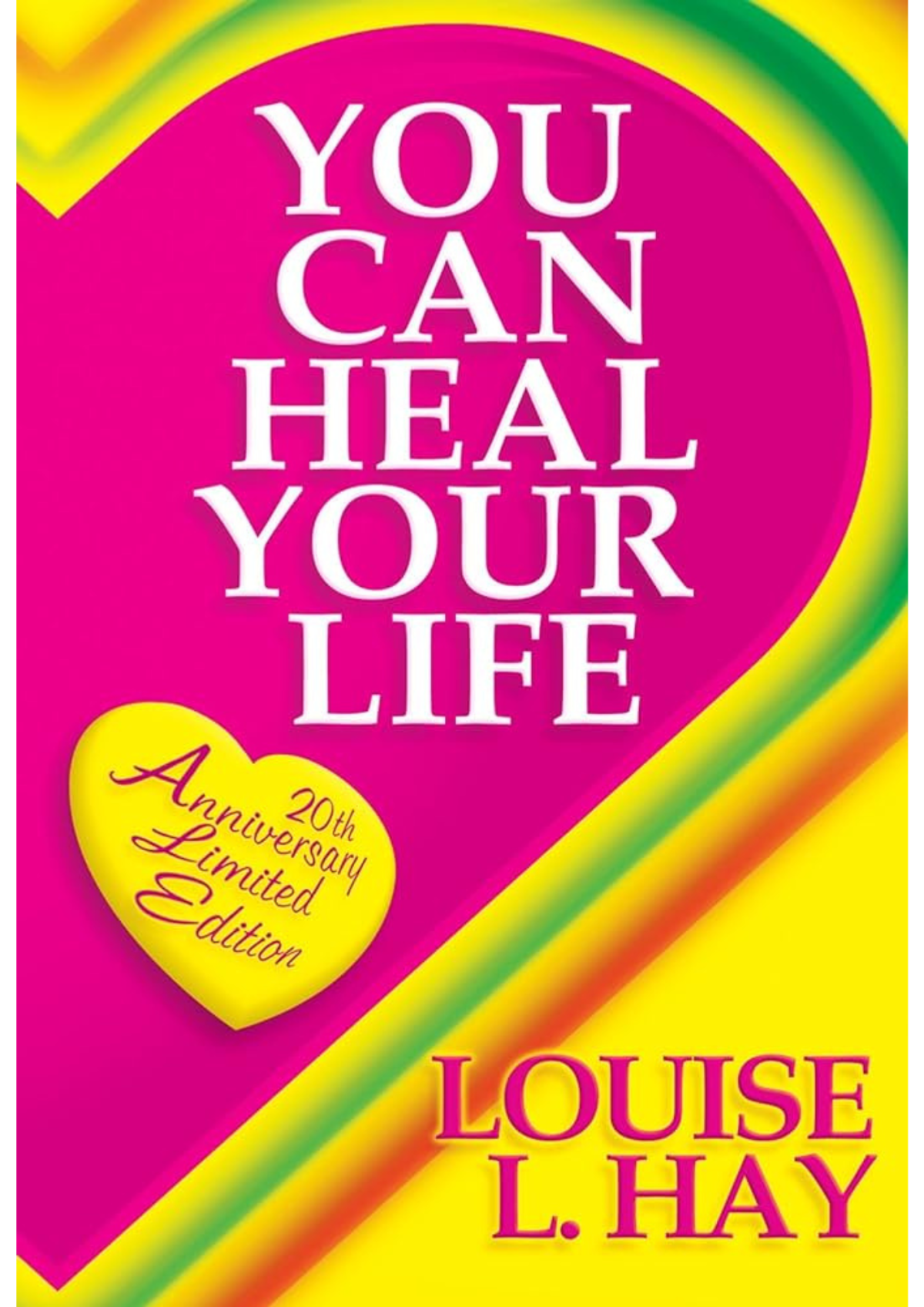
It was 1984. Big hair was in, the Cold War was freezing, and a woman named Louise Hay released a bright, primary-colored book that basically told the world their thoughts were making them sick. At the time, the medical establishment mostly rolled its eyes. Fast forward to today, and you’ll find the core tenets of You Can Heal Your Life echoed in everything from high-end wellness retreats to neuroplasticity research.
People are still obsessed with it. Why? Read more on a related subject: this related article.
Because being human is messy. We carry around these heavy backpacks of "not enoughness" and "it’s all my fault." Louise didn't just give people a self-help book; she gave them a Mirror Work practice and a list of affirmations that felt like a lifeline when everything else felt like a clinical cold shoulder. Honestly, the book is less about "magic" and more about the grueling, necessary work of mental hygiene.
The Core Logic of You Can Heal Your Life
The premise is deceptively simple. Louise Hay argued that our mental patterns—the stuff we say to ourselves when the lights are out—actually manifest as physical ailments. If you've got a persistent backache, she’d tell you it’s a lack of financial or emotional support. A sore throat? That’s suppressed anger or a refusal to speak up for yourself. Additional analysis by The Spruce explores comparable perspectives on this issue.
Now, look. Science doesn't back a 1:1 correlation for every single sneeze or itch. We know viruses exist. We know genetics are real. But the field of psychoneuroimmunology—a mouthful, I know—has spent decades proving that chronic stress and negative thought patterns absolutely tank the immune system. When you live in a state of self-loathing, your cortisol levels aren't just "high"; they're corrosive.
She focused on four main culprits: criticism, guilt, resentment, and fear. She called these the "most damaging patterns."
Most of us are walking around with a "should" list longer than a CVS receipt. "I should be thinner." "I should be making more money." "I should have been a better daughter." In the world of You Can Heal Your Life, that "should" is a form of violence against the self. It’s a constant rejection of the present moment.
The Mirror Work Phenomenon
If you want to feel really uncomfortable, try what Louise suggested. Stand in front of a mirror, look yourself dead in the eye, and say, "I love you and I accept you exactly as you are."
Most people can't do it.
They start crying. They get angry. They notice a pimple or a wrinkle and start critiquing their face instead of saying the words. This is where the work gets real. It’s not about being vain. It’s about acknowledging the person living inside that body. It’s about breaking the habit of being your own worst critic.
I’ve talked to people who did this for thirty days straight. It sounds woo-woo, sure. But by day twenty, they stopped looking for flaws and started looking for... them. The actual person.
Affirmations Aren’t Just Wishful Thinking
A lot of critics think affirmations are about lying to yourself. They think if you say "I am a millionaire" while you have five dollars in your bank account, you're just being delusional.
Louise’s approach was a bit different. She saw affirmations as planting seeds. You don't plant a tomato seed and then scream at the dirt because there's no fruit five minutes later. You water it. You give it sun. You wait.
The goal of the affirmations in You Can Heal Your Life is to replace the old, "broken" recordings in your brain. Your brain is a supercomputer. If you've been running "Software: I Suck 2.0" for thirty years, you can't expect "Software: I’m Great" to install in an afternoon. You have to repeat the new code until it becomes the default.
Breaking Down the Physical Map
One of the most famous parts of the book is the "List." It’s an alphabetical breakdown of illnesses and their probable mental causes.
- Headaches: Often come from invalidating the self. Critical of the self. Fear.
- Shoulder issues: Representing our ability to carry experiences in life. We make life a burden by our attitude.
- Knee problems: Stubborn pride and ego. Inability to bend. Fear. Inflexibility. Won't give in.
- Inflammation: Fear. Seeing red. Inflamed thinking.
Is it a medical diagnostic tool? Absolutely not. But as a prompt for journaling? It’s gold. If your neck is killing you, asking yourself "Where am I being stiff-necked or stubborn?" might actually lead to a realization that helps you relax those muscles. It’s a bridge between the physical and the emotional that many doctors simply don't have the time to build with you.
The Criticism and the Nuance
We have to talk about the elephant in the room. Louise Hay claimed she healed herself of cancer through these methods. This is where things get controversial.
Critics argue that this kind of philosophy can lead to victim-blaming. If you didn't get better, was it because you didn't love yourself enough? That’s a dangerous road. It’s vital to acknowledge that bad things happen to good people for no reason at all. Biology is complex. Environmental toxins are real. Poverty is a health risk factor that affirmations can't always overcome.
However, Louise’s work was never meant to replace medicine. She often encouraged people to work with health professionals. Her point was that while the doctor fixes the "effect" (the tumor, the rash, the infection), the patient needs to work on the "cause" (the internal environment that allowed the stress to manifest).
She lived until she was 90. She built an empire from her living room. Whatever you think of her science, her results in terms of personal resilience were undeniable.
Why 2026 Needs This More Than 1984
We are more "connected" and more lonely than ever. Our "mirrors" are now front-facing cameras with filters that smooth out our humanity. We are bombarded with reasons to feel inadequate.
The radical act of You Can Heal Your Life is the decision to stop participating in your own destruction. It’s the decision to say, "I am willing to change."
That’s her favorite phrase. "I am willing to change."
It’s not "I have changed." It’s not "I am perfect." It’s just the willingness. That tiny crack in the door allows new thoughts to creep in. It’s the difference between a closed system and an open one.
How to Actually Use the Philosophy Today
If you’re looking to incorporate this without feeling like you’ve joined a cult, start small.
First, watch your language. Not the "bad" words, but the "self-attacking" words. Notice how many times a day you call yourself an idiot or a klutz. Just notice it. Don't judge the judgment.
Second, find one affirmation that doesn't make you want to gag. Maybe it’s not "I am a radiant being of light." Maybe it’s just "I am learning to be kinder to myself." Use that as your "reset" button when you’re spiraling.
Third, look at your "resentment list." Who are you still mad at? Louise believed that holding onto resentment is like drinking poison and waiting for the other person to die. Forgiveness isn't for them; it’s so you don't have to carry the weight anymore.
Actionable Steps for Inner Work
- Audit your internal monologue: For one hour, write down every negative thought you have about yourself. It will be eye-opening and probably a bit depressing. That’s okay.
- The Morning Mirror Check: Before you put on makeup or shave, look at yourself. Say "I'm doing the best I can." It’s a low-bar affirmation that is hard to argue with.
- Identify the "Payoff": Louise often asked what the payoff was for staying sick or unhappy. Does it get you attention? Does it let you avoid responsibility? Be brutally honest.
- Release the Past: Write a letter to someone you're angry with. Pour out all the venom. Then burn it. Don't send it. The release is for your nervous system, not their ego.
- Clean up your space: Louise believed our external environment reflected our internal state. Toss one thing today that you don't love or use.
The reality is that You Can Heal Your Life isn't a one-time read. It’s a manual for a lifelong process. You don't "heal" and then stay healed forever like a fixed car. You maintain your mental health the same way you brush your teeth. It’s daily. It’s repetitive. And honestly, it’s the only way to keep the rot away.
Start by picking one area of your life that feels stuck. Just one. Apply the idea that your thoughts about that area are creating your experience of it. Change the thought, wait for the feeling to follow, and see what happens to the situation. It’s a slow-motion miracle, but it’s one you actually have control over.



