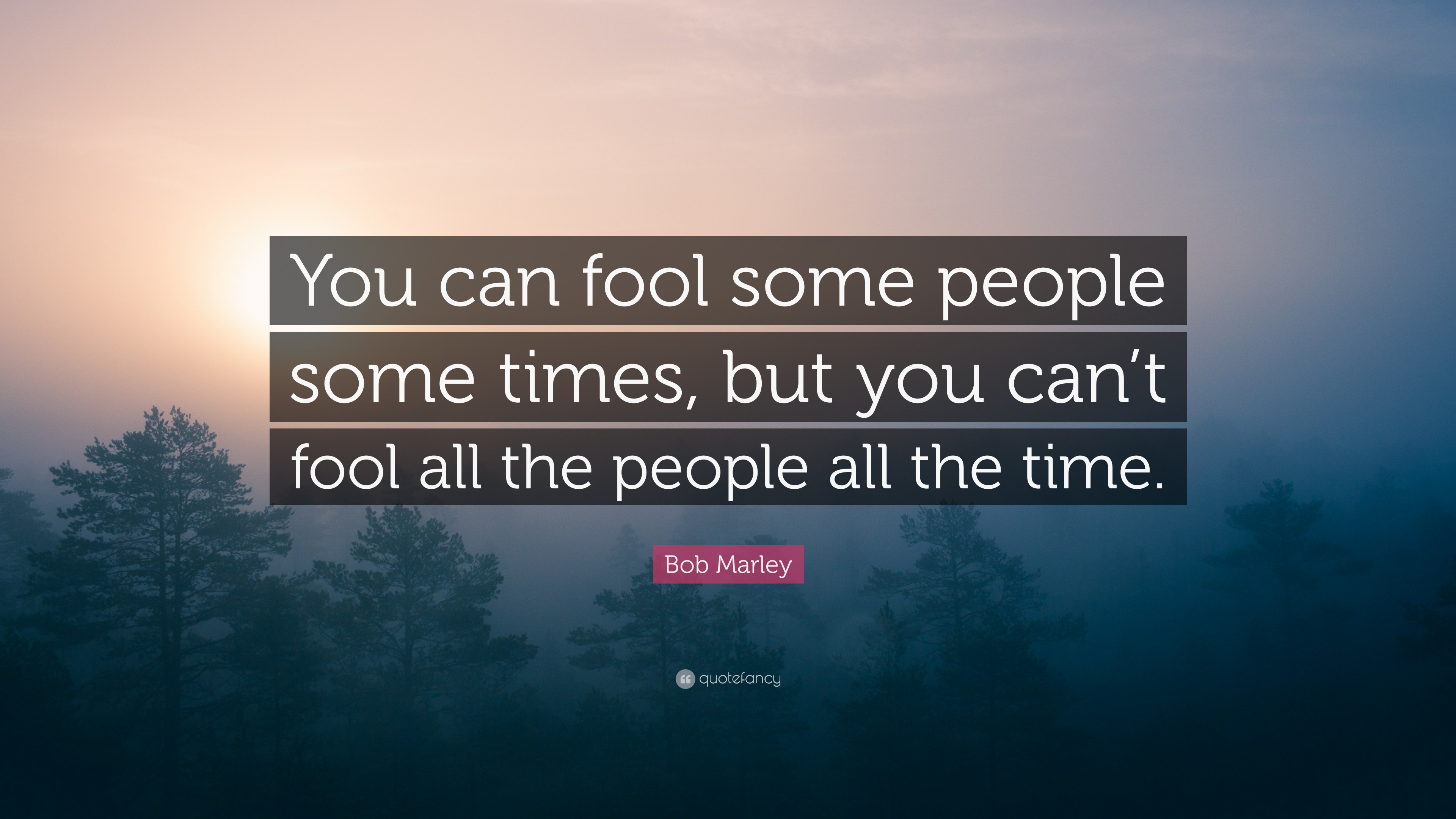
We’ve all heard it. It’s one of those lines that feels so true it just has to be a real quote from a giant of history. "You can fool all the people some of the time, and some of the people all the time, but you cannot fool all the people all the time." It’s the ultimate mic-drop for skeptics and a warning to every politician who thinks they’ve finally mastered the art of the spin.
But here is the thing. Abraham Lincoln probably never said it.
That’s a weird way to start, right? We’re talking about a phrase that has become a cornerstone of American political thought, yet the paper trail is almost non-existent. There is no written record from Lincoln’s hand—no diary entry, no speech transcript, no telegram—that contains those words. Instead, we have a messy, human history of hearsay and "he-said-she-said" that didn’t even surface until decades after he was gone. It’s the perfect irony. The very quote about not being able to fool everyone forever might actually be a bit of a historical trick itself.
The Mystery of the 1858 Clinton Speech
The most common "source" cited for the idea that you can fool all the people is a speech Lincoln allegedly gave in Clinton, Illinois, on September 2, 1858. This was during the heat of the Lincoln-Douglas debates. Tempers were high. The fate of the Union was basically on the line.
If you go to Clinton today, you’ll see a statue commemorating this moment. But if you look at the newspapers from September 3, 1858, they don’t mention the quote. The Chicago Tribune, which was basically the PR arm for the Republican party at the time, didn't print it. The Illinois State Journal? Nothing.
It wasn't until 1910—more than fifty years later—that a few elderly residents of Clinton claimed they remembered him saying it. Think about that. Can you remember exactly what someone said at a rally five decades ago? Probably not. You’d remember the vibe. You’d remember the feeling. But the specific, rhythmic phrasing of "some of the people all the time"? That feels like a memory that’s been polished by time.
Why the Quote Refuses to Die
So why does it stick? Why do we keep repeating it?
Because it feels like a universal law of physics for the soul. We want to believe that truth has a gravity that eventually pulls everything down to earth. In a world of deepfakes, "alternative facts," and social media echo chambers, the idea that you can fool all the people only temporarily is a comfort. It’s a promise that the "long arc of the moral universe" isn't just bending toward justice, but toward transparency.
Honestly, the quote is a masterpiece of rhetorical structure. It uses something called antithesis and parallelism. It’s catchy. It’s "sticky." It’s the 19th-century equivalent of a viral tweet. Even if Honest Abe didn’t coin it, the sentiment fits his brand so perfectly that we’ve collectively decided to let him keep it.
The Phineas T. Barnum Connection
If Lincoln didn’t say it, who did? Some historians point toward P.T. Barnum, the legendary showman who famously (and also apocryphally) said, "There’s a sucker born every minute."
Barnum knew a lot about fooling people. He made a fortune off of "Feejee Mermaids" (which were just monkey torsos sewn onto fish tails) and "Joice Heth," a woman he claimed was 161 years old and George Washington’s former nurse. Barnum understood the math of deception. He knew you didn't need to fool everyone. You just needed a steady stream of "some of the people."
But the "all the people" quote doesn't really sound like Barnum. Barnum was cynical. The quote, despite its warning, is fundamentally optimistic. It’s a democratic ideal. It says that the collective wisdom of the public is, in the long run, unshakeable. That sounds way more like a lawyer from Illinois than a circus promoter from Connecticut.
The Psychology of Mass Deception
Let's get into the "how" of it. How do you actually go about trying to fool everyone?
Psychologists often talk about the Illusory Truth Effect. This is the glitch in our brains where we start to believe something is true simply because we’ve heard it repeated so many times. Repetition creates "fluency." Our brains are lazy. If a piece of information is easy to process because we've seen it before, we mistake that ease for accuracy.
This is how misinformation scales.
- Step 1: Plant a seed that confirms a pre-existing bias.
- Step 2: Use multiple "independent" sources to repeat the same claim.
- Step 3: Wait for the "echo" where the public starts repeating it to each other.
Once you reach Step 3, you’ve successfully fooled a significant portion of the people. But the "all the time" part? That’s where the system breaks. Reality is a stubborn thing. You can tell people the sky is green for a month, but eventually, they’re going to look up and see blue.
The Cost of the "Long Run"
The problem with the idea that you can fool all the people only for a limited time is that "the long run" can be devastatingly long.
Take the tobacco industry. For decades, they managed to fool a huge percentage of the population about the link between smoking and lung cancer. They used "merchant of doubt" tactics—hiring their own scientists to muddy the waters. They didn't have to prove smoking was safe; they just had to prove that the science was "uncertain."
They fooled enough of the people for long enough to make trillions of dollars. By the time the truth became "un-foolable," millions had died. So while the quote is true in a cosmic sense, it’s a bit cold when applied to real-world consequences.
Detecting the "Fooling" in the Digital Age
How do we apply the "Lincoln" standard today? We are currently living through the greatest experiment in mass deception in human history.
Algorithmic feeds are designed to keep us in a state of constant emotional high. When we are emotional—angry, scared, or even overly excited—our critical thinking takes a backseat. This is the prime environment for those who think you can fool all the people.
But there are "tells." There are ways to spot when the "fooling" is happening:
- Extreme Simplicity: If a complex global issue is boiled down to a single villain and a single hero, you’re likely being sold a narrative, not a fact.
- Urgency without Evidence: "You need to share this NOW before it gets taken down!" is the calling card of a scam.
- Lack of Nuance: Real life is messy. If someone is telling you a story where their side is 100% right and the other side is 100% evil, they are trying to fool you.
What Experts Say
Dr. Stephan Lewandowsky, a cognitive scientist who specializes in misinformation, has spent years studying how to "pre-bunk" lies. His research suggests that once a lie is in your head, it’s incredibly hard to scrub out, even after it’s been debunked. This is known as the Continued Influence Effect.
This is why the quote is so vital. It’s not just a warning to the liars; it’s a warning to the listeners. Once you're fooled, the "un-fooling" process is painful and slow.
A Better Way to Look at the Quote
Maybe we shouldn't worry so much about whether Lincoln said it.
Maybe we should focus on why we need him to have said it. We need a hero to anchor this truth. We need to believe that our leaders, at their best, understand the limits of power.
The phrase is a check and balance. It’s a reminder that power is leased from the public, and that lease is based on a foundation of shared reality. When that reality is fractured, the lease gets canceled. Sometimes it happens at the ballot box. Sometimes it happens in the streets. Sometimes it happens in the quiet halls of a courtroom.
Actionable Steps for the "Un-foolable" Citizen
If you want to live by the creed that you can fool all the people never works on you, you have to be proactive. You can't just be a passive consumer of information.
- Diversify your "Information Diet": If you only read people you agree with, you are doing the work of the deceivers for them. Read the smart version of the argument you hate.
- Check the Source, then Check the Source's Source: Most "viral" news is just a summary of a summary. Go back to the original document, the original data, or the original video.
- Wait 20 Minutes: Before you retweet or share something that makes your blood boil, go wash the dishes. If it still feels true after the adrenaline spike has faded, then maybe it is. But usually, you’ll see the holes in the story once you’ve calmed down.
- Acknowledge Your Own "Sucker" Potential: The easiest person to fool is yourself. We all have blind spots. We all want to be right. The moment you think you’re too smart to be fooled is the exact moment you are most vulnerable.
History is littered with people who thought they could maintain a lie forever. They built empires on it. They started wars for it. And in every single case, the "all the time" part of the equation eventually ran out. The truth doesn't need a PR team. It just needs time.
Keep your eyes open. Don't let the rhythm of a good quote—even a fake Lincoln one—distract you from the hard work of finding out what's actually true. Real skepticism isn't about believing nothing; it's about having a very high bar for what you let into your head.
Be the person who is impossible to fool "all the time."