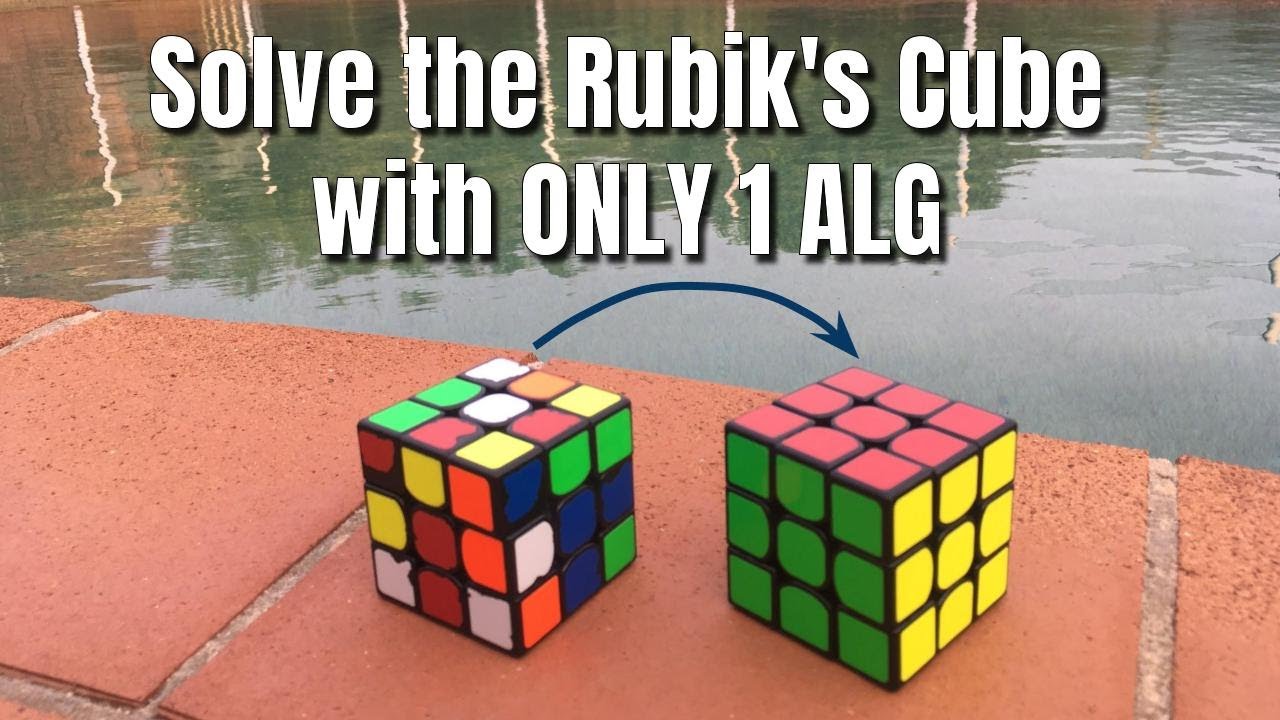
Honestly, the 3x3 Rubik’s Cube is the world’s most frustrating paperweight until it isn’t. You’ve probably got one sitting on a shelf somewhere, gathering dust, or maybe it’s buried in a "random stuff" drawer with some old batteries and a tangled charging cable. Most people pick it up, twist it for five minutes, realize they can't even get one side finished without messing up the first few stickers, and toss it aside. They think it requires some genius-level IQ or a deep understanding of group theory. It doesn't. You can do the cube 3x3 without being a math prodigy or having the finger speed of a competitive gamer. It’s just about muscle memory and breaking the intimidation factor.
Let’s be real. The "3x3" is a 1974 invention by Ernő Rubik that has over 43 quintillion possible configurations. That number is terrifying. If you had a different cube for every one of those combinations, they would cover the entire surface of the Earth. But here is the secret: you aren't solving 43 quintillion possibilities. You are just moving pieces into slots.
The Mental Block: Why You Think You Can’t Solve It
Most beginners approach the cube the wrong way. They try to solve it side by side. You see a blue face, and you try to get all the blue stickers together. Then you move to the red side, and suddenly the blue side is ruined. It’s maddening.
The trick is layers. Think of the cube like a three-story building. You build the foundation (the bottom layer), then the walls (the middle layer), and finally the roof (the top layer). When you stop looking at the cube as six faces and start looking at it as three horizontal slices, everything changes.
People also freak out about the "algorithms." That word sounds like something out of a Silicon Valley boardroom or a high-level calculus textbook. In the cubing world, an algorithm is just a sequence of moves. It’s like a cheat code in a video game. Down, Right, Up, Left. If you can remember how to tie your shoes or navigate to the grocery store without GPS, you can learn these sequences.
Getting Started: The Cross and the Corners
The very first thing you need to understand is that the center pieces never move. The white center is always opposite the yellow center. Blue is always opposite green. Red is always opposite orange. This is your North Star. You are building the colors around these fixed points.
You start with the "White Cross." This is the part where most people actually manage to do okay, but they forget to line up the side colors. If you have a white edge piece next to the white center, the other side of that edge piece (say, red) must match the red center. It’s a simple alignment.
Once the cross is done, you’re dropping in the corners. This is where you first learn the "Sexy Move." That’s the actual name for it in the community. It’s a four-move sequence: Right side up, Top side left, Right side down, Top side right. If you repeat those four moves, you can slot any corner into its place. It feels like magic the first time it works. Suddenly, the entire bottom floor of your "building" is complete.
Tackling the Middle Layer
This is where the frustration usually peaks. You’ve got the bottom layer perfect, and you don’t want to touch it for fear of breaking it. But to solve the middle, you have to temporarily mess up the bottom. It’s counterintuitive.
You’re looking for edge pieces on the top layer that don’t have any yellow on them. You move them above their matching center and then use a slightly longer sequence to "tuck" them into the middle row. If you do it right, the piece slides into place and the bottom layer miraculously repairs itself.
It’s about trust. You have to trust that the sequence will put things back where they belong. Many people quit here because they make one wrong turn, see their hard-earned bottom layer disintegrate, and give up. Don't. If you mess up, just start over. The second time is always faster.
The Yellow Top: The Home Stretch
Now you’re at the roof. This is where "you can do the cube 3x3" becomes a reality. You turn the cube over so the white side is on the bottom. Now you’re looking at a yellow mess.
You go through a series of phases:
- Make a yellow cross.
- Make the whole top yellow (OLL - Orientation of the Last Layer).
- Move the yellow pieces into their final spots (PLL - Permutation of the Last Layer).
At this stage, you aren't even looking at the whole cube anymore. You are looking for specific patterns—a "hook" shape, a "bar" shape, or a "fish" shape. Each pattern has a specific "spell" (algorithm) to fix it.
Does the Gear Matter?
You don't need a $50 magnetic speedcube to start. The original Rubik's brand cubes are famously stiff and "clunky," but they work. However, if you find yourself getting hooked, spending ten bucks on a basic "speedcube" from brands like MoYu or QiYi will make the experience way more enjoyable. They turn with the flick of a finger and don't lock up as much. It makes the learning process feel less like a physical workout and more like a puzzle.
Beyond the Basics: What Happens Next?
Once you solve it for the first time, your brain does something weird. You get a hit of dopamine that makes you want to do it again, but faster. This is the "Layer-by-Layer" or "Beginner's Method." It’s reliable, but it’s slow.
If you want to get under a minute, you eventually move to the CFOP method (Cross, F2L, OLL, PLL). This is what the pros use. Instead of doing the bottom corners and middle edges separately, they do them at the same time (First Two Layers). It involves learning about 78 different algorithms, but don't let that scare you. You learn them one by one, over months or years.
There is also the Roux method, which is more intuitive and uses fewer moves but requires better spatial awareness. Or the ZZ method, which focuses on edge orientation. The point is, the 3x3 isn't a single puzzle; it's an entire ecosystem of logic.
Common Misconceptions
People think you have to be a "math person." I know people who can solve a cube in 10 seconds who struggle with basic algebra. It’s spatial reasoning, not arithmetic.
Another myth is that you can just "peel the stickers off." Please don't. It ruins the cube, and everyone will know you cheated because the stickers never lay flat again. Plus, it's way more satisfying to actually solve it.
Finally, people think it takes hours to learn. If you sit down with a decent video or a written guide, you can probably get your first solve in about two hours. By the end of the week, you can do it in five minutes. By the end of the month, you’re that person at the coffee shop doing it in under two minutes while waiting for a latte.
The Impact on the Brain
There’s actually some decent evidence that cubing helps with "working memory." That’s the ability to hold and manipulate information in your head. When you’re looking at the top layer and trying to remember which algorithm to use while also tracking where a specific corner is going to land, you’re giving your prefrontal cortex a serious workout.
It’s also a great way to manage anxiety or ADHD. It’s a tactile, "fidget" task that has a clear beginning, middle, and end. In a world of endless digital scrolling, having a physical object with a definitive "solved" state is incredibly grounding.
Your Immediate Strategy to Solve the 3x3
If you are holding a scrambled cube right now, here is exactly what you should do:
Find the White Center. Keep it on top for now. Find the four white edge pieces and move them so they surround the yellow center first (this is called the "Daisy"). It’s much easier than going straight for the white cross. Once you have the Daisy, line up the side colors and flip them 180 degrees down to the white center. Boom. Perfect cross.
Learn the "Sexy Move." Practice R U R' U' (Right clockwise, Top clockwise, Right counter-clockwise, Top counter-clockwise) until you can do it without thinking. This single move sequence is responsible for about 50% of the solve if you use it correctly.
Use a Reference. Don't try to "figure it out" on your own the first time. The greatest cubers in the world learned from someone else. Use a site like Ruwix or a reputable YouTube creator like J Perm. They have high-quality diagrams that show you exactly where your fingers should go.
Don't Panic When It Breaks. You will mess up. You will get to the very last step, turn the wrong side, and see the whole thing scramble. That’s part of the process. Every time you restart, you get faster at the early steps.
Slow Down. Speed comes from fluidity, not rushing. If you try to turn too fast, the cube will catch, or you'll lose your place in the algorithm. Smooth is fast.
The reality is that you can do the cube 3x3 if you just stop treating it like a test and start treating it like a sequence of patterns. It’s a skill, like typing or riding a bike. Once it "clicks," you never really forget it. Get that cube off the shelf. Give it a few turns. You might be surprised at how quickly your hands start to understand what your brain hasn't quite figured out yet.



