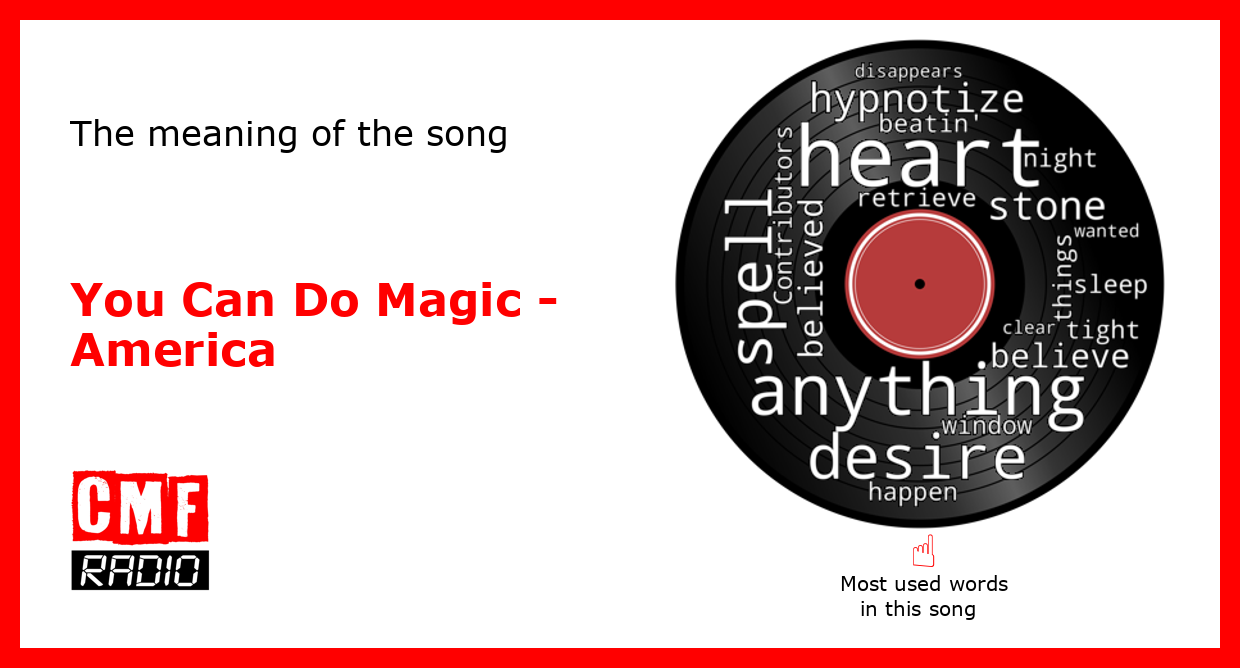
Ever get a song stuck in your head that feels less like a melody and more like a time machine? For a lot of us, that’s exactly what happens the second that shimmering synth intro kicks in. Honestly, You Can Do Magic song lyrics have this weird, lasting power that most "comeback" tracks from the eighties just don't possess.
It was 1982. The band America—originally a trio but by then a duo consisting of Gerry Beckley and Dewey Bunnell—was in a bit of a slump. They were the "Horse with No Name" guys, the folk-rockers who’d been a bit quiet since the mid-seventies. Then comes this track. It didn't just climb the charts; it basically reinvented their entire sound.
The Skeptic’s Journey in the Lyrics
The song starts out with a confession. "I never believed in things that I couldn't see," the lyrics admit. It's a classic setup. You’ve got a narrator who thinks he’s too logical for love, too grounded for anything "supernatural."
Then, everything changes.
The lyrics describe a person who has this almost terrifying level of control over the narrator's reality. When he can't sleep, this person appears and "the rain disappears." It’s not just a crush; it's a total paradigm shift.
- The Hook: "You know darn well when you cast your spell / You will get your way."
- The Metaphor: A "heart of stone" turning into "clay."
It’s simple, sure. But it works because it taps into that universal feeling of being completely mesmerized by someone. It’s about the "magic" of influence—how one person can suddenly make the world feel less heavy just by existing in your space.
The Man Behind the Magic: Russ Ballard
Most people don't realize that America didn't actually write this one. The heavy lifting was done by Russ Ballard. If that name sounds familiar, it's because the guy was a songwriting machine back then. He wrote "Since You Been Gone" for Rainbow and "God Gave Rock and Roll to You."
Ballard didn't just hand them a sheet of paper and leave. He produced the track at Abbey Road Studios (Studio 2, to be exact—the same room where The Beatles lived). Legend has it that Ballard played almost every instrument on the recording himself, including the programming of the Linn drum machine that gives the song its rhythmic heartbeat.
He was hired by Rupert Perry at Capitol Records specifically to save America’s commercial standing. It worked. The song hit number 8 on the Billboard Hot 100. For a band that many had written off as "sevenies relics," it was a massive middle finger to the idea of fading away.
Why the Lyrics Work in 2026
We live in an era where everything is hyper-analyzed. We have apps for sleep, apps for weather, and apps for dating. Yet, the You Can Do Magic song lyrics still resonate because they describe a feeling that data can't capture.
There's a specific line in the bridge: "If I wanted to, I could never be free."
That’s a heavy sentiment for a pop song. It suggests a lack of agency that's actually kind of dark if you look at it through a certain lens. But in the context of the 1982 production—those bright, airy harmonies and the driving beat—it feels like a celebration of surrender. It's the "magic" of letting go of control.
Misconceptions and Trivia
People often confuse this song with something from the late 70s. It’s an easy mistake. America’s earlier hits like "Sister Golden Hair" have that warm, acoustic vibe. But "You Can Do Magic" is firmly 80s pop. It’s got that polished, glossy sheen that only early digital production could provide.
Another fun fact? The song was used as the opening theme for Baltimore Orioles games in 1982. Maybe there was some actual magic in the lyrics—the team won the World Series the very next year.
Actionable Insights for Music Lovers
If you're looking to dive deeper into this specific era of songwriting or just want to appreciate the track more, here is what you should do:
Listen to the 1994 Re-recording Check out the version on the album Hourglass. It’s a bit more stripped back and allows you to hear the vocal nuances between Beckley and Bunnell without the heavy 80s production. It highlights just how strong the actual melody is.
Explore the Russ Ballard Catalog If you like the "vibe" of this song, look into Ballard's solo work or his hits for other artists. You'll start to hear a pattern: he's a master of the "skeptic-to-believer" narrative arc.
Analyze the Vocal Arrangement Pay attention to the "Doo doo doo" sections. This wasn't just filler. In the early 80s, these phonetic hooks were designed to be "sticky" for radio play. Notice how the harmonies stack; it’s a masterclass in folk-pop vocal layering that very few modern bands can replicate without heavy pitch correction.
The real takeaway? "Magic" isn't about sleight of hand. In the world of America and Russ Ballard, it’s about the undeniable, almost scientific power of another person's presence to change your mental weather.



