Paul Simon was in trouble. Big trouble. By 1984, his marriage to Carrie Fisher had imploded, his solo career was flatlining after the failure of Hearts and Bones, and he felt like a ghost in his own life. Then he went to South Africa. He came back with a tape full of mbaqanga rhythms and a set of words that would eventually become the You Can Call Me Al lyrics, a song that somehow turned a nervous breakdown into a worldwide dance party.
It’s a weird track. You know the bass riff—that incredible, gravity-defying Bakithi Kumalo moment—but the words are where the real magic (and the real anxiety) lives. People hear the catchy horn section and assume it’s just a goofy 80s hit. They’re wrong.
The True Story Behind the Names Al and Betty
Let’s get the most famous part out of the way first. People always ask: who are Al and Betty? Are they real friends of Paul’s? Nope. It’s actually a story about a social blunder involving a famous French conductor.
Back in the late 70s, Paul and his then-wife Peggy Harper threw a party. Pierre Boulez, the legendary composer and conductor, showed up. As he was leaving, he turned to Paul and said, "Thanks for everything, Al. And give my best to Betty." He got both of their names wrong. He called Paul "Al" and Peggy "Betty."
Simon, being a songwriter who never throws away a good anecdote, tucked that away for years. When he was struggling to find a hook for this new South African sound, he pulled that memory out. It wasn't just a funny mistake anymore; it became a metaphor for a man who doesn't even recognize himself in his own house.
Why the First Verse Feels Like a Panic Attack
The song starts with a guy who is basically having a sensory overload. He’s looking at his life and realizing he’s middle-aged, out of shape, and spiritually empty.
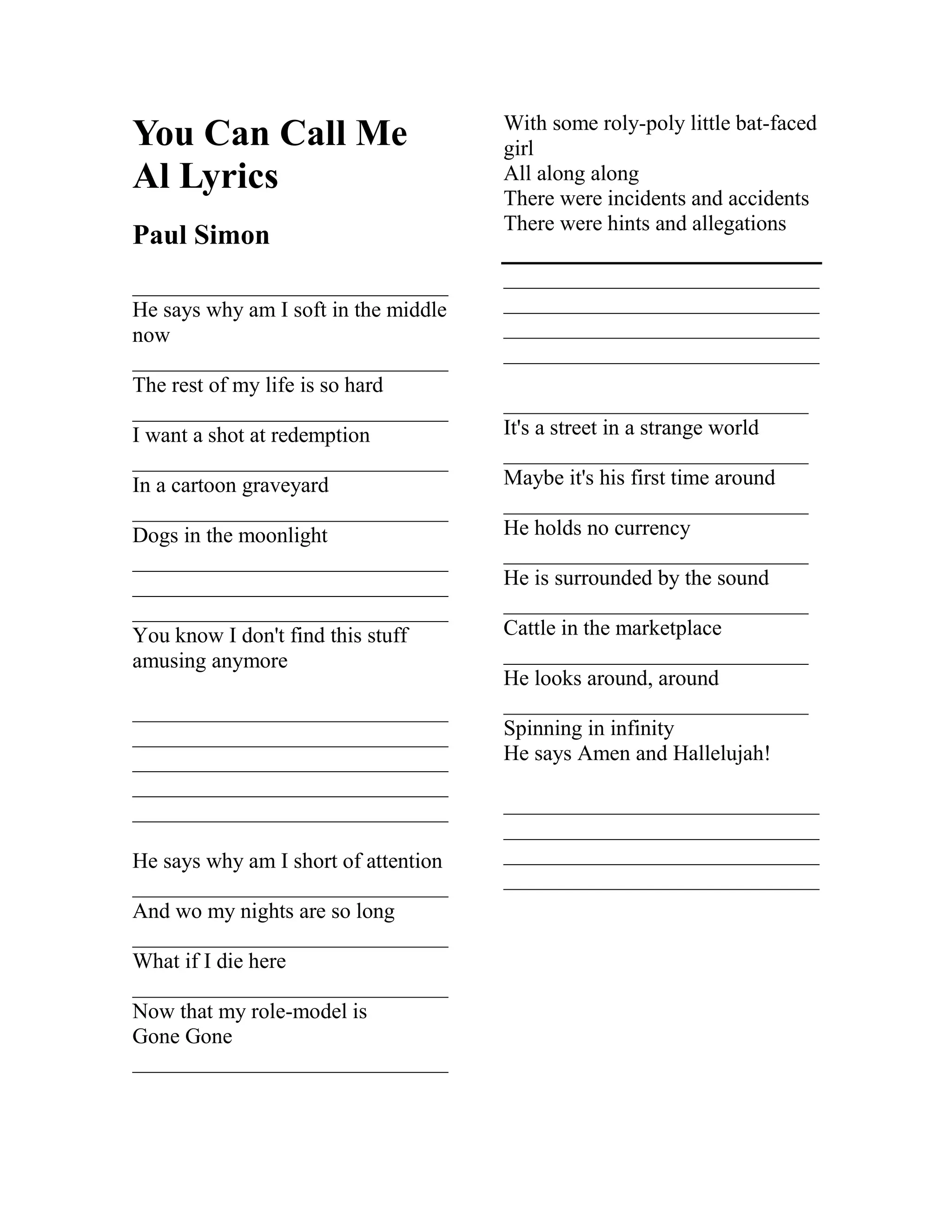
"A man walks down the street, he says, 'Why am I soft in the middle now? Why am I soft in the middle? The rest of my life is so hard.'"
That’s not a joke. It’s a literal description of a mid-life crisis. He’s obsessed with his "short little span of attention" and the "incidents and accidents" that define his day. It’s frantic. The You Can Call Me Al lyrics are structured to feel breathless, like a man talking too fast because he’s afraid if he stops, he’ll have to face the fact that he’s irrelevant.
He talks about "ducking and dodging" and "cattle in the marketplace." It's urban chaos. He's looking for a "photo opportunity" or a "shot at redemption." He wants to be seen, but he doesn't know who he is. It's the ultimate "first-world problems" verse, but written with so much wit that you don't realize how dark it is until you really look at the page.
Transitioning from New York Stress to African Spirit
By the time we hit the third verse, everything changes. The setting shifts. We aren't in a cramped New York apartment or a busy street anymore. We are in the "Third World," a term that was much more common in the mid-80s lexicon.
The protagonist is now a "foreign man" who is "surrounded by the sound, sound." This is Paul Simon describing his own experience recording Graceland. He went to Johannesburg during Apartheid, a move that got him in massive trouble with the UN and the African National Congress, but he felt he had to follow the music.
In this verse, the character sees things he doesn't understand. He sees "disabilities and alterations." He sees a world that is much bigger and much older than his own neurotic problems. The lyrics move from the "soft in the middle" ego to a sense of awe. He’s looking at the "angles in the architecture" and the "stray light beams."
It’s a spiritual awakening disguised as a travelogue. Honestly, it’s one of the most effective shifts in pop music history. He goes from complaining about his beer belly to finding God in the "black industrial sky."
The Music Video and the Chevy Chase Factor
You can't talk about these lyrics without mentioning the man in the light blue suit. Because Paul Simon is... well, Paul Simon-sized, and the song was such a massive hit, the original music video didn't quite work. It was a performance on Saturday Night Live that felt a bit stiff.
Enter Chevy Chase.
The iconic video—where Chevy lip-syncs the entire song while Paul sits there looking bored and playing tiny instruments—saved the track's commercial life. It played into the "Al and Betty" dynamic. Chevy was the big, loud, confident "Al," and Paul was the actual creator hidden in plain sight. It added a layer of postmodern irony to the You Can Call Me Al lyrics that wasn't there before. It made the song approachable. It took the heavy themes of cultural displacement and aging and gave them a goofy face.
Technical Brilliance: That Bass Solo
While we are focusing on the words, we have to acknowledge that the lyrics are supported by some of the most complex arrangements in 80s pop. The bass solo by Bakithi Kumalo is actually a bit of studio wizardry.
The first half of the solo is what Bakithi played. The second half is the first half played backward.
Engineers Roy Halee and Paul Simon decided to flip the tape because the way the notes resolved sounded "alien" and "perfect" for a song about feeling like a stranger. This technical choice mirrors the lyrical content perfectly. It’s a palindrome in audio form, reflecting a man who is looking forward and backward at the same time.
Common Misconceptions About the Song
A lot of people think the song is about drugs. It’s not. The "Mr. Beerbelly" and "soft in the middle" lines get mistaken for a guy who’s burnt out on substances, but Simon has been pretty clear that it’s about the soul, not the syringe.
Others think it’s a political protest song because it was recorded in South Africa. While the Graceland album was a massive political lightning rod, "You Can Call Me Al" is actually one of the least political songs on the record. It’s deeply personal. It’s about a white man from New Jersey trying to find a reason to keep making art in a world that feels like it’s moving on without him.
How to Truly Appreciate the Lyrics Today
To get the most out of the You Can Call Me Al lyrics, you have to listen to it as a three-act play.
- Act I: The Ego. A man is obsessed with his own physical decline and lack of fame.
- Act II: The Journey. He leaves his comfort zone and travels to a place where he is a "foreign man."
- Act III: The Revelation. He realizes that he is just a small part of a much larger, brighter, and more "long-distance" world.
It’s a song about humility. It’s about the moment you stop trying to be "Paul Simon" and become okay with just being "Al."
Actionable Insights for Music Lovers
If you want to dive deeper into the world of this song, don't just stream it on a loop. Try these steps to really grasp the craftsmanship:
- Listen to the isolated vocal track. You can find these on YouTube. Without the horns and the bass, Simon’s delivery is much more rhythmic and percussive than you’d expect. He’s essentially rapping in a folk-singer’s cadence.
- Compare it to "The Boy in the Bubble." That’s the opening track of Graceland. While "Al" is about internal anxiety, "Bubble" is about external, global anxiety. They are two sides of the same coin.
- Read about the "Graceland" controversy. To understand why the "foreign man" verse matters, you need to understand the risk Simon took. Check out the 2012 documentary Under African Skies. It provides the essential context for why these lyrics were so defiant at the time.
- Watch the bass solo breakdown. There are several interviews with Bakithi Kumalo where he explains the "backward" recording technique. It will change the way you hear the middle of the song forever.
The brilliance of the song is that it doesn't offer a neat solution. The man doesn't get "un-soft" in the middle. He doesn't solve his attention span issues. He just finds a way to be okay with the "stray light beams" and the "angels in the architecture." He finds a way to dance through the crisis. That is why, forty years later, we are still calling him Al.



