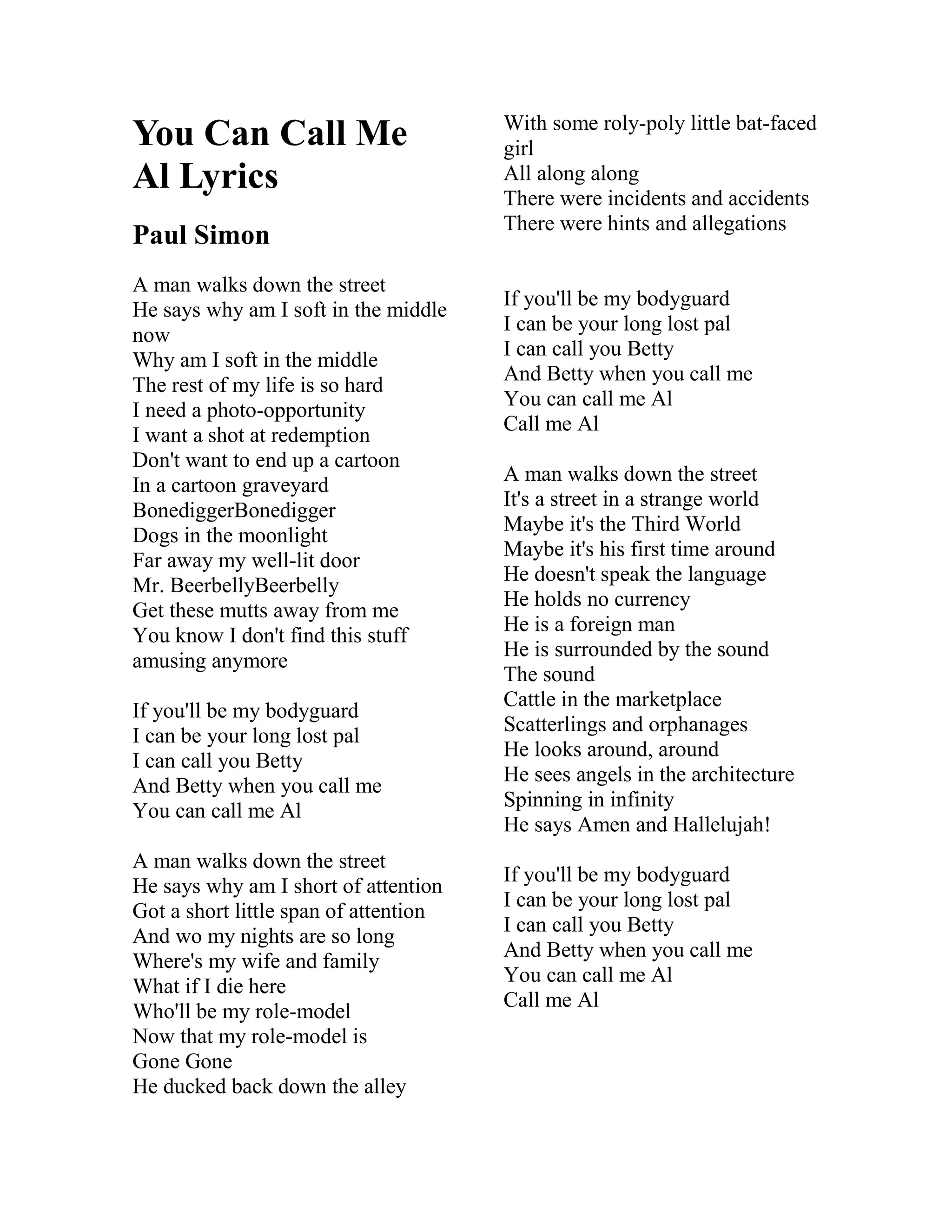
Paul Simon was basically having a mid-life crisis when he landed in Johannesburg in the mid-1980s. He’d just come off a failed marriage to Carrie Fisher and a professional flop with Hearts and Bones. He was wandering. Then he heard Mbaqanga music—the "Township Jive"—and everything shifted. When people look up the You Can Call Me Al lyrics, they usually expect a lighthearted synth-pop romp. What they actually get is a dense, almost manic stream of consciousness about a man who is terrified of his own irrelevance.
It’s a weird song. Seriously.
That Bizarre Opening Line
The song kicks off with a guy who isn't just lost; he’s losing his grip on his surroundings. "A man walks down the street / He says, 'Why am I soft in the middle, now?'" Honestly, who hasn't felt that? It’s the quintessential mid-life realization. You wake up, you’re forty-something, and your body doesn't belong to you anymore. But Simon doesn't stop at physical decay. He moves straight into a spiritual identity crisis.
The protagonist is obsessed with his "short little span of attention." He’s looking for a "photo-opportunity" or a "shot at redemption." It’s an incredibly cynical take on how we try to fix our lives. We don't want to do the hard work of soul-searching; we just want a good picture of us looking like we’ve found ourselves.
Where Did Al and Betty Actually Come From?
There is a very specific, real-life origin story for the names in the chorus. It wasn't some deep metaphorical choice. It was a mistake.
In the late 1970s, Paul Simon and his then-wife Peggy Harper threw a party. One of the guests was the famous composer and conductor Pierre Boulez. As Boulez was leaving, he accidentally referred to Paul as "Al" and Peggy as "Betty." Most people would just find that funny and move on. Simon, being the songwriter he is, tucked that awkward moment into his brain for years.
When it came time to write the You Can Call Me Al lyrics, he used those names to ground the song’s surrealism. The chorus acts as a sort of pact between two people. If you’ll be my bodyguard, I can be your long-lost pal. It’s about finding a connection in a world that feels increasingly alienating. You don't have to know who I really am, just call me Al. It’s protective. It’s a mask.
The Third Verse Shift: From New York to Africa
If the first two verses are about a guy complaining in a city, the third verse is where the song actually goes somewhere. This is where the Graceland influence hits hardest.
"A man walks down the street / It's a street in a strange world / Maybe it's the Third World / Maybe it's his first time around."
Suddenly, the protagonist isn't in his comfortable apartment anymore. He’s surrounded by "foreign colors" and "the sound of cattle in the marketplace." He sees "the scatters and the remnants of the buildings and the bones." This isn't just travel writing; it’s a confrontation with the reality of the world outside the Western bubble.
Some critics at the time, and even now, find this part problematic. They argue Simon was using Africa as a backdrop for his own white ego. But if you look closely at the lyrics, he’s actually mocking himself. He’s the "duck out of water." He’s the guy looking at "dogs in the moonlight" and feeling like he doesn't belong. He’s not the hero of the story; he’s the bewildered tourist trying to find a common language.
That Bass Solo and the Penny Whistle
You can't talk about the lyrics without talking about the music, because the two are fused together. Bakithi Kumalo’s bass run is legendary. It’s actually a "palindromic" solo. The first half was recorded, and then the engineers literally flipped the tape to create the second half. It’s a mirror image.
Then there’s the penny whistle solo. It’s frantic. It’s joyous. It’s played by Morris Goldberg, and it provides the emotional release that the lyrics refuse to give. While the words are talking about "the duck and the finger of suspicion," the music is celebrating. This contrast is why the song works. It’s a depressed man dancing.
Why We Still Care Decades Later
Kinda makes you wonder why a song about a guy complaining about his "soft middle" is still a staple at weddings and bars.
It’s because the You Can Call Me Al lyrics tap into a universal anxiety. We are all, at some point, the man walking down the street wondering where the years went. We are all looking for a bodyguard to help us navigate a world that doesn't make sense anymore.
The song doesn't provide an answer. It doesn't tell you how to find redemption. It just tells you that it’s okay to be lost as long as you can still hear the music. It’s a reminder that even in the midst of a "strange world," there is rhythm.
Key Takeaways for the Curious Listener
If you want to really understand what's happening in this track, keep these points in mind next time it pops up on your playlist:
- The "Al" and "Betty" names were a real-life blunder by Pierre Boulez at a party.
- The song is a transition from the self-absorbed worries of the first world to a broader global consciousness.
- The "Bonedigger" line refers to the literal remnants of history and conflict that Simon saw while traveling through regions of South Africa.
- It is intentionally funny. Simon used humor to mask the very real fear of aging and irrelevance.
How to Deepen Your Appreciation
To get the most out of the You Can Call Me Al lyrics, don't just read them—listen to the Graceland album in order. Notice how the themes of displacement and searching travel from "The Boy in the Bubble" all the way through to "All Around the World or the Myth of Fingerprints."
Check out the music video featuring Chevy Chase. It’s iconic for a reason. Chase lip-syncs the entire song while Simon sits there looking small and awkward. It perfectly captures the song's theme of losing your identity and letting someone else take the lead.
Finally, look into the history of the South African musicians who played on the track. Ray Phiri and Bakithi Kumalo didn't just provide "backing"; they provided the heartbeat of the song. Understanding their context makes the "strange world" Simon describes feel much more real and much less like a metaphor.



