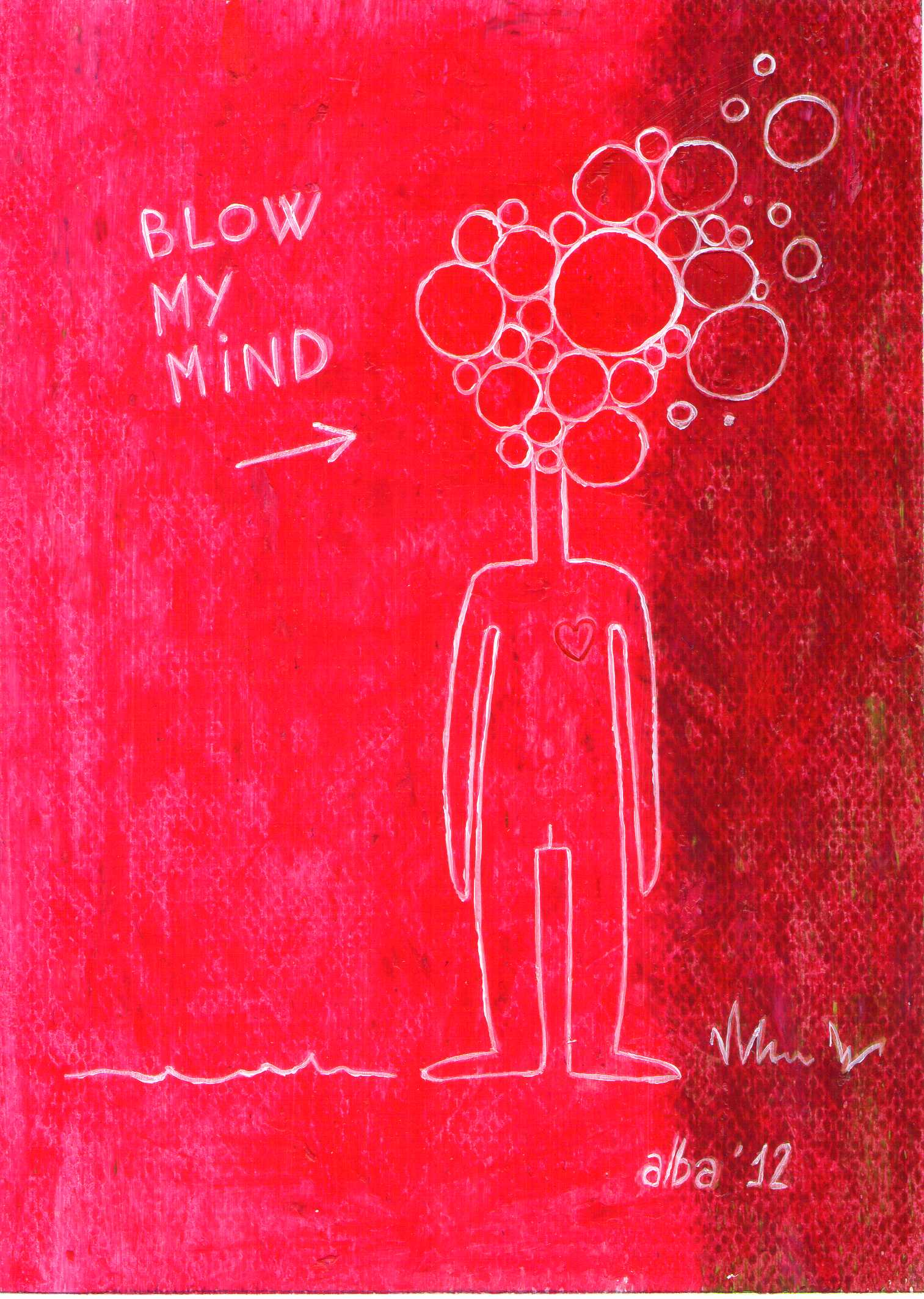
Ever had that feeling where your brain just... stalls? You’re staring at a photo of the Pillars of Creation taken by the James Webb Space Telescope, or maybe you just watched a street magician pull a live goldfish out of a dry deck of cards. Your jaw drops. You feel small, but weirdly connected to everything. You might actually blurt out, "you blow my mind." It’s a cliché, sure, but it’s one of those rare phrases that perfectly captures a physical sensation.
Honestly, we don't use it for minor stuff. You don't say it because your latte was slightly better than usual. You save it for the heavy hitters.
It’s about the total collapse of your current expectations. Psychology calls this "accommodation." Basically, your brain has a map of how the world works, and then something happens that is so massive or strange that the map doesn't fit anymore. You have to literally rebuild your mental models in real-time. That "blowing" sensation? That's the sound of your old logic hitting a wall.
The Real Biology of Being Mind-Blown
When something makes you feel like it's blowing your mind, your body isn't just sitting idle. Dacher Keltner, a psychologist at UC Berkeley and author of the book Awe, has spent years tracking what happens to us in these moments. It’s fascinating.
Your "vagus nerve" kicks in. This is the primary bundle of the parasympathetic nervous system. While "fight or flight" amps you up, the feeling of being mind-blown actually slows your heart rate down. It makes you go quiet. You might get "goosebumps"—technically called piloerection—which is an evolutionary leftover from when we had more hair and needed to look bigger or stay warm. But in a modern context, it’s the physical marker of an emotional overload.
It’s not just a feeling. It’s a physiological shift.
Recent fMRI studies have shown that when people experience something truly mind-blowing, the "Default Mode Network" (DMN) in the brain actually deactivates. The DMN is the part of your brain responsible for your "self"—your ego, your to-do list, your worries about what you said to your boss yesterday. When the DMN shuts down, you stop thinking about yourself. You become completely absorbed in the thing in front of you. That’s why people describe these moments as "transcendent." You literally lose yourself for a second.
Why We Seek Out the Mind-Blowing
We’re kind of addicted to it.
Think about the film industry. We spend billions on CGI just to see something that defies physics. Why? Because the feeling of having your mind blown is one of the few things that can snap us out of the "hedonic treadmill"—that boring cycle of getting used to things until nothing feels special anymore.
Interestingly, there’s a social component to this. Research published in the journal Psychological Science suggests that people who experience awe or "mind-blowing" moments are more likely to be generous. When your ego is temporarily offline because you just saw the Grand Canyon or realized the scale of the universe, you’re less focused on your own needs and more focused on the group.
It makes us better humans. Briefly.
When the Phrase Hits Different
There’s a difference between a "neat fact" and something that makes you say you blow my mind.
Take the "Overview Effect." It’s the cognitive shift reported by astronauts when they see Earth from space for the first time. They aren't just seeing a planet; they’re seeing a fragile, borderless marble hanging in a void. It’s a total perspective shift. It’s the ultimate version of the phrase.
But you don't need a rocket.
Sometimes it’s a person. We use the phrase when someone displays a level of skill or kindness that we didn't think was possible. When a musician improvises a perfect solo or a friend shows a level of forgiveness that seems superhuman, they blow your mind because they've raised the bar for what you thought "human" meant.
The Dark Side of Being Blown Away
It’s not all sunshine and stardust.
The same mechanism that allows us to feel wonder also makes us vulnerable to "shock and awe" tactics in marketing and politics. When we are overwhelmed by massive, complex, or frightening information, our critical thinking skills can take a backseat. If you’re too busy being "blown away" by a charismatic speaker or a terrifying news cycle, you’re less likely to poke holes in their logic.
Information overload is a real thing. Sometimes, the world tries to blow your mind so often—via 24-hour news and viral TikToks—that you just end up feeling numb. This is "awe-fatigue." If everything is mind-blowing, nothing is.
How to Get Your Mind Blown More Often
If you feel like life has become a bit of a gray blur, you can actually train yourself to experience this more often. It’s called "Awe Walking."
Instead of walking with your headphones in, looking at the pavement, you go for a walk with the specific intention of looking for things that are vast or unexpected. Maybe it’s the way the light hits a spiderweb, or the sheer scale of a construction project, or just the realization that every person you pass has a life as complex as your own.
It sounds hippy-dippy. It isn't. It’s a way to force that DMN to quiet down.
What We Get Wrong About Wonder
People think you need to be a scientist or an artist to have your mind blown. You don't. You just need to be paying attention.
We often confuse "surprise" with "mind-blowing." A jump scare is a surprise. A plot twist in a movie is a surprise. But something that blows your mind has to have weight. It has to change your "internal architecture."
If you learn a fact like "sharks are older than trees" (which they are, by about 50 million years), it’s a fun fact. But if you sit and really think about a shark swimming in an ocean on a planet that didn't have a single leaf yet... that’s when you get into the you blow my mind territory. It’s the contemplation that does the work, not just the information.
Actionable Ways to Expand Your Perspective
- Practice Selective Ignorance: Stop consuming "bite-sized" content that gives you a cheap hit of novelty. Read one long, complex article or book that challenges a belief you’ve held for years.
- Look Up, Literally: Most of our lives happen between 0 and 5 feet from our faces. Spend five minutes looking at the clouds or the stars. The scale alone is a natural trigger for awe.
- Ask the "How" Questions: Instead of just accepting that your phone works, look into the supply chain or the physics of silicon chips. The sheer impossibility of modern logistics is enough to break most brains.
- Seek Out "Moral Beauty": Read stories of people who have done extraordinary things for others. It’s a different kind of mind-blowing than a nebula, but it’s often more impactful.
- Accept the Discomfort: That feeling of being "lost" when you encounter a big idea is good. Don't rush to simplify it. Sit with the fact that you don't understand it yet.
The world is objectively weirder than we give it credit for. When you tell someone you blow my mind, you’re acknowledging that they’ve cracked your reality open just a little bit. That’s a gift. Don't be afraid to seek it out, even if it makes you feel small. Being small in a massive, incredible universe is a lot better than being the center of a tiny, boring one.



