It is 2009. You’re sitting in your room, probably staring at a poster or a laptop screen, and a girl in thick glasses is holding up a piece of paper that says "I Love You" through a window. That image is basically burned into the collective consciousness of anyone who survived the late 2000s. We’re talking about Taylor Swift’s "You Belong With Me," a track that didn't just climb the charts—it redefined the "girl next door" trope for an entire generation.
But if you actually look at the You Belong With Me lyrics, there’s a lot more going on than just a high school crush. It’s a masterclass in narrative songwriting. Taylor wrote this with Liz Rose, her frequent collaborator in those early Nashville days, and the story goes that it was inspired by a phone call Taylor overheard between a male friend and his girlfriend. He was apologizing, sounding defeated, and Taylor just thought, "Man, he really is with the wrong person."
That spark turned into a diamond.
The Anatomy of the You Belong With Me Lyrics
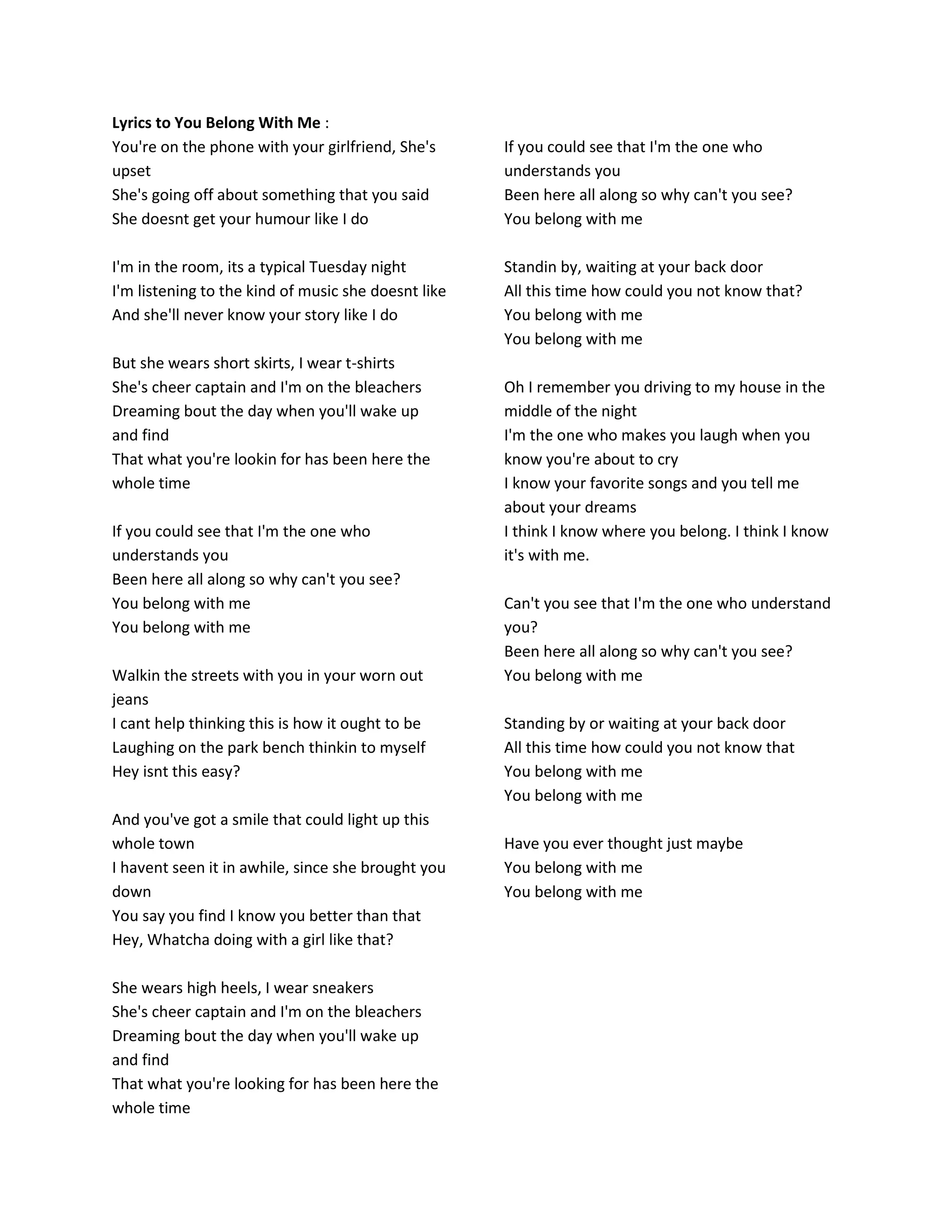
The song opens with a specific, relatable conflict. You’ve got the protagonist on the phone with a guy who’s getting yelled at by his girlfriend. The first few lines set the stage: "You're on the phone with your girlfriend, she's upset / She's going off about something that you said." It’s visceral. You can almost hear the muffled, angry voice on the other end of the line.
What makes these lyrics work isn't just the story; it's the contrast. The "short skirts" versus "t-shirts" line is iconic, but honestly, it’s kind of a cliché that Taylor managed to make feel brand new. She positions herself as the safe harbor. She’s the one who knows his favorite songs and his dreams, while the girlfriend is just "cheer captain."
It’s interesting to look back on this through a 2026 lens. Some people argue the song is a bit "pick me," a term that didn't even exist when the song was released. Critics point to the lyrics as pitting women against each other. But you have to remember the context of 2009. This was the peak of the "not like other girls" era. Taylor wasn't trying to be a social commentator; she was writing a diary entry about feeling invisible. That’s why it resonated then, and that’s why it still gets 100,000 people screaming every night during the Eras Tour.
The Bridge is Where the Magic Happens
If you want to know why Taylor Swift is a billionaire today, look at the bridge of this song. "Oh, I remember you driving to my house in the middle of the night / I'm the one who makes you laugh when you know you're 'bout to cry."
The rhythm shifts. It gets urgent.
She isn't just saying she's a better fit; she's providing evidence. The lyrics move from observation to a direct plea. It’s the "hey, wake up" moment. Most pop songs from that era were content to stay in the chorus-verse-chorus loop without much emotional progression. Taylor, even at 18 or 19, knew that the bridge is where you win the audience's heart.
Why We Are Still Obsessed With the Narrative
Let's talk about the music video for a second because you can't separate the You Belong With Me lyrics from the visual of Taylor playing both the protagonist and the antagonist. Lucas Till, who played the love interest, once mentioned in an interview that the chemistry was easy because the song's story was so clear.
The lyrics create a world.
- The bleachers.
- The typical Tuesday night.
- The "hey, isn't this easy?" vibe.
It’s a specific brand of American teenage nostalgia that feels universal even if you didn't grow up in a town with a football team.
There’s a weirdly specific detail in the lyrics about the guy "driving to my house in the middle of the night." It implies a level of intimacy that goes beyond just "friends." They are already in a relationship in every way that matters, except for the label. That is the exact tension that keeps people listening. It’s the frustration of the "friend zone" before that term became a tired meme.
Factual Nuances: The Fearless (Taylor's Version) Shift
When Taylor re-recorded this for Fearless (Taylor's Version) in 2021, the lyrics didn't change, but the delivery did. The 2009 version has a slight country twang—a bit of a "yeehaw" in the vowels. The 2021 version is cleaner, more mature.
Listening to a 31-year-old woman sing "I'm in my room, it's a typical Tuesday night" should feel weird. It doesn't.
Why? Because the songwriting is structurally sound. The rhyme scheme ($AABB$ or $ABAB$ depending on the section) is tight. The internal rhymes—like "know" and "show" or "see" and "me"—keep the momentum going so fast you don't realize you're being hit with a heavy emotional beat.
The Misconception of the "Protagonist"
Most people think the narrator is a loser. She isn't. If you read the lyrics closely, she's incredibly self-assured. She isn't asking if she's the right one; she's telling him she is.
"I know your favorite songs / And you tell me 'bout your dreams / Think I know where you belong / Think I know it's with me."
That's not a shy girl. That's a girl with a plan.
The Cultural Impact and SEO Longevity
People search for these lyrics every single day. Not just because they want to sing along, but because they want to use them for Instagram captions or TikTok transitions. The song has stayed relevant because it’s a template for unrequited love.
The 2010 Grammy Awards saw this song nominated for Record of the Year, Song of the Year, and Best Female Pop Vocal Performance. It didn't win Song of the Year (that went to "Single Ladies" by Beyoncé—shoutout to Kanye for that whole mess), but it solidified Taylor as a songwriter who could bridge the gap between country and pop.
What You Should Do Next
If you’re looking to really understand the brilliance of the You Belong With Me lyrics, don't just read them. Listen to the "Taylor's Version" and the original 2009 track back-to-back. Look for the way her voice hits the word "humor" in the second verse.
- Analyze the Contrast: Notice how the lyrics use clothing (skirts vs. t-shirts, high heels vs. sneakers) as a shorthand for personality. It’s a songwriting trick called "object-oriented storytelling."
- Check the Credits: Look into Liz Rose’s other work with Taylor, like "All Too Well" or "White Horse." You’ll see the same DNA of specific, biting imagery.
- Watch the Eras Tour Film: Pay attention to how the crowd reacts to the "double-tap" on the drums right before the chorus. That beat is baked into the lyrical structure.
The song isn't just a relic of the late 2000s. It’s a blueprint for how to tell a story in three minutes and thirty seconds. Whether you're a die-hard Swiftie or just someone who likes a good pop hook, there's no denying the craft here.
The next time you hear it, listen for the way the lyrics build the stakes. It’s not just a song about a boy. It’s a song about the fear of being the only one who sees the truth. And that, honestly, is something everyone can relate to.
To get the most out of your Taylor Swift deep dive, compare these lyrics to her later work on Folklore or Evermore. You’ll find that the "invisible narrator" theme she used in 2009 is the same one she perfected in "Invisible String" or "Right Where You Left Me." The songwriting evolution started right here, on a typical Tuesday night.
---



