It is 2:00 AM and a girl is wearing a t-shirt and glasses. You know the rest. If you grew up in the late 2000s, those lyrics didn't just play on the radio; they lived in your head. You Belong With Me is more than just a catchy country-pop crossover. It’s a cultural touchstone that perfectly captured the universal ache of being overlooked. Honestly, even if you weren't a teenage girl at the time, the song hits on a specific type of social anxiety that doesn't really go away with age.
Taylor Swift wrote this with Liz Rose for her second studio album, Fearless, released back in 2008. The story goes that Swift overheard a male friend of hers arguing with his girlfriend over the phone. He was apologizing, sounding defeated, and Swift just thought, "Why is he with her?" That's the spark. It wasn't some grand poetic vision from the start. It was just a teenager observing a messy relationship and thinking she could do it better.
People still scream these lyrics at the top of their lungs today. Why? Because the song isn't actually about a boy. Not really. It's about the feeling of being the "underdog" while someone "better" takes the prize. It’s about the sneakers vs. high heels dichotomy that launched a thousand memes.
Breaking Down the You Belong With Me Lyrics
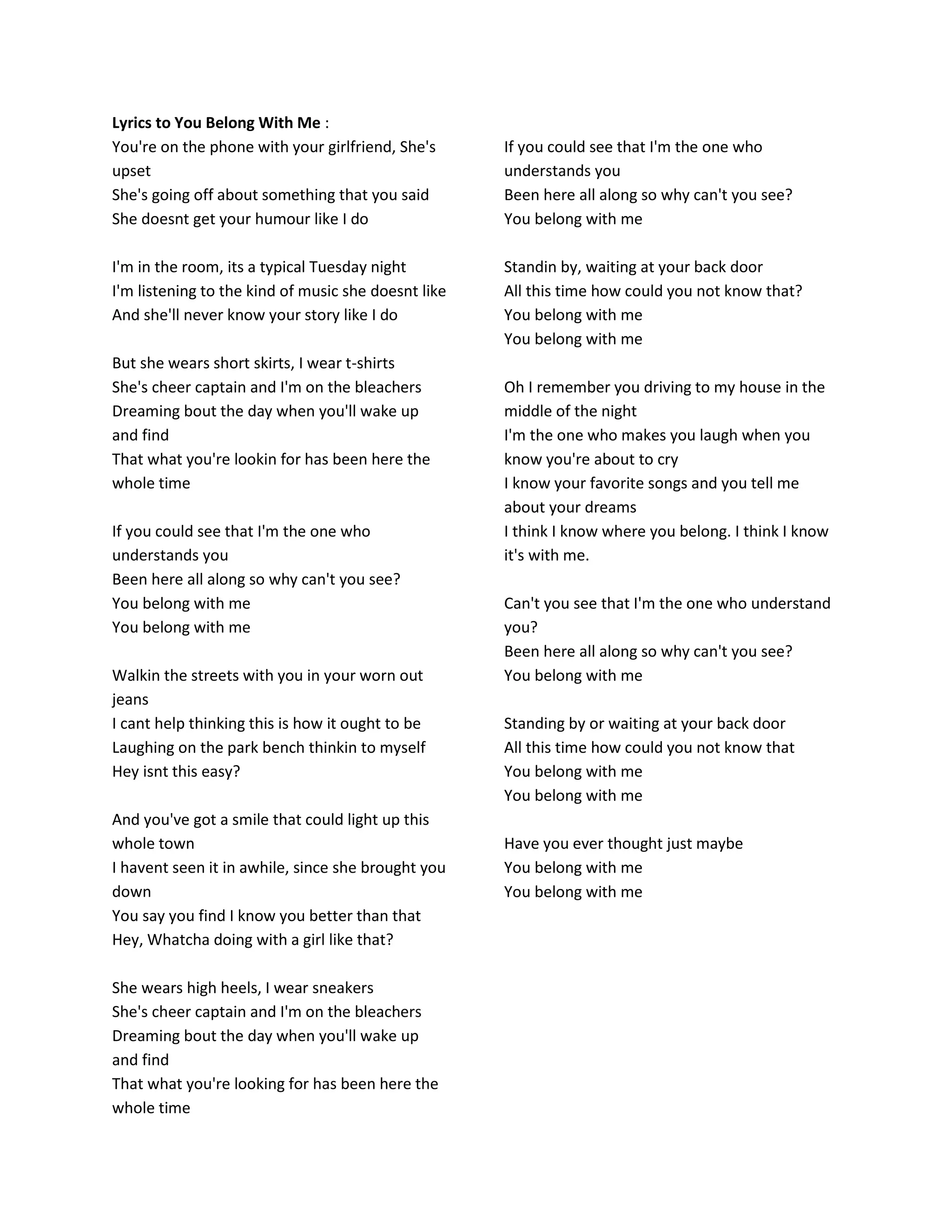
The opening lines set a scene that feels like a movie. You’ve got the guy on the phone, the girlfriend who is "upset" and "going off about something" that he said. Swift positions herself immediately as the confidant. She’s the one who "gets" his humor. She’s the one who knows his stories.
When you look at the chorus, it’s a masterclass in simple, effective songwriting. "If you could see that I'm the one who understands you / Been here all along so why can't you see?" This is the core of the "Friend Zone" anthem. It’s frustrating. It’s desperate. It’s also kinda selfish, right? If we’re being real, the lyrics are a bit "pick me." But that’s what makes them authentic. Teenagers are "pick me." They are convinced that their crush is making a monumental mistake by dating anyone else.
The contrast in the second verse is where the visual storytelling really kicks in. You have the "short skirts" and "t-shirts," the "cheer captain" and the girl on the "bleachers." It’s classic high school trope territory. Critics have sometimes pointed out that this paints other women in a negative light—the "other girl" is always the villain. But in the context of a 16-year-old’s diary, it makes perfect sense. To a girl in love with her best friend, the rival is the villain.
The Bridge and the Emotional Peak
The bridge is where the song shifts from complaining to pleading. "Oh, I remember you driving to my house in the middle of the night." This implies a level of intimacy that goes beyond just classmates. They are close. They share secrets. This makes the rejection—or the lack of realization on the boy's part—feel even more like a betrayal.
Then there’s the famous "Hey, isn't this easy?" line. Swift is basically arguing that love shouldn't be a fight. It shouldn't be the drama he’s dealing with on the phone in the first verse. It should be as easy as two friends hanging out. It’s a compelling argument, and one that resonates with anyone who has ever watched someone they love get treated poorly by someone else.
Why the Lyrics Still Matter in 2026
You might think a song from 2008 would feel dated by now. It doesn't. While the "sneakers vs. heels" thing might feel a little cliché in a world of diverse fashion, the feeling behind it is timeless. We still have that "bleachers" energy sometimes.
During the Eras Tour, the reaction to this song was consistently one of the loudest of the night. It bridges the gap between the "Old Taylor" and the global superstar she became. Interestingly, when she re-recorded the track for Fearless (Taylor's Version) in 2021, her vocals were more mature, but she kept that same yearning. She didn't try to make it sound "adult." She respected the teenage version of herself who felt those things so deeply.
Common Misconceptions About the Song
- It’s based on a specific celebrity crush. Actually, no. Swift has been pretty clear it was inspired by a friend's real-life phone call. It wasn't about a famous boyfriend.
- She’s the protagonist in the video and the song. While Taylor plays both the "nerdy" girl and the "popular" girl in the music video (directed by Roman White), the song lyrics themselves don't mention a double role. That was a creative choice for the visual.
- It’s a "mean girl" song. Some people argue it’s "slut-shaming" because of the skirt comment. Honestly, it’s more about social tiers in an American high school setting than it is about judging someone's character based on clothes. It's about feeling like you don't fit the "ideal" mold.
The Technical Brilliance of the Lyrics
Swift and Rose used a very specific rhyme scheme that keeps the energy moving. Most of the verses use AABB or ABAB patterns that feel familiar and safe. This "safety" in the music mirrors the "safety" the narrator is offering the boy.
The "You Belong With Me" lyrics use what’s called internal rhyme and rhythm to make them sticky. Think about the way "typical Tuesday" rolls off the tongue. Or "I'm in my room, it's a typical Tuesday night / I'm listening to the kind of music she doesn't like." It builds a world in just two lines. You know exactly what that room feels like. You can almost smell the old posters and the late-night snacks.
Also, notice the use of sensory details.
- Sound: The "screaming" on the phone.
- Sight: The "short skirts," "high heels," and "bleachers."
- Emotion: That specific "ache" of being right there but being invisible.
Impact on the Music Industry
This song was a massive crossover success. It peaked at number two on the Billboard Hot 100. It proved that "country" lyrics could be universal. You didn't need a tractor or a cowboy hat to be country; you just needed a story and an acoustic guitar. It paved the way for the "genre-less" era of music we live in now.
Before this, country was often seen as something for older audiences. Swift took the songwriting mechanics of Nashville—the storytelling, the specific details—and applied them to the teenage experience. The result was a juggernaut. It’s why you see artists like Olivia Rodrigo or Sabrina Carpenter citing Swift as a primary influence. They learned how to turn specific, almost mundane details into massive pop hooks.
What to Take Away From the Story
If you’re looking at these lyrics from a songwriter's perspective, the lesson is clear: be specific. Don't just say "I like you." Say "I know your favorite songs and you tell me about your dreams." The more specific the lyric, the more universal it becomes. It sounds counterintuitive, but it's true. Everyone has their version of the "t-shirt" or the "bleachers."
For fans, the song is a reminder that being the "underdog" is a temporary state of being. The girl in the song eventually gets the guy (at least in the video's happy ending). But even if she didn't, she found her voice. She articulated her worth. That’s the real power of the track.
How to Fully Experience the Song Today
If you want to really dive back into the You Belong With Me lyrics, don't just put it on as background noise.
- Listen to both versions: Compare the 2008 original with the 2021 Taylor's Version. You can hear the change in her breath control and the subtle shift in the guitar mix.
- Read the lyrics as poetry: Strip away the catchy melody. Read the words on the page. It’s a very tight, well-constructed narrative.
- Watch the music video again: It’s a time capsule of 2009 fashion and cinematography. Lucas Till (the guy in the video) actually went on to be in X-Men, which is a fun bit of trivia.
The song is a piece of pop history. It’s a reminder of a time when the biggest problem in the world was who was taking who to prom. And sometimes, we all need to lean into that nostalgia. Whether you're in your room on a typical Tuesday or driving down the highway, those lyrics still hold a weird, magical kind of gravity. They pull you back to a version of yourself that felt everything 100 times harder than you do now. And that’s a pretty cool thing for a song to do.
To get the most out of your Taylor Swift deep dive, check out the liner notes for the Fearless album, where she famously hid secret messages in the lyrics using capitalized letters. For "You Belong With Me," the secret message was "LOVE IS SO BLIND," which pretty much sums up the entire three-minute and fifty-one-second journey.
Next time you hear it, pay attention to the banjo in the background of the country version—it's a subtle reminder of where she started, even as she was headed straight for pop superstardom.
Actionable Insights:
- Analyze the contrast: Use the "You Belong With Me" lyrics as a template for storytelling. Contrast two different worlds (sneakers vs. heels) to create immediate conflict.
- Study the bridge: Notice how the bridge changes the "argument" of the song. It moves from observation to a direct plea, increasing the emotional stakes.
- Appreciate the specifics: When writing your own stories or content, use "typical Tuesday" details instead of broad generalizations to build a more relatable narrative.



