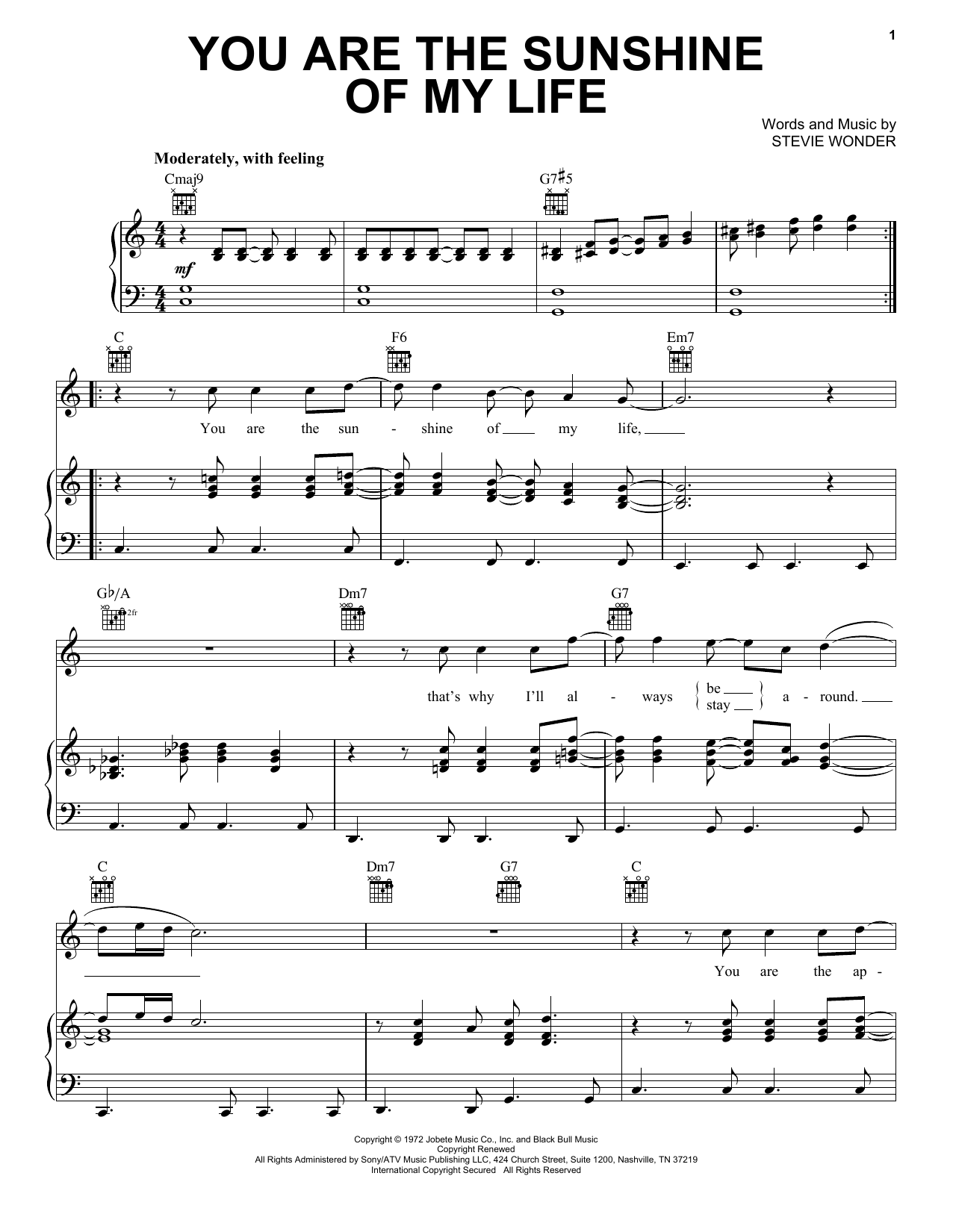
It starts with a Rhodes piano, soft and shimmering, like a hazy morning in 1972. Then, a voice comes in. But wait—that’s not Stevie.
Most people don't realize that You Are the Sunshine of My Life actually opens with someone else entirely. Two people, actually. Jim Gilstrap takes the first two lines, his voice warm and steady, before Lani Groves answers him with the next two. It’s an incredibly generous move for a guy who was just coming into his own as a global superstar. He literally hands the opening of his future number-one hit to his backup singers. Why? Maybe to show that love isn't just a solo act. Or maybe, as some fans joke, he just wanted to keep us on our toes. For a different perspective, consider: this related article.
The Breakdown of a Masterpiece
Released in 1973 as the second single from the legendary album Talking Book, the song is a sonic hug. It’s smooth. It’s soulful. Honestly, it’s the kind of track that makes you forget Stevie Wonder was only 22 years old when he recorded it. Think about that for a second. At 22, most of us are trying to figure out how to do laundry without shrinking our favorite shirt. Stevie was out here rewriting the rules of R&B and pop.
The track famously broke through the "easy listening" barrier. It was Stevie's first #1 on the Billboard Easy Listening chart, proving he could reach an audience far beyond the Motown faithful. But don't let the "soft" label fool you. The musicianship here is elite. Scott Edwards provides a bassline that’s almost invisible but holds everything together, while Daniel Ben Zebulon adds congas that give the song its gentle, swaying rhythm. Related coverage on this trend has been published by E! News.
Who was the "Sunshine"?
Everyone wants to know who the song is about. The answer is complicated and a little bittersweet. It’s widely accepted that the inspiration was Syreeta Wright, Stevie’s first wife. They were married in 1970, a pairing of two brilliant musical minds who co-wrote hits like "Signed, Sealed, Delivered I'm Yours."
But here’s the kicker.
By the time the world was slow-dancing to You Are the Sunshine of My Life, the marriage was basically over. They split up in 1972. It’s a strange contradiction—singing about forever while the "forever" is actively dissolving. Yet, there’s no bitterness in the lyrics. Stevie sings about "drowning in my own tears" if the love were to end, but the melody remains jubilant. It suggests a level of maturity that most people don't reach in their 50s, let alone their early 20s. They stayed close friends until her passing in 2004, which makes the line "forever you'll stay in my heart" feel less like a romantic promise and more like a profound truth.
Why it sounds different on the radio
If you grew up listening to the radio, you might have heard a version with a punchy horn section. If you bought the vinyl of Talking Book, those horns are nowhere to be found.
The single version was remixed specifically for airplay. They added those bright, triumphant brass flourishes to give it a bit more energy for the AM dial. Usually, these kinds of "radio edits" can ruin the vibe of a song, but here, it actually works. It turns a bedroom ballad into a celebratory anthem.
The Grammy Gold
The industry noticed. At the 1974 Grammys, Stevie was the man of the hour. You Are the Sunshine of My Life won him the award for Best Male Pop Vocal Performance. It was also nominated for Record of the Year and Song of the Year. It was part of a run where Stevie was essentially untouchable.
Consider the context:
- He had just finished touring as the opening act for the Rolling Stones.
- He was experimenting with the TONTO synthesizer system, which gave his music a futuristic edge.
- He was demanding—and getting—complete creative control from Motown.
This song wasn't just a hit; it was a victory lap. It proved that he could do "pretty" just as well as he could do "funky" (like the album's other monster hit, "Superstition").
A Legacy of Covers
You know a song has "made it" when everyone from Frank Sinatra to The Muppets tries their hand at it. Sinatra’s version is exactly what you’d expect—swaggering and brassy—but it lacks the raw, vulnerable soul of the original. There’s a specific "Stevie" magic in the way he stretches the vowels in the word "rescue." It’s hard to replicate.
Actionable Insights for Music Lovers
If you want to truly appreciate this track today, don't just stream the "greatest hits" version. Go back to the source.
- Listen to the full Talking Book album: It’s a 43-minute masterclass. The transition from the gritty "Maybe Your Baby" into the sweet "You and I" is essential context for understanding Stevie's range.
- Pay attention to the mix: If you have decent headphones, listen for the way the Rhodes piano sits in the stereo field. It’s incredibly lush.
- Watch the live versions: Look up Stevie performing this in the mid-70s. The way he interacts with his band, Wonderlove, shows how much of the "Sunshine" was actually a collaborative spirit.
- Check out Syreeta's work: To understand the muse, listen to her 1972 debut album, Syreeta. Stevie produced it, and you can hear the musical conversation they were having at the time.
Ultimately, You Are the Sunshine of My Life remains a staple because it captures a universal feeling without being cheesy. It’s sincere. In an era where music can feel over-processed, the sight of a young Stevie Wonder sitting at a keyboard, pouring his heart out for a love that was already fading, still feels incredibly real.
To fully experience the genius of this era, listen to the original Talking Book LP mix on high-quality headphones to hear the subtle nuances of the Fender Rhodes and conga tracks that are often lost on standard radio speakers. For a deeper historical dive, track down the 1972 Rolling Stones tour documentaries to see how Stevie’s live energy during this period helped bridge the gap between soul and rock audiences.



