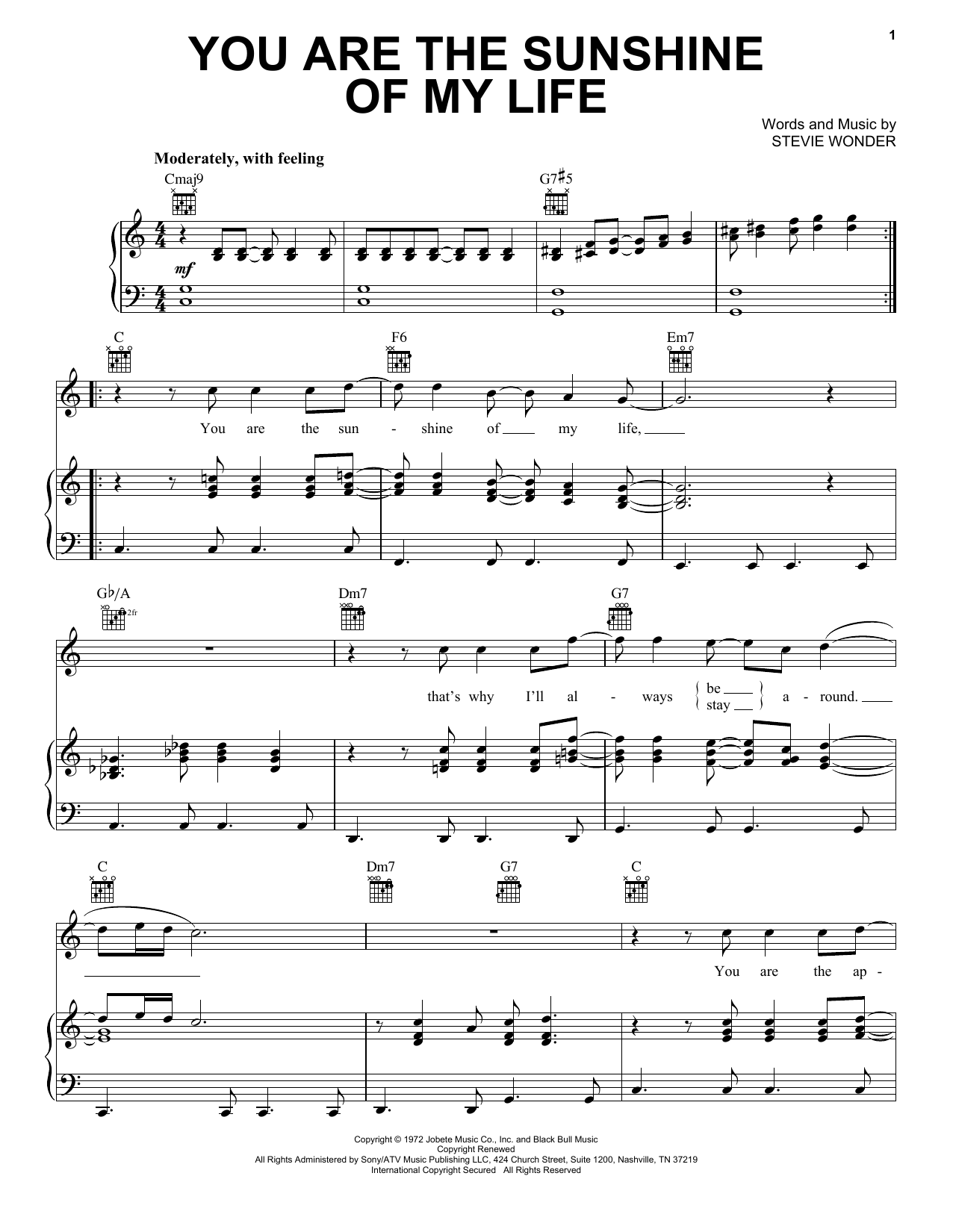
Ever wake up with a song stuck in your head that actually makes you feel like the world isn't falling apart? For most people, that's You Are the Sunshine of My Life. It’s the ultimate "wedding song," the quintessential "I'm in love" anthem, and honestly, one of the most perfectly constructed pop songs ever recorded.
But there’s a weird thing about it.
If you listen closely to the very beginning—the first four lines—you aren't even hearing Stevie Wonder.
The Mystery Voices
Most fans don't realize that Stevie doesn't start his own song. He lets his backup singers take the lead for the first verse. Jim Gilstrap sings the first two lines: "You are the sunshine of my life / That's why I'll always be around." Then Lani Groves takes over for the next two: "You are the apple of my eye / Forever you'll stay in my heart." Stevie finally comes in after that, his voice soaring with that unmistakable grit and warmth. It was a bold move. Most superstars in 1972 wouldn't dream of giving away the opening of their big single to session singers. But Stevie wasn't exactly following the rules back then.
He was in the middle of what critics now call his "classic period." He’d just turned 21, finally wrested creative control away from the Motown hit machine, and was busy reinventing what soul music could sound like.
Why Talking Book Changed Everything
The song appeared on the 1972 album Talking Book. If you haven't sat down and listened to that record start-to-finish, you’re missing out on a masterclass. It’s the same album that gave us "Superstition," which is basically the opposite of "You Are the Sunshine of My Life." One is dark, funky, and skeptical; the other is bright, jazzy, and vulnerable.
This duality is what made Stevie a genius. He wasn't just a singer. He was a multi-instrumentalist who played almost everything on his records. On You Are the Sunshine of My Life, he’s playing the Fender Rhodes electric piano and the drums.
The sound is incredibly lush.
It feels like a warm hug, but if you look at the technical side, it's actually quite complex. The song uses a bossa nova-influenced rhythm and sophisticated jazz chords that most pop stars wouldn't touch. Yet, it feels simple. That’s the trick. It takes a massive amount of talent to make something this complex sound this easy.
Who was the "Sunshine"?
People always ask who the song was written for. The common consensus is that it was inspired by Syreeta Wright, Stevie’s first wife and a brilliant songwriter in her own right. They married in 1970 and, although their marriage didn't last long, their creative partnership was legendary.
They co-wrote hits like "Signed, Sealed, Delivered I'm Yours." Even after they split up, Stevie produced her solo albums. There’s a beautiful, bittersweet reality there—this "forever" love song was written by a man whose marriage was actually hitting some rocky ground. By the time the song became a massive hit in 1973, they were already headed toward divorce.
Life is messy. Music makes it look clean.
Breaking the "R&B" Box
Back in the early 70s, the music industry loved to pigeonhole artists. If you were Black, you were "R&B." If you were white, you were "Pop" or "Rock." Stevie hated that.
You Are the Sunshine of My Life was a massive crossover success. It wasn't just a hit on the R&B charts; it went to Number 1 on the Billboard Hot 100 and the Easy Listening (now Adult Contemporary) charts. It won him a Grammy for Best Male Pop Vocal Performance.
Not R&B. Pop.
He was proving that soul music was universal. He spent part of 1972 touring with the Rolling Stones, playing for massive crowds of white rock fans who had never seen anything like him. By the time this song dropped as a single in early '73, he was a global icon.
Technical Brilliance in the Studio
Recording this track wasn't just about catching a vibe. Stevie was working with Robert Margouleff and Malcolm Cecil, two synth wizards who helped him harness the power of the TONTO—a massive, room-sized synthesizer.
While this specific song is more acoustic and Rhodes-heavy than his funkier tracks, it still benefits from that meticulous production. The congas (played by Daniel Ben Zebulon) give it that gentle, percussive drive. The bass (Scott Edwards) keeps it grounded.
It’s a perfect mix.
Everything sits exactly where it should. There's no clutter. Every note from the electric piano feels like a raindrop on a tin roof.
What We Get Wrong About the Lyrics
We often think of this as a "simple" love song. But look at the bridge:
"I feel like this is the beginning / Though I've loved you for a million years / And if I thought our love was ending / I'd find myself drowning in my own tears."
There is a deep sense of desperation hidden under the sweetness. It’s the feeling of being so in love that the mere thought of it ending is a literal death sentence. That’s the "Wonder" touch. He never gives you pure sugar; there’s always a little bit of salt in there to make the flavor pop.
Impact and Legacy
Fifty years later, the song is everywhere. It’s been covered by everyone from Frank Sinatra to Jack White. It’s been in countless movies and commercials.
Why?
Because it taps into a universal truth. Everyone wants to be someone’s "sunshine." Everyone wants to feel that "apple of my eye" level of devotion. It’s a song that transcends its era. It doesn't sound "70s" in a dated way; it sounds like a classic from the Great American Songbook that just happened to be written by a kid from Detroit with a synthesizer.
How to Truly Appreciate This Track
If you want to experience the song properly, stop listening to it on tinny phone speakers.
- Find a high-quality version (FLAC or a clean vinyl pressing).
- Use decent headphones.
- Focus on the drums. Notice how Stevie’s drumming isn't "perfect" like a machine; it has a slight "swing" to it that feels human.
- Listen for the background harmonies. The way the voices blend in the chorus is subtle but incredibly complex.
- Check out the rest of the album. Talking Book is a journey. This song is the bright doorway that leads you into some much darker, funkier rooms.
You can actually learn a lot about songwriting just by humming the melody. It’s a lesson in restraint and melody. Sometimes, you don't need to shout to be heard. Sometimes, a whisper and a Rhodes piano are enough to change the world.
Actionable Takeaways
- Study the crossover: Notice how the song blends jazz, soul, and pop. If you're a musician, try playing the chords—they aren't your standard three-chord progression.
- Listen for the "hand-off": Pay attention to the transitions between Gilstrap, Groves, and Wonder. It’s a masterclass in vocal arrangement.
- Explore the "Classic Period": If you like this, move immediately to Innervisions and Fulfillingness' First Finale. It’s the greatest three-album run in music history.
Stevie Wonder didn't just write a love song; he wrote a blueprint for how to be vulnerable and technically brilliant at the same time. That’s why we’re still talking about it. That’s why we’re still singing it.



