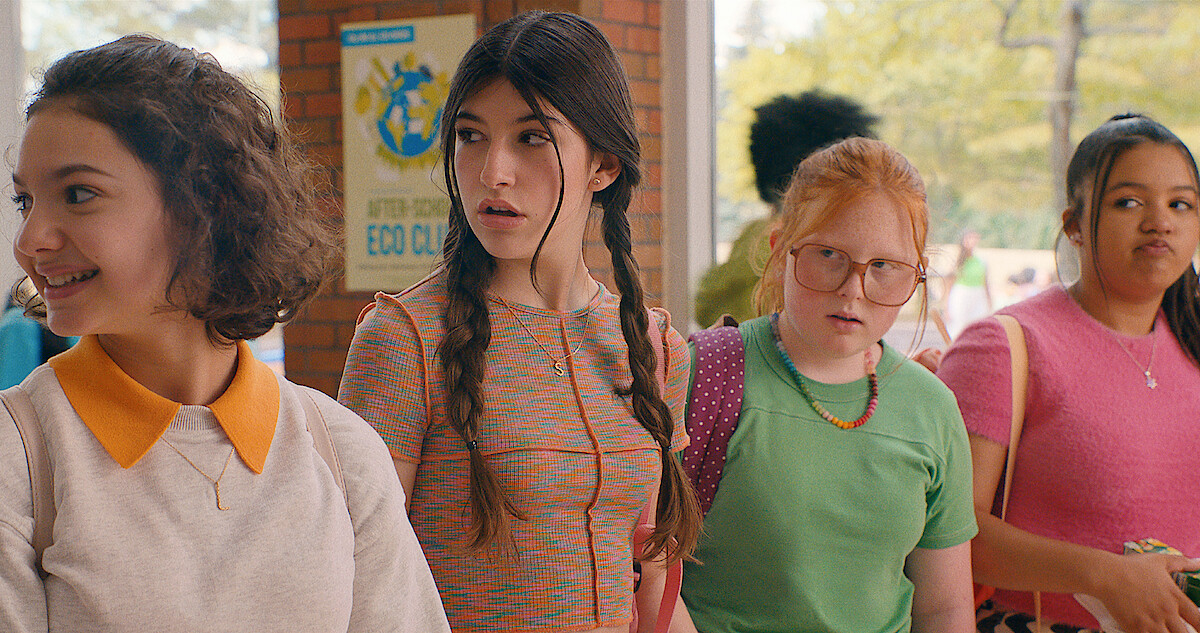
It shouldn't have been this good. Usually, when a massive movie star casts their entire immediate family in a project, the result is a cringey vanity project that feels more like a recorded Thanksgiving dinner than a cinematic achievement. But somehow, You Are So Not Invited to My Bat Mitzvah dodged every single nepo-baby landmine. It’s weirdly charming. Honestly, it’s one of the most authentic depictions of middle-school female friendship we've seen in years, and that’s coming from someone who usually finds Adam Sandler’s Netflix era a bit hit-or-miss.
The movie, which hit Netflix in late 2023, isn't just a vehicle for Sunny and Sadie Sandler to get their SAG cards. It’s based on Fiona Rosenbloom’s 2005 novel of the same name. If you grew up in the early 2000s, you probably remember that bright pink book cover in the Scholastic Book Fair. Adapting a twenty-year-old YA novel for the Gen Z era is risky. Trends change. Slang dies. But the core humiliation of being thirteen? That’s eternal.
The Sandler Family Dynamic That Actually Makes Sense
Most people went into You Are So Not Invited to My Bat Mitzvah expecting Adam Sandler to be the main event. He isn't. He plays Danny Friedman, the quintessential "cool but embarrassing" Jewish dad. He spends half the movie in cargo shorts, yelling about how much a party costs. It’s a supporting role, and he plays it with a level of restraint that lets his real-life daughter, Sunny Sandler, actually carry the film.
Sunny plays Stacy Friedman. She’s obsessed with having the perfect Bat Mitzvah. She wants a private island theme. She wants the right boy to notice her. Most importantly, she wants her best friend Lydia (played by Samantha Lorraine) by her side. When a boy—the incredibly well-cast, floppy-haired Andy Goldfarb—comes between them, the fallout is nuclear.
What’s fascinating is the chemistry. Usually, on-screen families feel staged. Here, because Sunny and Sadie (who plays the older sister, Ronnie) are actually sisters, the bickering feels lived-in. There’s a scene where they’re just hanging out on a couch, and the rhythm of their dialogue is so specific to siblings that you can’t really fake it. Sadie Sandler, in particular, has this deadpan comedic timing that suggests she’s been making fun of her dad’s movies for her entire life.
Why the "Nepo Baby" Narrative Misses the Point Here
We have to talk about the elephant in the room. The internet loves to hate a "nepo baby." When the casting was announced, Twitter (now X) was ready to pounce. People expected a disaster. However, critics like Courtney Howard and outlets like Variety pointed out something pretty undeniable: the kids can actually act.
Director Sammi Cohen, who previously did Crush on Hulu, has a knack for capturing the chaotic energy of puberty without making it feel like an adult’s caricature of a teenager. The film doesn't look down on Stacy’s problems. To a thirteen-year-old, a best friend "betrayal" isn't a minor inconvenience. It’s the end of the world. By casting his own kids, Sandler actually added a layer of protection to the production. You can tell these girls felt safe enough to be goofy, ugly-cry, and act genuinely bratty without the polished "Disney Channel" sheen that ruins most teen movies.
It’s also worth noting that Idina Menzel plays the mom. This is a Uncut Gems reunion we didn't know we needed. While she doesn't have a massive amount of screen time, her presence grounds the family. She’s the voice of reason when Danny is arguing about the price of a DJ.
The Cultural Specificity is the Secret Sauce
One of the biggest reasons You Are So Not Invited to My Bat Mitzvah ranks so well with audiences is that it doesn't shy away from the "Jewishness" of the story. It isn't just a generic party movie. We see the Hebrew school struggles. We see the Torah portions. We see Sarah Sherman (from Saturday Night Live) playing a quirky rabbi who tries way too hard to be relatable.
Sherman is a riot. Her character, Rabbi Rebecca, is basically a human cartoon, but anyone who grew up in a religious community knows exactly who this person is. The person who uses a guitar to make "the youth" care about ancient texts. It’s specific. It’s niche. And because it’s so specific, it feels universal.
The movie captures the weird tension of the Bat Mitzvah season. It’s a rite of passage that is ostensibly about becoming an adult in the eyes of the faith, but in reality, it often turns into a high-stakes competition of who can hire the best hype-man or have the coolest giveaway hoodies. Stacy’s struggle to balance the "meaning" of the event with her desire for social status is the central conflict, and it’s handled with a surprising amount of grace.
Breaking Down the Plot Without the Fluff
Look, the plot is straightforward. Stacy and Lydia have a "plan." They’ve been dreaming of their Bat Mitzvahs since they were toddlers. Then Lydia kisses Andy Goldfarb. Stacy finds out. Stacy goes on a revenge tour.
She tries to ruin Lydia’s reputation. She makes a "burn" video (which is a very 2020s update to the Mean Girls burn book). She ignores her parents. She messes up her Mitzvah project. It’s a classic "girl loses her way" arc. But the movie succeeds because Stacy isn't always likable. She’s selfish. She’s impulsive. She’s thirteen.
The resolution isn't some grand romantic gesture with the boy. The boy is actually kind of a jerk, which is a great lesson for the target audience. The real "love story" is the friendship between the two girls. When Stacy finally gives up her own big moment to fix things with Lydia, it feels earned. It’s a reminder that at that age, your best friend is the sun and the moon. Everyone else is just a planet orbiting that relationship.
Technical Details and Production Notes
- Director: Sammi Cohen
- Writer: Alison Peck (Screenplay), Fiona Rosenbloom (Novel)
- Release Date: August 25, 2023
- Platform: Netflix
- Runtime: 103 minutes
The soundtrack is also a massive highlight. It features a mix of current pop and classic party tracks that you’d actually hear at a bar mitzvah in Long Island or New Jersey. It builds an atmosphere that feels current but nostalgic for the parents watching along.
What Most People Get Wrong About the Movie
There’s a misconception that this is just a "kids' movie." Honestly, it’s a parenting movie in disguise. Adam Sandler’s character represents the struggle of watching your child grow into a person you don't always recognize. There’s a scene where he’s hitting golf balls and talking to Stacy about her choices, and you can see the genuine exhaustion and love in his eyes. It’s a performance that reminds you he’s a father of two daughters in real life. He’s not acting the "dad" part; he’s living it.
Another misconception is that you have to be Jewish to "get" it. Not true. While the religious milestones are central, the themes of envy, social media pressure, and the terrifying ordeal of being known by your peers are universal. Whether it’s a Bat Mitzvah, a Sweet 16, or a Quinceañera, the pressure to "perform" adulthood is something almost everyone can relate to.
Actionable Takeaways for Movie Night
If you're planning to watch You Are So Not Invited to My Bat Mitzvah or you're a creator looking at why it succeeded, here are a few things to keep in mind:
For Parents and Teens: Watch it together. It’s one of the few movies that actually opens up a dialogue about "mean girl" behavior without being overly preachy. It shows the consequences of social media bullying in a way that feels real rather than like a PSA. Plus, it’s genuinely funny for both generations.
For Aspiring Screenwriters and Content Creators: Study the "specificity" rule. The reason this movie stood out in a sea of Netflix teen rom-coms is that it leaned into the specific details of its culture and setting. Don't write "generic teen girl." Write "thirteen-year-old girl in 2023 who is obsessed with a specific brand of lip gloss and feels like her life is over because of a botched Instagram post." Detail creates authenticity.
For the "Nepo Baby" Critics: Use this as a case study for when talent outweighs the "foot in the door." Yes, the Sandler girls got the roles because of their dad. But they kept the audience’s attention because they have a natural screen presence. It’s an example of using your platform to foster genuine talent rather than just handing out unearned favors.
The movie ends not with a "happily ever after" with a boy, but with a dance floor full of friends. It’s a celebration of the messiness of growing up. It reminds us that you’re going to make mistakes, you’re going to be "not invited" to things, and you’re probably going to embarrass yourself in front of a room full of relatives. And that’s okay.
To get the most out of your viewing experience, pay attention to the background characters—the kids at the school are exceptionally well-cast and represent a diverse range of modern teen experiences that many movies overlook. Check out the original book by Fiona Rosenbloom if you want to see how the story was updated for a world with TikTok and smartphones; the comparison is a masterclass in modernizing a "period" piece for a new generation.



