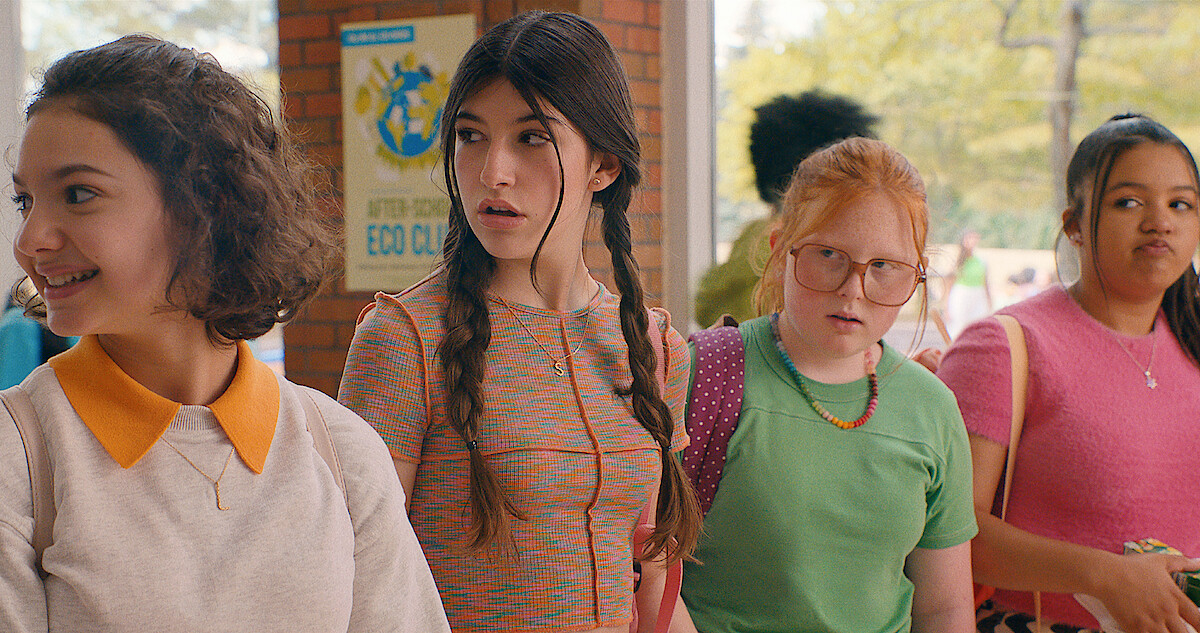
It is hard to get the middle school experience right without making it feel like a caricature. Most movies lean too hard into the "mean girl" trope or make the kids sound like 30-year-old screenwriters. Then came You Are So Not Invited To My Bat Mitzvah. It dropped on Netflix and immediately felt different. Maybe it’s because the lead, Sunny Sandler, was actually a teenager at the time. Or maybe it’s because the film understands that for a 13-year-old, a stolen crush or a ruined party isn’t just drama—it is the literal end of the world.
The movie isn't just another Netflix teen flick. It’s a snapshot of modern Jewish life, Gen Z social dynamics, and the specific anxiety of wanting to be "seen" while simultaneously being terrified of being judged.
Honestly, it worked.
Critics liked it. Audiences actually watched it. It managed to bypass the "nepotism baby" discourse by being genuinely charming. When you look at the landscape of 2020s comedies, this one stands out because it prioritizes heart over cynicism. It’s a movie about a Bat Mitzvah, sure, but it’s really about the brutal, messy, and eventually beautiful process of outgrowing your childhood skin.
The Sandler Family Dynamic: Beyond the "Nepo Baby" Label
Let’s address the elephant in the room. Adam Sandler produced the movie and stars in it, but he isn't the lead. His real-life daughters, Sunny and Sadie Sandler, take center stage. Usually, this is where the internet starts sharpening its knives. We’ve seen enough vanity projects to be skeptical. However, You Are So Not Invited To My Bat Mitzvah avoids the trap because the chemistry is unforced.
Adam plays Danny Friedman, a dad who is perpetually stressed about the cost of lighting and DJs. It’s a toned-down, relatable version of the Sandler we know. He isn't doing a voice. He isn't playing a caricature. He’s just a dad.
The film follows Stacy Friedman (Sunny Sandler) and her best friend Lydia Rodriguez Katz (played by Idina Menzel’s real-life protégée of sorts, Samantha Lorraine). They have a plan. The plan is simple: have the greatest Bat Mitzvahs ever, secure the popular boy, and enter high school as legends.
It fails. Spectacularly.
When Stacy catches Lydia kissing her crush, Andy Goldfarb, the fallout is nuclear. The title of the movie becomes the ultimate weapon. In the world of 13-year-olds, an un-invitation is a social death sentence. It’s "The Scarlet Letter" with more glitter and a Torah portion.
Why the "Coming-of-Age" Genre Needed This Refresh
Most teen movies today feel like they were written by someone who hasn't spoken to a teenager since 1998. They use slang that died three years ago. They focus on "edgy" topics that don't reflect the daily reality of most kids.
You Are So Not Invited To My Bat Mitzvah feels lived-in.
Director Sammi Cohen and screenwriter Alicia Thompson (adapting Fiona Rosenbloom’s 2005 novel) updated the story for a world of TikTok and viral embarrassment. But they kept the core truth: puberty is a nightmare.
Stacy Friedman is not a "perfect" protagonist. She’s actually kind of a jerk for a lot of the movie. She spreads rumors. She’s selfish. She ignores her parents. And that is exactly why she’s a great character. Real kids make terrible decisions when they’re hurting. The movie doesn't sugarcoat Stacy’s flaws, but it doesn't demonize her either.
The Cultural Accuracy of the Mitzvah Circuit
For anyone who grew up in a Jewish community, or even just attended a few Bar/Bat Mitzvahs, the details here are spot on.
- The over-the-top themes (Stacy wants a NYC/Paris/Lounge hybrid).
- The "Mitzvah project" that feels more like a chore than a charity.
- The Rabbi who tries way too hard to be "cool" and "hip" (Sarah Sherman is a scene-stealer here).
- The awkward slow-dancing to songs that are slightly too old for the kids.
It captures the specific tension of a religious milestone being hijacked by a desire for social status. The Torah is there, the Bimah is there, but Stacy is mostly worried about her "Grand Entrance."
Breaking Down the Conflict: Stacy vs. Lydia
The heart of the film is the friendship breakup. In many ways, a friendship breakup at 13 is more painful than a romantic one. Stacy and Lydia have a history that predates their interest in boys. They have a language of their own.
When Lydia starts dating Andy, Stacy feels a double betrayal. Not only is her crush gone, but her safe space—her best friend—is now the "enemy."
The movie tracks this descent into petty warfare. Stacy creates a "burn film" instead of a tribute video. It’s cringe-inducing. It’s hard to watch because we’ve all felt that level of spite. But the movie’s resolution isn't about the boy. Andy Goldfarb is basically a cardboard cutout of a "cute guy." He’s not the prize. The prize is the realization that Stacy was throwing away a decade of friendship for a week of popularity.
A New Era for Happy Madison Productions
For years, Adam Sandler’s Happy Madison production company was known for "the guys' trips"—movies where Sandler and his friends went to a cool location and made jokes. They were hits, but they weren't necessarily "prestige" or "nuanced."
You Are So Not Invited To My Bat Mitzvah represents a pivot.
Between this and Hustle, Sandler is showing a keen eye for storytelling that goes beyond the slapstick. By putting his family in the film, he actually raised the stakes. There is a warmth in the Friedman household that feels genuine because the actors actually love each other. When Sadie Sandler’s character, Ronnie, gives her younger sister advice, it doesn't feel like a script. It feels like an older sister who has been through the trenches.
The "Discover" Factor: Why This Movie Stayed Relevant
Why did this movie trend for so long?
It wasn't just the Sandler name. It was the "Watch-with-your-parents" factor. It is one of the few modern comedies that doesn't feel condescending to adults or boring to kids. It hit that sweet spot of nostalgia for Gen X/Millennial parents and current relevance for Gen Z.
The fashion also played a huge role. The outfits in the movie became a massive talking point on social media. Stacy’s transition from "kid clothes" to her Bat Mitzvah dress mirrored her internal growth. The aesthetic was bright, poppy, and highly shareable.
Key Takeaways for Navigating Modern Adolescence
If you’re watching this as a parent, or if you’re a teen looking for a roadmap, the film actually offers some decent "actionable" life advice disguised as comedy.
1. The "Boy" is Rarely the Point In the heat of the moment, Andy Goldfarb feels like the center of the universe. He isn't. He’s a catalyst. The movie shows that focusing on a romantic interest at the expense of your support system is a losing game.
2. Accountability is Better Than a Perfect Party Stacy tries to "fix" her social life by throwing a better party. It doesn't work. The only thing that fixes her life is admitting she was a bad friend. The "Mitzvah" isn't the party; it’s the "good deed" or the act of becoming a responsible adult.
3. Lean Into the Awkwardness The movie embraces the "cringe." Whether it's a period mishap or an embarrassing video, it teaches that these moments don't actually kill you. They just become stories later.
4. Family is the Safety Net Despite the screaming matches, the Friedman family is there. The movie reminds us that while friends might come and go during the chaotic middle school years, having a stable home base (even an annoying one) is the ultimate cheat code.
The Future of the Cast
Keep an eye on Sunny Sandler and Samantha Lorraine. Their performances here weren't just "good for kids." They had timing, vulnerability, and range.
We are seeing a shift in how teen stories are told. We are moving away from the "perfect" glossy worlds of the 2000s and toward something a bit more frantic and honest. You Are So Not Invited To My Bat Mitzvah proved that you can have a massive hit without being mean-spirited or overly dark.
Next Steps for Fans
If you enjoyed the movie, you should check out the original book by Fiona Rosenbloom. It’s a bit different (written in a different era of technology), but the heart is the same.
Also, look into Sammi Cohen’s other work, like Crush. She has a talent for directing young actors in a way that feels authentic rather than forced.
Ultimately, the movie reminds us that growing up is a series of "not invited" moments that eventually lead us to find the people who actually want us there. It’s messy. It’s loud. It’s expensive. But as Stacy Friedman eventually learns, it’s worth it.



