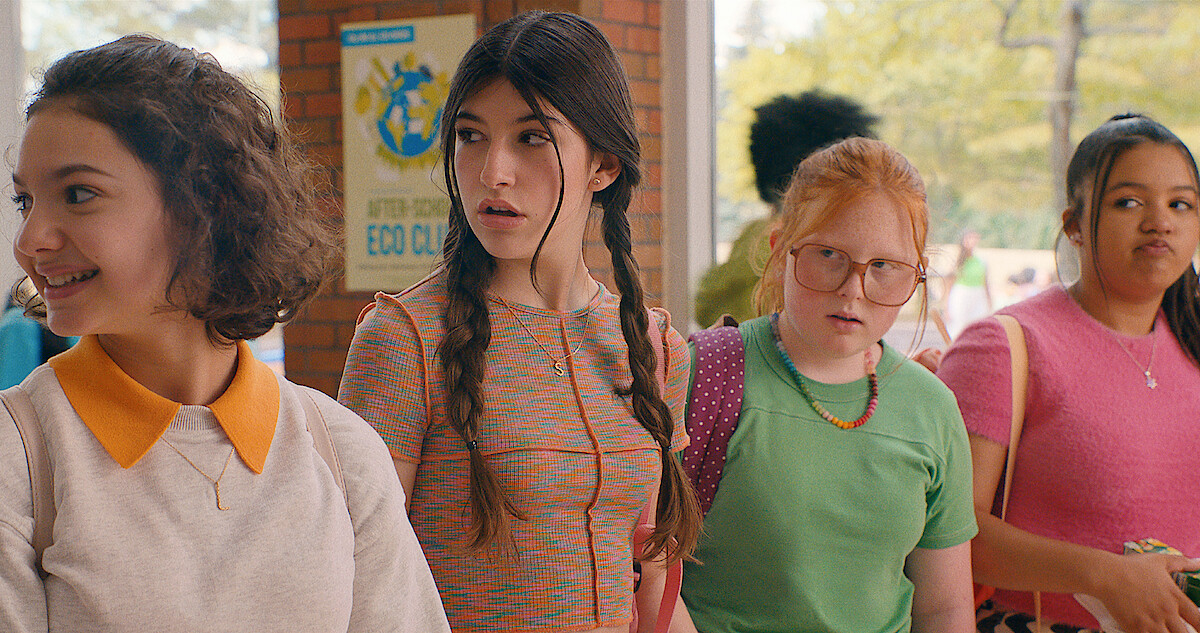
It is rare for a Netflix teen comedy to actually capture the visceral, sweaty-palmed anxiety of middle school, but You Are So Not Invited to My Bat Mitzvah somehow pulled it off. Most movies about thirteen-year-olds feel like they were written by people who haven't spoken to a child since the Clinton administration. This one felt different. It felt loud. It felt messy. Honestly, it felt a little too real for anyone who still has repressed memories of Hebrew school or cafeteria politics.
The movie isn't just another Happy Madison production where Adam Sandler runs around in a Hawaiian shirt. Well, he’s there, and he’s wearing some pretty questionable suburban dad outfits, but the soul of the film belongs to his daughters, Sunny and Sadie Sandler. Specifically, it belongs to the chaotic, friendship-ending, world-ending drama of Stacy Friedman and Lydia Rodriguez Katz.
The Stacy and Lydia Fallout: More Than Just a Movie Plot
Middle school friendships are a high-stakes poker game where everyone is bluffing. In You Are So Not Invited to My Bat Mitzvah, the central conflict triggers a "social apocalypse" because of a boy—Andy Goldfarb. It’s a classic trope, sure. But the movie treats the rift between Stacy and Lydia with the gravity of a Shakespearean tragedy, which is exactly how it feels when you're thirteen.
When Stacy sees Lydia kissing Andy, her world doesn't just crack; it liquefies. The title isn't just a line of dialogue; it’s a declaration of war. In the Jewish community, the Bat Mitzvah is the pinnacle of a young girl's social existence up to that point. Rescinding an invitation isn't just "not hanging out." It is a public excommunication.
Director Sammi Cohen and screenwriter Fiona Rosenbloom (who wrote the 2005 novel the film is based on) understood that the "Bat Mitzvah" part of the title is almost secondary to the "Not Invited" part. Inclusion is the only currency kids have. If you're out, you're bankrupt.
Why the Sandler Family Dynamic Changed the Game
People were ready to hate on this for the "nepo baby" discourse. It’s an easy target. But the chemistry works because it isn't manufactured. Adam Sandler plays Danny Friedman, a stressed-out dad who just wants his daughter to stop acting like a "meshuggener" and focus on her Torah portion. His real-life wife, Jackie Sandler, plays Lydia’s mom.
Watching Stacy (Sunny Sandler) argue with her father feels authentic because the rhythms of their speech match. The way she pushes his buttons and the way he sighs with the exhaustion of a man who has explained the value of a dollar four hundred times—that’s not just acting. That’s a Sunday afternoon in every suburban household.
The film avoids the "perfect teen" aesthetic. Stacy is often annoying. She is selfish. She makes terrible decisions that hurt people she loves. Honestly, she’s kind of a jerk for a solid sixty minutes of the runtime. And that is exactly why the movie succeeds. If she were a saint, we wouldn't care. We care because we remember being that specific brand of irrational.
The Cultural Accuracy of the Modern Mitzvah
Let’s talk about the parties. If you haven't been to a Bar or Bat Mitzvah in the last five years, you might think it’s just a nice service followed by some bagels and lox in the basement of a synagogue. You would be wrong.
In You Are So Not Invited to My Bat Mitzvah, the "party planner" DJ Schmuley represents a very real subculture of the event industry. These parties have themes that rival the Met Gala. We're talking high-end streetwear pop-ups, professional dancers, and entrance videos that look like they were directed by Michael Bay.
The film captures the intense pressure on these kids to perform. It’s not just about the "coming of age" religiously; it’s about the branding. Stacy wants a New York City-themed party. She wants the "cool" factor. The movie subtly critiques this "extravaganza" culture while also acknowledging that, for a thirteen-year-old, this is their Super Bowl.
- The Torah Portion vs. The Entrance: The tension between the sacred and the superficial is the heartbeat of the film. Stacy’s Rabbi (played brilliantly by Sarah Sherman) tries to keep her focused on her "mitzvah project" (acts of charity), but Stacy is more concerned with whether her hair will look good under the bimah lights.
- The Viral Element: In the 2005 book, Stacy didn't have to worry about TikTok. In the 2023 movie, the humiliation is digital. When a private, embarrassing video of Stacy gets shown at a party, it’s not just a local gaffe—it’s a permanent digital stain.
Breaking Down the "Cool Girl" Myth
Lydia, played by Samantha Lorraine, is the "cool" best friend who accidentally becomes the villain. But the movie is smart enough to show that Lydia is also hurting. Her parents are going through a messy divorce. Her "perfection" is a shield.
The film deconstructs the idea that there is a "winning" side in a friendship breakup. When Stacy tries to sabotage Lydia’s Bat Mitzvah, it doesn't feel like a triumph. It feels gross. It feels like a mistake.
Most teen movies end with the protagonist getting the guy and the popularity. This movie ends with Stacy realizing that the "guy" (Andy) is actually a shallow idiot who doesn't deserve the chaos he caused. The real "win" is the apology. It’s the realization that a decade of friendship is worth more than a week of dating a boy who smells like body spray and poor decisions.
Idina Menzel and the "Uncut Gems" Reunion
For the film nerds, seeing Idina Menzel and Adam Sandler onscreen together again was a treat, albeit in a much less stressful environment than Uncut Gems. In that film, they were a couple spiraling into debt and disaster. Here, they are the anchors of a relatively stable, loving Jewish home.
Menzel plays the mother, Bree, with a grounded warmth that balances Sandler’s manic energy. She’s the one who sees through Stacy’s nonsense first. Her presence adds a layer of "prestige" to what could have been a generic comedy. It reminds the audience that while this is a movie for and about teens, it’s being told through a lens of adult experience.
Sarah Sherman is the Secret Weapon
If there is one person who steals every scene, it’s SNL’s Sarah Sherman as Rabbi Rebecca. She is weird. She sings. She uses a treadmill desk. She represents a shift in how religious figures are portrayed in media—no longer just stiff, judgmental old men, but people trying (sometimes too hard) to make ancient traditions relevant to kids who only care about their "for you" page.
Her "Mitzvah" lessons aren't just plot fillers; they provide the moral framework for Stacy’s eventual redemption. You have to do something good for the world, not just for your Instagram feed.
Why This Movie Ranks Above Other Teen Comedies
It's about the nuance of the "I hate you" phase.
Every girl has had that one friend. The one who knows all your secrets and therefore knows exactly where to twist the knife. You Are So Not Invited to My Bat Mitzvah treats that relationship with more respect than the romantic interests. It understands that at thirteen, your best friend is your soulmate. Losing them is a grief that adults often dismiss, but this film sits right in the middle of that pain.
It also avoids the "mean girl" caricature. There isn't a Regina George who is evil just for the sake of it. The "mean" things happen because of insecurity, jealousy, and the terrifying speed of puberty.
What We Can Learn From Stacy's Mistakes
If you're watching this as a parent, or even as a teen going through it, there are a few takeaways that aren't just "be nice."
- The "Big Event" is never the solution. Stacy thought the perfect Bat Mitzvah would fix her social standing. It didn't. The party is just a party.
- Apologies require action. Stacy couldn't just say "sorry." She had to give up her own moment to fix the moment she ruined for Lydia.
- Parents are people too. One of the best parts of the film is Stacy seeing her parents as individuals with their own stresses, not just obstacles to her happiness.
Practical Steps for Handling "Social Apocalypse"
If you find yourself in a situation where you feel like you’re "not invited" to the social event of the year—literally or metaphorically—here is how to handle it based on the Stacy Friedman school of hard knocks.
Assess the "Why" Honestly Stacy spent most of the movie blaming Lydia, but Stacy was the one who pushed things too far. Take a second. Did you actually do something wrong, or is this a misunderstanding? If you're the one at fault, own it before the "video at the party" stage of the drama.
Stop Stalking the Socials The digital age makes a "not invited" status feel 10x worse because you have to watch the event happen in real-time on Stories. Put the phone in a drawer. Go for a walk. Play with your dog. Whatever Stacy was doing on her phone usually led to her crying or making a bad decision.
Talk to a "Rabbi Rebecca" Figure Find an adult who isn't your parent but who you trust. Sometimes you need a third-party perspective to tell you that you're being a "meshuggener." Whether it’s a teacher, a coach, or a cool aunt, get out of your own head.
Focus on the Mitzvah, Not the Party In the end, the movie is about becoming a "daughter of the commandment." It’s about responsibility. If your social life is a mess, focus on doing something for someone else. It sounds cheesy, but as Stacy found out, helping someone else is the only way to stop obsessing over your own drama.
The film is a rare gem that manages to be funny without being cynical. It’s a love letter to the chaos of growing up, the specific beauty of Jewish traditions, and the enduring power of a friendship that can survive even the most disastrous Bat Mitzvah in history.



