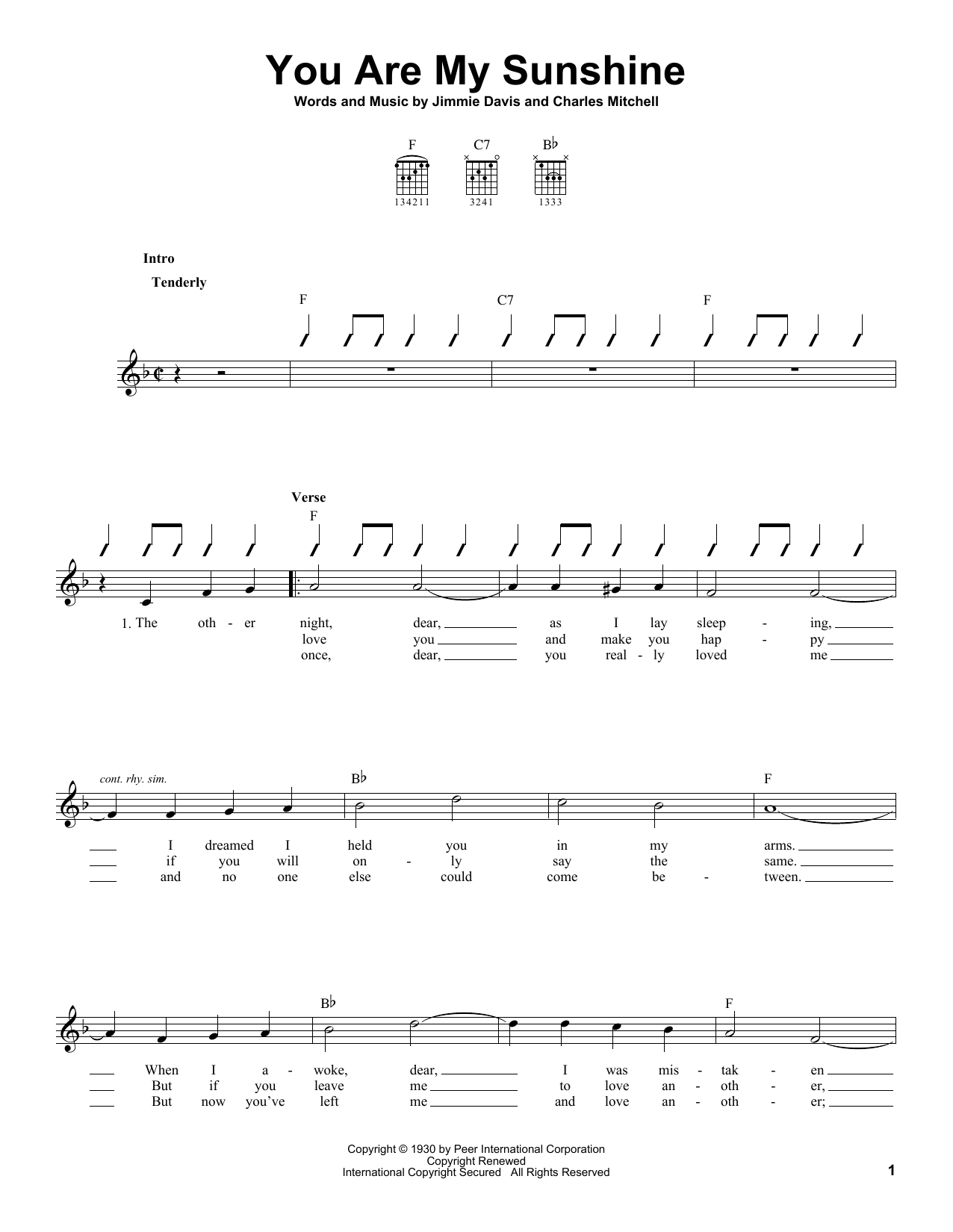
Everyone knows the chorus. Honestly, if you grew up anywhere in the English-speaking world, those first seven notes of "You Are My Sunshine" are probably hard-wired into your brain. It feels easy. It feels like something a toddler could peck out on a toy piano—and they often do. But when you actually sit down to look at you are my sunshine music notes, things get a little weird.
There is a strange gap between the "sunny" version we sing to babies and the actual history of this song. It’s not just a lullaby. It’s a song about heartbreak, abandonment, and a desperate plea for a lover not to leave.
If you're looking for the notes to play this on a piano, guitar, or even a recorder, you’re usually looking for something in the key of C Major. It’s the "white keys only" approach. It starts on G. Specifically, the G below Middle C.
The sequence goes: G – C – D – E – E.
Simple, right? That’s "You are my sun-shine." But the rhythm is where people trip up. Most beginners play it too straight, like a robot. In reality, the song has a swing to it. It’s a country song at its heart.
The Mystery of Who Actually Wrote the Music
Here is something most people get wrong about the you are my sunshine music notes. We usually credit Jimmie Davis and Charles Mitchell. Davis was the singing governor of Louisiana—twice. He used the song as his campaign theme. He even rode a horse named "Sunshine" into the state capitol.
But did he write those notes? Probably not.
Music historians like Colin Escott have pointed out that Davis likely bought the rights to the song from Paul Rice. Rice allegedly wrote it in the late 1930s. Some even trace parts of the melody further back to old folk traditions. This was common back then. You’d find a catchy tune, pay a few bucks for the copyright, and suddenly you’re a legend.
The original 1939 recording by the Pine Ridge Boys has a much more upbeat, "old-timey" string band feel than the slow, dragging version we hear today. If you want to play it like the original, you have to speed up the tempo and add some grit.
Breaking Down the You Are My Sunshine Music Notes for Beginners
If you’re staring at a keyboard right now, let’s get practical. You don't need a degree in music theory to play this.
For the C Major version, your thumb starts on G.
- You are my sunshine: G – C – D – E – E
- My only sunshine: E – D – E – C – C
- You make me happy: C – D – E – F – A
- When skies are grey: A – G – F – E – C
Wait. Did you see that jump in the third line? That’s the "hook." It’s the part that catches the ear. Going from that E up to the F and then the A is where the emotion sits. Most people think the song stays in a tight little box, but that jump to the A is crucial.
If you miss that A, the song sounds flat. Boring. Like a ringtone from 2004.
Why the Chords Matter More Than the Melody
If you’re a guitar player, looking for you are my sunshine music notes usually means you're looking for chords. You can play almost the entire song using the 1-4-5 progression. In the key of C, that’s C, F, and G.
- C Major: Use this for the "Sunshine" and "Happy" parts.
- F Major: Hit this when the melody goes high ("You'll never know, dear").
- G Major: This is your "turnaround" chord. It builds the tension before you go back to the C.
The "dark" verses—the ones nobody sings to their kids—actually sound better if you play them with a bit of a slower strumming pattern. When you sing "The other night, dear, as I lay sleeping, I dreamed I held you in my arms," the music shouldn't be bouncy. It should be mournful.
It’s actually a pretty depressing song if you read the lyrics. "But when I awoke, dear, I was mistaken, so I hung my head and I cried." That’s a far cry from a nursery rhyme.
Transposing for Different Instruments
Maybe you aren't playing on a piano. Maybe you've got a trumpet or a saxophone.
For Bb instruments, you’ll want to transpose those you are my sunshine music notes up a whole step. So instead of starting on G, you’d start on A. Your C becomes a D.
It’s also a favorite for the ukulele. Since the uke is naturally bright and "plucky," it fits the title of the song perfectly. On a ukulele, the fingerings for C, F, and G7 are some of the first things any player learns. It's the perfect "Level 1" song because the melody is diatonic—meaning it stays within the scale. No sharps or flats to worry about if you stay in C.
Common Mistakes When Learning the Sheet Music
Don't rush the "Dear."
In the line "You'll never know, dear, how much I love you," that "dear" is usually a held note. If you're looking at sheet music, you'll see a half-note or even a dotted half-note there.
Another mistake? Ignoring the pickups.
The song doesn't start on the "one" beat. It starts on the "four." (Rest) - (Rest) - (Rest) - You | Are my sun-shine...
If you start banging on the keys right on the first beat of the measure, you're going to be out of sync with anyone trying to sing along. You have to breathe into the song.
The Cultural Impact of These Seven Notes
Why do we care about you are my sunshine music notes nearly a century later?
It’s been covered by everyone. Johnny Cash, Ray Charles, Aretha Franklin, and even Brian Wilson of the Beach Boys. Each of them changed the notes slightly to fit their style. Ray Charles added soulful accidentals—those "blue notes" that aren't in the standard C scale. Cash kept it steady and rhythmic, like a train.
In 1977, Louisiana made it the official state song. It’s been used in countless movies to represent innocence, or sometimes, in horror movies, to represent something creepy. There's a certain irony in a song about losing someone being used as a symbol of pure happiness.
How to Master the Song Today
To actually get good at playing this, stop looking at the paper after five minutes. The melody is already in your head. Your job is to make your fingers find what your ears already know.
Start by humming the melody while you play the root notes of the chords with your left hand.
- Left hand hits C; Right hand plays "You are my sunshine."
- Left hand hits F; Right hand plays "You'll never know, dear."
Once you can split your brain like that, you've mastered the basics.
Next Steps for Players:
- Record yourself: You probably think you’re playing in time. You’re likely not. Listen back and check if you’re rushing the "skies are grey" part.
- Try a different key: If C Major feels too "kiddie," move it to G Major. Start the melody on D. It gives the song a deeper, more resonant feel, especially on a guitar.
- Learn the verses: Don't just play the chorus. Learning the melody for the verses will make you a much more versatile musician. The notes are similar but the phrasing changes.
- Experiment with dynamics: Play the first chorus softly (pianissimo) and the second one loud (forte). This is how you turn a simple song into a performance.
There is no "perfect" version of these notes because the song belongs to the folk tradition now. It changes with every person who picks up an instrument. Just play it with some heart, and you’ll be doing Jimmie Davis—or Paul Rice, or whoever really wrote it—proud.



