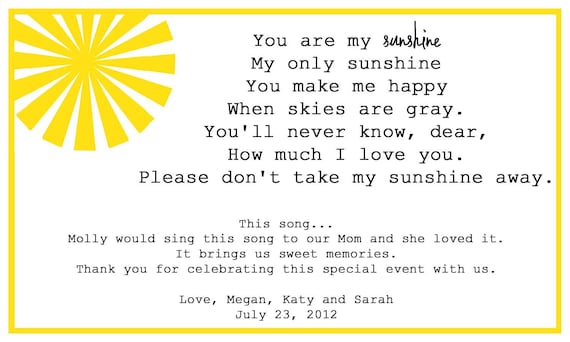
You probably sang it in kindergarten. Or maybe your grandma hummed it while rocking you to sleep. It’s the ultimate "feel-good" anthem, right? Honestly, most people think the lyrics of song You Are My Sunshine are just a sweet, sugary tribute to a loved one or a child. They see it as a warm hug in musical form.
They're wrong.
If you actually sit down and read the full text—not just the chorus everyone knows by heart—you’ll realize it is one of the most devastating "lost love" songs ever written. It isn't about a sunny day. It's about a cold, grey morning where the person you love has walked out the door, leaving you begging for them to come back.
The disconnect between the song's reputation and its actual meaning is wild. It’s a cultural phenomenon that has been sanitized by time.
The Lyrics You Know vs. The Lyrics You Don’t
Most people stop after the first eight lines. You know the ones. "You are my sunshine, my only sunshine..." It's catchy. It's simple. It’s iconic. But the verses tell a much darker story of abandonment and regret.
Check out the second verse. The singer talks about dreaming they held their lover in their arms, only to wake up and realize it was all a lie. "When I awoke, dear, I was mistaken / So I hung my head and I cried." That isn't a lullaby. That’s a country-blues heartbreak standard.
By the third verse, things get even more intense. The singer reminds the "sunshine" that they once said they loved them and that "no one else could come between." But then? "But now you've left me and love another / You have shattered all of my dreams."
It’s heavy stuff. Yet, we keep singing it to babies.
There is a strange irony in how we use this song. We’ve collectively decided to ignore the misery in the verses to preserve the warmth of the chorus. It’s a bit like how people play "Every Breath You Take" at weddings, ignoring the fact that it's about a stalker. We hear what we want to hear.
Who Actually Wrote This Thing?
The history of the lyrics of song You Are My Sunshine is a messy, tangled web of Southern politics and disputed royalties. Most people associate the song with Jimmie Davis. He was a country singer who eventually became the Governor of Louisiana—twice. He used the song as his campaign theme, literally riding a horse named "Sunshine" into the state capitol.
But did he write it? Probably not.
Music historians like Colin Escott have dug into this, and the trail is murky. Most evidence points to Paul Rice and the Rice Brothers Gang, who were performing it in the late 1930s. Some even suggest a woman named Oliver Hood wrote the original words on the back of a brown paper sack. In those days, it was common for "professional" musicians to buy the rights to songs from local artists for a few bucks and a handshake.
Davis bought the rights, put his name on the copyright in 1940, and rode it all the way to the Governor’s mansion. It’s a classic story of how the music business worked back then. It was less about who had the pen and more about who had the paperwork.
The Jimmie Davis Legacy
Whether he wrote it or not, Davis made it a hit. He recorded it in 1940 for Decca Records, and it exploded. It wasn't just a hillbilly hit; it crossed over into the mainstream. Since then, it’s been covered by everyone from Johnny Cash and Ray Charles to Aretha Franklin and even Brian Wilson of the Beach Boys.
Each artist brings a different vibe. Ray Charles made it soulful and almost pleading. Johnny Cash gave it that weathered, gravelly honesty that made the heartbreak in the verses feel real. When you hear Cash sing it, you don't think about sunshine. You think about a man standing in the rain.
Why the Song Stuck Around
Why does this specific set of lyrics resonate eighty years later?
It’s the simplicity. The metaphor of a person being "sunshine" is universal. We all have that one person who makes the world feel bright, and we all have that primal fear of them leaving. The song taps into a very basic human insecurity: the idea that our happiness is dependent on someone else's presence.
- It uses "light" and "dark" imagery that a three-year-old can understand.
- The melody is a "circular" tune, meaning it’s incredibly easy to memorize.
- The emotional stakes are incredibly high (shattered dreams, hanging heads, crying).
There’s also the "Mandela Effect" of the lyrics. Because the verses are so sad, many popular versions—especially those recorded for children—just omit them entirely. They turn it into a loop of the chorus. This has effectively "re-branded" the song over the decades.
If you grew up with the "Kids Songs" version, you likely had no idea there was a whole narrative about a cheating partner and a broken heart. You just thought it was about how much your mom loves you.
The Darkest Verse Nobody Sings
There is a fourth verse that is rarely included in modern recordings, and it’s the most aggressive of the bunch. It goes:
"You told me once, dear, you really loved me / And no one else could come between / But now you've left me and love another / You have shattered all of my dreams."
Wait, I already mentioned that one. But there's another variation that gets even more bitter:
"If you leave me to love another / You'll regret it all some day / You'll come back and leave me further / And you'll throw your life away."
That’s not just sad; that’s a warning. It’s a "you’ll be sorry" moment. It adds a layer of spite to the song that completely changes the context of the chorus. Suddenly, "Please don't take my sunshine away" sounds less like a sweet request and more like a desperate, perhaps even possessive, plea.
How to Actually Use This Song
So, knowing all this, should you stop singing it to your kids? Of course not. The chorus remains one of the most beautiful expressions of affection in the English language. But maybe, as an adult, you can appreciate the song for what it truly is: a complex piece of American folk-country history that captures the fragility of happiness.
If you’re a musician looking to cover it, try lean into the melancholy. Everyone does the "happy" version. The world has enough upbeat versions of this song. What the world needs is more versions that acknowledge the "hanging my head and crying" part.
When you look at the lyrics of song You Are My Sunshine through the lens of a breakup, it becomes a much more powerful piece of art. It’s a reminder that sunshine is temporary. Clouds always come back.
Real-World Impact
The song is actually one of the "state songs" of Louisiana. It’s also preserved in the National Recording Registry by the Library of Congress because it’s "culturally, historically, or aesthetically significant." That’s a fancy way of saying it’s part of our collective DNA now.
Interestingly, during the Great Depression and the lead-up to World War II, this song served as a weird kind of comfort. People were living through literal dark times, and the idea of "sunshine" was more than just a romantic metaphor—it was a hope for a better future. Even if the verses were about a breakup, the chorus was a prayer for better days.
Understanding the Structure
If you're trying to learn the song or analyze it, notice how the rhyme scheme is very basic (AABB or ABCB). This is intentional. It’s built on the "Common Meter" style often found in hymns and folk ballads. This structure makes it feel "old" even when it was brand new in 1939.
- The Hook: The chorus is the hook that reels you in.
- The Conflict: The verses provide the "Why" behind the sadness.
- The Resolution: There isn't one. The song ends with the person still gone and the singer still pleading.
It’s an unresolved narrative. That might be why it lingers in the mind. It doesn't give you a happy ending. It leaves you in that moment of waking up from a dream and realizing your "sunshine" is gone.
Next Steps for the Curious
If you want to really "get" this song, stop listening to the lullaby versions on YouTube. Go find the 1939 Rice Brothers Gang recording or Jimmie Davis’s original 1940 cut. Listen to the twang. Listen to the way they sing the verses with a bit of a bite.
Then, compare that to the 1962 Ray Charles version. He turns it into a soul-shaking anthem. By looking at how different artists handle these specific lyrics, you start to see the "bones" of the song.
You can also look into other "false happy" songs. "Ring Around the Rosie" is the classic example (though the plague connection is debated by historians), but "You Are My Sunshine" is a much more modern version of this phenomenon. It’s a song that changed its meaning because we, as a culture, needed it to be something simpler than it actually was.
Next time you hear it, listen past the first thirty seconds. You might find a completely different song hiding in plain sight.
Actionable Insights:
- Check the Credits: Always look up the original songwriters of "standards." Usually, the person who made it famous isn't the one who felt the pain that inspired it.
- Read the Full Text: Before you use a song for a significant event (like a wedding or a funeral), read every single verse. You’d be surprised how many "happy" songs are secretly about death or divorce.
- Vocal Dynamics: If you are a singer, use the contrast between the verses and the chorus to create tension. The chorus is a plea; the verses are the justification for that plea.
- Explore Variations: Seek out the "lost" verses. They offer a much grittier, more "Old West" feel to the narrative that modern pop versions completely strip away.



