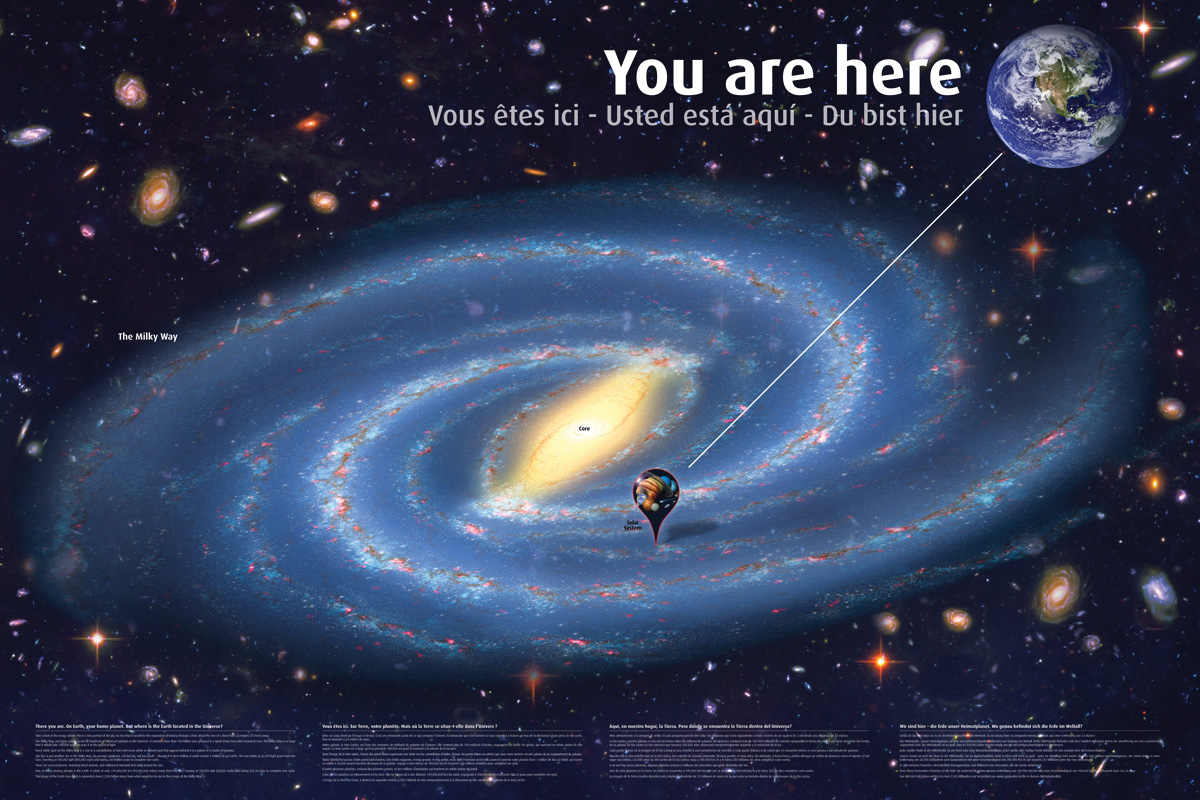
You’re sitting there, probably holding a phone or staring at a monitor, feeling like the center of your own world. It makes sense. From your perspective, everything radiates outward from your eyes. But if we actually zoom out—not just to the clouds, but way out—the reality of where you are here in the universe gets pretty unsettling. It’s not just that we’re small. It’s that we are moving through a void at speeds that should make your head spin, tucked into a corner of a galaxy that is itself just a speck in a cosmic web so large it defies human language.
Look at your thumb. It’s made of atoms that were cooked inside a dying star billions of years ago. You aren’t just in the universe; you are a localized piece of it trying to figure itself out.
The Local Neighborhood is Bigger Than You Think
Most people picture the solar system like those plastic models from third grade. You know the ones—the planets are all lined up like marbles on a string, huddled close to a basketball-sized Sun. That is a lie. If the Sun were the size of a grapefruit in New York City, the Earth would be the size of a grain of salt about 50 feet away. But Neptune? That would be over two blocks away. And the nearest star, Proxima Centauri, wouldn’t even be in the same state. It would be in another country.
Space is mostly just... space. Empty, cold, and terrifyingly vast.
We live on a rocky world called Earth. It feels solid. Permanent. But it’s actually a wet ball of dust spinning at 1,000 miles per hour at the equator. We are orbiting a G-type main-sequence star we call the Sun. We’re in the "Goldilocks Zone," which is just a fancy way of saying we aren't melting and we aren't frozen solid. Yet.
The Sun isn't stationary either. It’s dragging us along at 448,000 miles per hour around the center of the Milky Way. Think about that next time you’re stuck in traffic. You’re currently screaming through the vacuum of space faster than a bullet, held in place by nothing but the invisible grip of gravity.
Finding Our Street Address in the Milky Way
If you want to know exactly where you are here in the universe, you have to look at the Orion Arm. Our galaxy, the Milky Way, is a barred spiral. It has these massive, glowing arms made of gas, dust, and hundreds of billions of stars. We aren't in the bright, crowded center where the supermassive black hole Sagittarius A* lives. Honestly, that’s a good thing. The center is a high-radiation nightmare.
Instead, we live in the suburbs.
The Orion Arm is a minor spiral arm, about 3,500 light-years across. We are roughly 26,000 light-years away from the galactic center. For a long time, astronomers thought we were in a tiny "spur," but recent data from the Gaia mission suggests our little neighborhood is more significant than we gave it credit for.
- The Solar System: Our immediate home.
- The Local Interstellar Cloud: A "fluff" of gas the Sun is currently passing through.
- The Local Bubble: A 300-light-year-wide cavity in the interstellar medium, likely cleared out by ancient supernovae.
- The Milky Way: A disk of 100 to 400 billion stars.
When you look up at the night sky and see that milky smear of light, you're looking edge-on into the disk of your own home. It’s like being a single microbe on a dinner plate trying to see the rim.
The Laniakea Supercluster: Our Cosmic Continent
For decades, we thought our "local group" of galaxies was just a random cluster. We have the Milky Way, Andromeda (our big neighbor that’s going to crash into us in about 4 billion years), and about 50 other smaller dwarf galaxies like the Magellanic Clouds.
But in 2014, a team led by R. Brent Tully at the University of Hawaii redefined our map. They mapped the velocities of galaxies and found that we belong to a massive structure called Laniakea. The name means "immense heaven" in Hawaiian.
Laniakea is a supercluster. It’s 500 million light-years across. It contains 100,000 galaxies.
Imagine the Milky Way is just one house. The Local Group is the neighborhood. Laniakea is the entire continent. And all of it—all of us—is being pulled toward something called the Great Attractor. This is a mysterious region of space with a gravitational pull so massive it’s tugging on entire superclusters. We can’t see it clearly because the disk of our own galaxy blocks the view, a problem astronomers call the "Zone of Avoidance."
The Scale of the Observable Universe
So, where does it end? It doesn’t, really. Or at least, we don’t think so.
Because light takes time to travel, when we look deep into space, we are looking back in time. The "observable universe" is a sphere centered on you. Its radius is about 46.5 billion light-years. Wait—if the universe is only 13.8 billion years old, how can it be 46 billion light-years wide?
The answer is expansion.
Space itself is stretching. The galaxies aren't just moving through space; the space between them is growing. It’s like dots on a balloon being blown up. This means there are parts of the universe we will never, ever see. The light from those distant regions will never reach us because the space is expanding faster than the light can travel across it.
Basically, we are in a bubble of visibility, and that bubble is just a fraction of the "whole" universe, which might be infinite.
Misconceptions About Our Place in the Void
People often think of the universe as a container. Like a big box that stars and planets were dumped into. That’s not quite right. Space and time are linked—the "fabric" of spacetime. Mass (like the Sun) curves that fabric.
Another common mistake? Thinking we are at the center because everything seems to be moving away from us. Every point in the universe feels like the center. If you were standing on a galaxy 10 billion light-years away, you’d see every other galaxy moving away from you.
It’s also a myth that the universe is a chaotic mess. On a large enough scale, it looks like a web. The "Cosmic Web" consists of long filaments of dark matter and gas, with galaxies clustered at the nodes. Between these filaments are "voids"—gigantic, empty bubbles where almost nothing exists. We are currently located on a filament, part of the structural skeleton of reality.
Practical Ways to "Feel" Your Location
Understanding that you are here in the universe shouldn't make you feel insignificant. It should make you feel rare. The conditions required to produce a conscious mind capable of asking "Where am I?" are staggeringly complex.
If you want to actually ground yourself in this knowledge, try these steps:
- Find the Zenith: Go outside at night. Locate the point directly above your head. You are looking out the "top" of the Earth's atmosphere into an infinite corridor of vacuum.
- Track the Ecliptic: Look for the Moon and planets. They follow a similar path across the sky. This is the "plane" of our solar system. When you see it, you are visualizing the flat disk we all live on.
- Use Modern Mapping: Apps like Stellarium or the European Space Agency’s Gaia Sky allow you to fly through 3D maps of real star data. It’s the closest we get to a "You Are Here" sign.
- Consider the Light-Time: When you look at the Moon, you see it as it was 1.3 seconds ago. Jupiter is 40 minutes ago. The stars in the Big Dipper are decades or centuries in the past. You aren't just looking at space; you are looking at history.
What This Means for Us Right Now
We are living in the first century where we actually have a working map of our location. For most of human history, "here" meant the valley you were born in. Then it meant the continent. Now, we know we are inhabitants of a specific arm of a specific galaxy in a specific supercluster.
The Great Attractor is still pulling. The universe is still expanding. And you are still here, on a blue marble, riding a solar wind through the dark.
The most actionable thing you can do is acknowledge the scale. Use a telescope. Watch the International Space Station fly over—a tiny human outpost 250 miles up. It helps put the "small" problems of Tuesday morning into perspective when you realize the sheer scale of the architecture you're currently standing in.
Next time you look at a "You Are Here" map in a mall, remember the real one. It starts with a street address, moves to the Orion Arm, crosses the Laniakea Supercluster, and ends at the edge of the observable horizon. You are a part of that structure. You are a way for the cosmos to know itself, as Carl Sagan famously put it. Stay curious, because the map is still being drawn.



