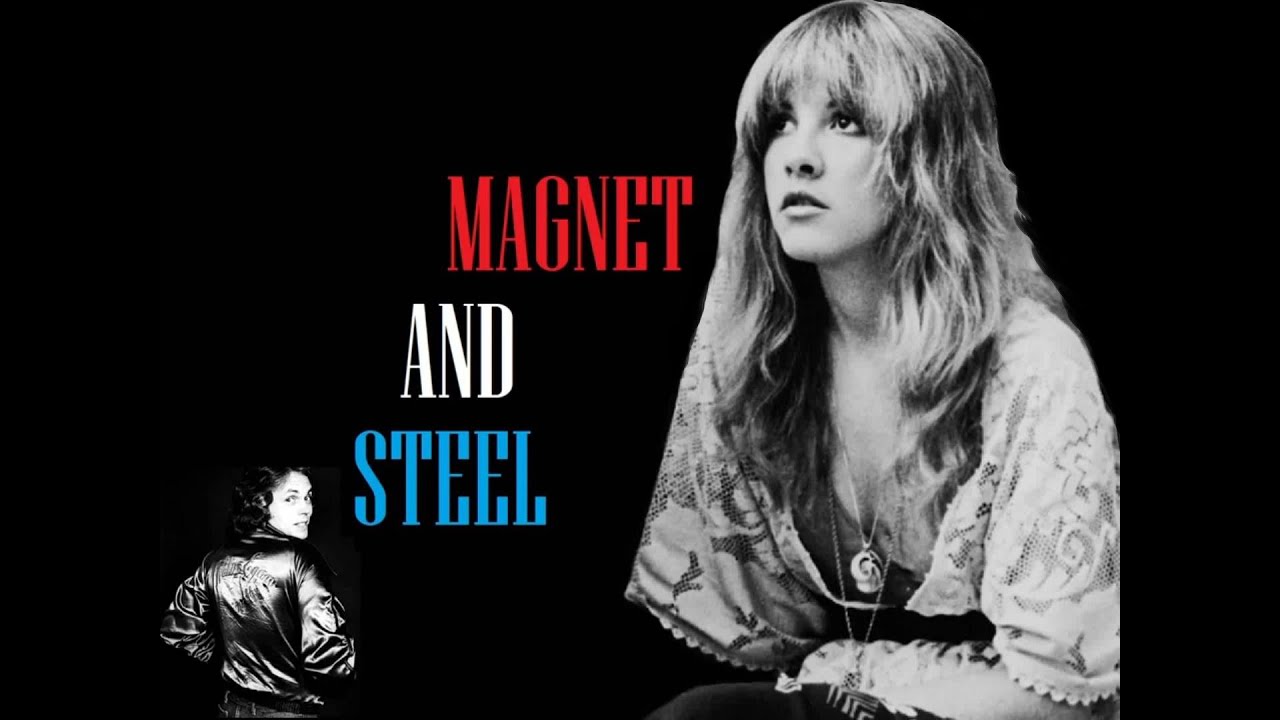
It is one of those lines that just lives in the back of your brain, rent-free, forever. You’ve heard it. You are a magnet and I am steel. It’s simple. It’s visceral. It’s also the backbone of one of the most enduring pop hits of the late 1970s, "Magnet and Steel" by Walter Egan. But honestly, there is a lot more to this phrase than just a catchy chorus or a basic metaphor for attraction.
Music has this weird way of taking high-school-level physics and turning it into a universal language for "I can't stay away from you even if I tried."
The Stevie Nicks Connection You Might Not Know
When Walter Egan wrote this song in 1978, he wasn't just thinking about magnets in a vacuum. He was thinking about Stevie Nicks.
At the time, Egan was touring with Fleetwood Mac. If you know anything about the late 70s rock scene, you know that Fleetwood Mac was basically the center of the universe. They were recording Rumours. The energy was chaotic. It was electric. Egan was completely captivated by Nicks—who wouldn't be?—and that specific tension is what birthed the line you are a magnet and I am steel.
Nicks actually sang backup on the track. You can hear her unmistakable raspy harmony in the background. It’s meta, really. The person who inspired the "magnet" was literally in the room helping create the pull. Lindsey Buckingham produced it, too. It’s a Fleetwood Mac song in everything but name, which explains why it feels so polished yet raw.
Is it Physics or Just Good Writing?
Let’s look at the metaphor. It’s scientifically sound-ish.
Steel is an alloy made mostly of iron. Iron is ferromagnetic. When you bring a permanent magnet near a piece of steel, the magnetic field induces a temporary magnetism in the steel. They click. They stick. They are, for all intents and purposes, inseparable until a greater force pulls them apart.
In songwriting, this works because it implies a lack of agency. If you’re the steel, you don't really have a choice in the matter. You aren't "choosing" to walk toward the magnet. You are being hauled across the room by an invisible force. It’s a bit desperate. It’s very 70s.
Compare this to other "attraction" metaphors in music. You’ve got "moth to a flame," which usually ends in death. Not great. You’ve got "gravity," which is a bit heavy. But you are a magnet and I am steel suggests a sleek, metallic, and modern kind of inevitability.
Why the Song Refuses to Die
Pop culture has a long memory for a good hook. The song peaked at number 8 on the Billboard Hot 100, but its life didn't end when it fell off the charts.
Think about the movie Boogie Nights. Paul Thomas Anderson used "Magnet and Steel" to perfectly capture that hazy, California-sunset vibe of the late 70s adult film industry. It’s a song that sounds like gold jewelry, unbuttoned shirts, and expensive shag carpet. It’s nostalgic, but it also has this underlying sense of "this might be a bad idea, but I’m doing it anyway."
There’s also the simplicity of the production. Buckingham’s influence is all over the "thump-thump" rhythm. It’s steady. It’s driving. It mimics a heartbeat. When Egan sings the title line, the instruments sort of drop away to let the harmony breathe. That’s the "pull."
Beyond Walter Egan: The Phrase as a Trope
The idea of the "Magnet and Steel" dynamic has transcended the song. In modern romance writing and fan fiction, you’ll often see this specific trope. It’s the "Opposites Attract" trope but with a mechanical twist.
One person is the active force (the magnet), and the other is the reactive force (the steel). It describes a relationship where one person has a massive personality or "gravity," and the other person finds themselves reorganized around that center.
Is it healthy? Maybe not. Is it great for drama? Absolutely.
The Technical Brilliance of the Composition
Musically, the song doesn't try to do too much. It stays in its lane. The chord progression is classic A-major territory, utilizing that bright, optimistic sound that defined the West Coast "mellow gold" era.
Egan’s vocals are somewhat understated. He isn't oversinging. He sounds like a guy who is just stating a fact. "I am steel. You are a magnet. This is just how the universe is currently functioning." That lack of vocal gymnastics makes the lyrics feel more sincere. It feels like a confession rather than a performance.
- Year Released: 1978
- Album: Not Shy
- Background Vocals: Stevie Nicks and Annie McLoone
- Producer: Lindsey Buckingham and Richard Dashut
How to Use the "Magnet and Steel" Concept in Your Own Life
If you’re feeling that "pull" toward someone or even a career path or a hobby, it’s worth asking if you’re the magnet or the steel.
Sometimes we are the ones doing the attracting. We have a vision, a goal, or a vibe that draws people in. Other times, we are the steel, feeling our molecules get rearranged by something bigger than us.
Understanding this dynamic helps in communication. If you feel like you’re being "pulled" too hard, it might be time to introduce some distance. Remember, magnetic force weakens with the square of the distance. If you don't like the pull, back up.
Actionable Takeaways for Your Next Playlist or Project
If you want to capture that specific you are a magnet and I am steel vibe in your own creative work or just want to dive deeper into the era, here is what to look for:
- Study the "Buckingham Sound": Listen to the percussion in this track and compare it to "Go Your Own Way." Notice the emphasis on the four-on-the-floor beat that makes it feel inevitable.
- Lean into Simple Metaphors: You don't need complex poetry to be profound. Physics-based metaphors resonate because everyone understands how the physical world works.
- Check Out the Rest of "Not Shy": Walter Egan is often dismissed as a one-hit wonder, but the album Not Shy is a masterclass in late 70s power pop. It’s worth a full listen if you like that crisp, dry studio sound.
- Acknowledge the Power of the Background: This song wouldn't be half as good without Stevie Nicks. Sometimes the "hook" isn't the lead vocal; it’s the texture of the harmonies behind it.
Stop overcomplicating your descriptions of attraction. Sometimes, it’s not a "deep connection of souls" or a "cosmic alignment." Sometimes, it’s just physics. One person is a magnet, the other is steel, and the rest is just noise.
Next time you hear that sliding guitar intro, pay attention to the space between the notes. That’s where the magnetism actually happens. It’s in the silence before the "click" when the two pieces finally meet.



