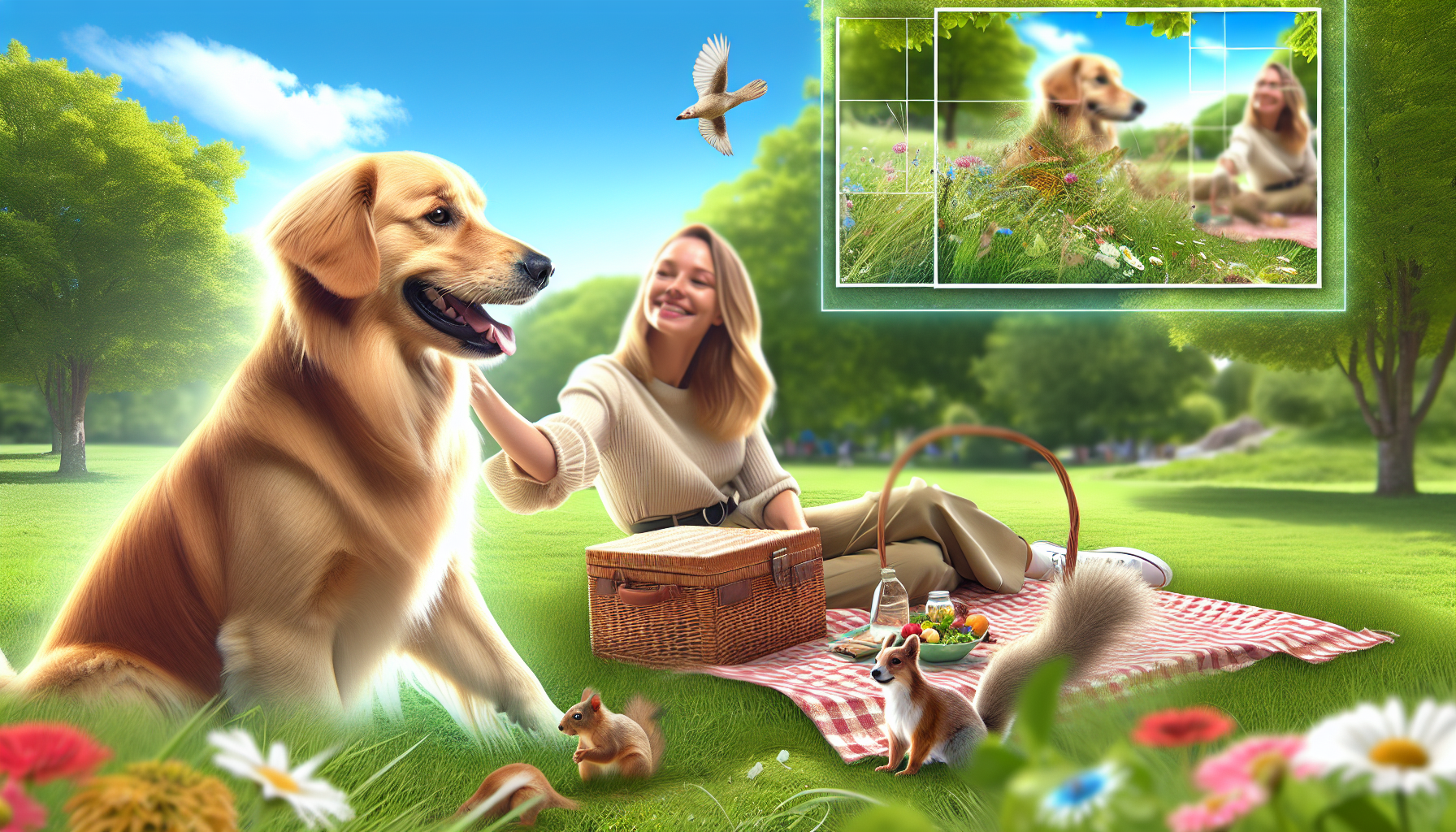
Ever looked at your Golden Retriever sprawled across the sofa and thought, "Man, I wish I had your life"? It looks easy. Sleep, eat, bark at the mailman, repeat. But if you are a dog, your entire reality is fundamentally different from the human experience. We’re talking about a sensory world so vibrant and specific that humans literally cannot imagine it without a lot of help from neuroscience.
Most people think being a dog is just about being a "simpler" version of a person. That’s wrong.
Actually, it's more like living in a 4D IMAX theater where the primary movie is played through your nose. While humans rely on vision for about 80% of our environmental data, a dog's world is built on scent. When you walk into a room, you see the couch, the TV, and maybe a messy coffee table. When a dog walks in, they smell who was sitting there three hours ago, what they ate for lunch, and whether the neighbor’s cat recently walked past the window outside.
The Olfactory Empire: Why Scent Is Your New Vision
If you are a dog, your nose is basically a time machine. Alexandra Horowitz, a cognitive scientist and author of Inside of a Dog, explains that scent tells dogs about the past and the future. The floor tells the story of who has been there. The air coming through the door tells them who is coming.
Humans have roughly 6 million olfactory receptors. That sounds like a lot until you realize a Bloodhound has 300 million. Their "smelling" brain power is about 40 times greater than ours.
Imagine you’re looking at a cup of coffee with a teaspoon of sugar in it. You can see the sugar if you watch it go in. A dog doesn't just "see" the sugar; they could technically detect that same teaspoon of sugar diluted in a million gallons of water. That's two Olympic-sized swimming pools.
How the mechanics actually work
It’s not just about "sniffing." It’s physics. Dogs have a fold of tissue inside their nostrils that separates the air into two paths: one for respiration and one specifically for scenting. When they exhale, the air exits through those slits on the side of their nose. This creates a swirl of air that actually helps pull new scent molecules into the nose. It’s a continuous loop of data.
Then there’s the vomeronasal organ, or Jacobson’s organ. Located above the roof of the mouth, this allows dogs to "taste-smell" pheromones. This is how they know another dog is stressed, happy, or in heat without a single sound being made.
Vision Isn’t All Gray (But It’s Not Technicolor Either)
There’s this persistent myth that dogs see in black and white. It’s weird how long that’s stuck around.
If you are a dog, you see the world in blues and yellows. Dogs are dichromatic. They lack the receptors for red and green. So, that bright red ball you bought because it looked high-visibility against the green grass? To your dog, it looks like a brownish-yellow ball against a brownish-yellow background. It’s a camouflage nightmare.
- Blues: Vibrant and clear.
- Yellows: Very distinct.
- Reds/Greens: Mostly a muddy gray-beige.
But they beat us in other ways. Their eyes have a higher density of "rods," which handle low-light vision and motion detection. They also have the tapetum lucidum—that reflective layer at the back of the eye that makes their eyes glow in photos. This acts like a mirror, reflecting light back through the retina a second time. It’s built-in night vision.
If something moves a quarter-mile away in the twilight, a dog sees it instantly. If it stays perfectly still, they might miss it entirely.
The Social Contract: Why They Stare at You
We tend to project human emotions onto dogs. We call it anthropomorphism. When a dog looks "guilty" because they ate the trash, research from Dr. Horowitz and others suggests they aren't actually feeling guilt. They are reacting to your body language. The lowered head and tucked tail are submissive signals meant to appease an upset leader.
But dogs are the only non-primate species that looks humans in the eye to seek help. If a wolf is given a puzzle it can't solve, it just keeps trying until it quits. If you are a dog and you can't get the treat out of the Kong, you eventually stop and look directly at your human.
This is a specific evolutionary byproduct of domestication. We’ve bred them to be our partners. They have even developed a specific muscle (the levator anguli oculi medialis) that allows them to raise their inner eyebrows—the "puppy dog eyes" look. Wolves don't have this. It's a physiological trait evolved purely to trigger a nurturing response in humans.
Time and Rhythm: Does a Dog Know It’s Tuesday?
Dogs don't have a concept of "five minutes" or "four o'clock." They don't use clocks.
Instead, they use "circadian rhythms" and, surprisingly, scent decay. Think about it: when you leave for work, your scent is strongest in the house. As the day goes on, your scent slowly dissipates.
There is a theory—though still being studied—that dogs can tell how long you’ve been gone by how much your scent has faded. If you always come home when your scent reaches a certain "thinness" in the air, the dog knows it’s time. To them, time is a smell.
Hearing the Inaudible
If you are a dog, the world is incredibly loud. Not just because of volume, but because of frequency.
Humans top out at around 20,000 Hz. Dogs can hear up to 45,000 Hz or even 65,000 Hz depending on the breed. This is why your dog starts barking at the door before you even hear the delivery truck turn into the cul-de-sac. They can hear the high-pitched hum of your electronics, the scuttle of a mouse behind a wall, and the vibration of a car engine that is still three blocks away.
This also means that things like vacuum cleaners or fireworks aren't just "loud"—they can be physically painful. The high-frequency whine of a vacuum motor is something we can't even perceive, but to a dog, it's a piercing shriek.
Misconceptions About "Alpha" Behavior
Let's kill the "Alpha" thing right now. The guy who popularized the "Alpha Wolf" theory, David Mech, spent years trying to get his own book out of print once he realized he was wrong.
In the wild, wolf packs aren't led by a "dominant" male who fought his way to the top. They are family units. The "alphas" are just the parents. When you are a dog in a human household, you aren't trying to "dominate" your owner. You’re just trying to figure out the rules of the house.
Aggression or "stubbornness" is usually a result of fear, lack of clarity, or unmet needs—not a coup attempt to take over the living room. Training based on "dominance" usually just breaks the bond of trust and replaces it with "learned helplessness."
Making Life Better for Your Dog
Understanding that you are a dog—or that your dog is a different species with different needs—changes how you should live with them.
First, let them sniff on walks. We often treat walks like a cardio session. For a dog, a walk is "reading the news." Pulling them away from a fire hydrant is like someone ripping a book out of your hands while you're in the middle of a cliffhanger. "Sniffaris" (walks where the dog chooses the direction and pace of the sniffing) are significantly more mentally exhausting for a dog than a fast-paced three-mile run.
Second, think about their "acoustic environment." If your dog seems anxious, try turning off unnecessary electronics or using white noise to drown out high-frequency sounds from the street.
Third, use their nose for play. Hide treats around the house. Use "snuffle mats." Engaging their primary sense is the fastest way to reduce boredom and destructive behavior.
What This Means for the Future of the Bond
We are moving away from the "command and obey" model of dog ownership. The modern approach is much more about "cooperation and communication."
By acknowledging that a dog's reality is 70% smell, 20% hearing, and 10% blurry, blue-yellow vision, we can stop being frustrated that they don't "listen" and start realizing they are often just overwhelmed by data we can't perceive.
Actionable Insights for Dog Owners:
- Stop the "Alpha" Mentality: Focus on positive reinforcement. Your dog isn't trying to rule the house; they’re trying to understand a confusing human world.
- The 5-Minute Sniff Rule: Give your dog at least five minutes of uninterrupted sniffing during every walk. It lowers their heart rate and cortisol levels.
- Visual Check: Avoid buying red toys for outdoor use. Opt for blue or bright yellow—your dog will actually be able to see them in the grass.
- Scent Comfort: If your dog has separation anxiety, leave a recently worn t-shirt with them. Your scent is their strongest "safety" signal.
- Audit Your Sounds: If your dog is restless, check for "electronic noise." Old routers, flickering lights, or certain appliances emit high-frequency sounds that drive dogs crazy.
Living as if you are a dog for a moment helps you realize that their "bad" behaviors are usually just biological responses. They aren't being difficult. They’re just living in a much louder, smellier, and more intense version of the world than we are. Treat their nose with respect, and you'll have a much happier animal.



