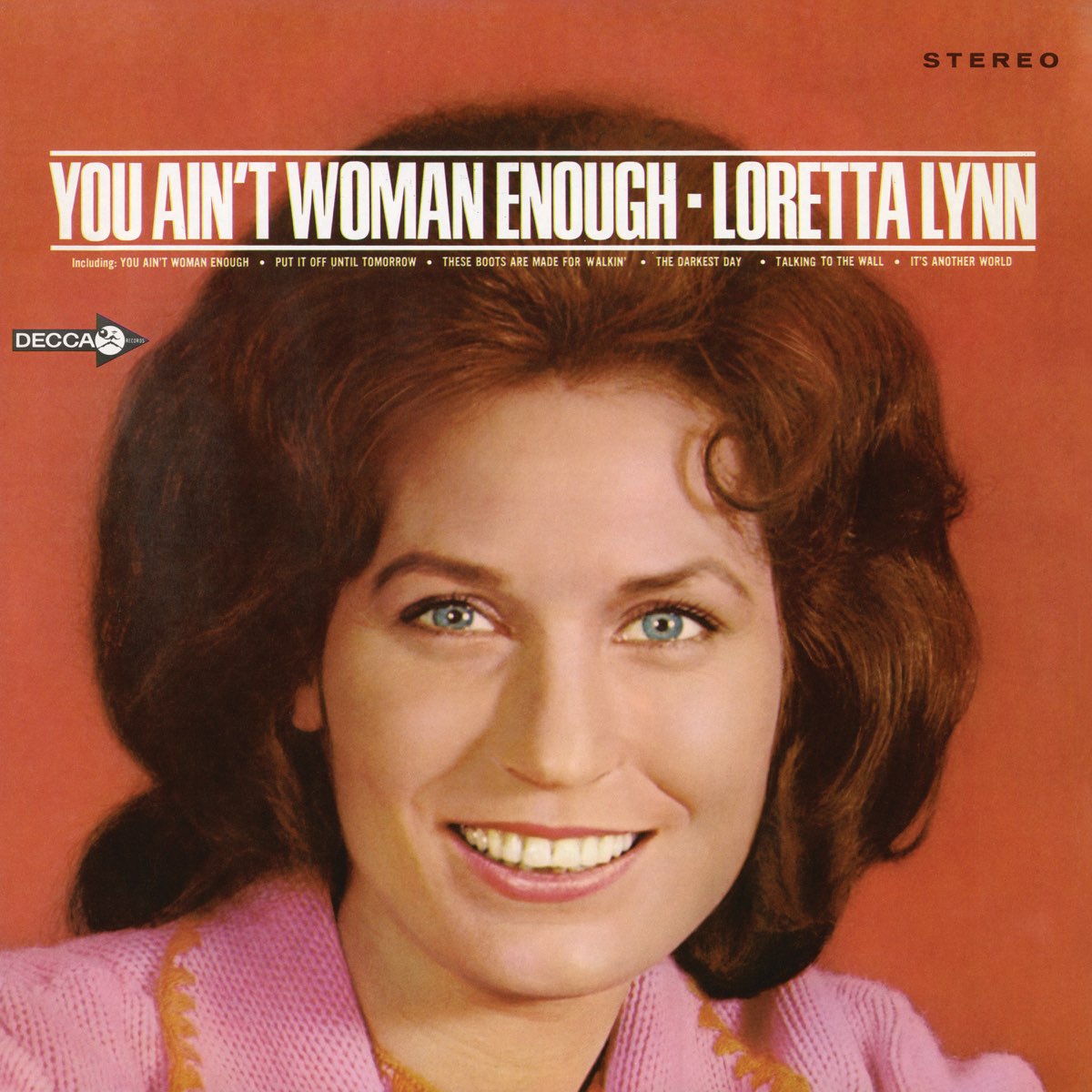
Loretta Lynn didn't play around. When she walked up to a microphone in 1966 to record You Ain't Woman Enough (To Take My Man), she wasn't just singing a catchy tune for the radio. She was drawing a line in the dirt. It’s one of those rare tracks that feels like a physical confrontation. You can almost hear the heels clicking on the floorboards as she stares down a rival.
Country music back then was often about the "soft" side of heartbreak. Women were expected to weep into their pillows or wait by the phone. Loretta changed that script. She brought a specific kind of Appalachian steel to the Nashville sound, and honestly, the industry hasn't been the same since.
The Real Story Behind the Confrontation
Most people think songwriters just sit in a room and imagine scenarios. Not Loretta. She lived her lyrics. The inspiration for You Ain't Woman Enough came from a real-life encounter backstage at the Grand Ole Opry.
A young fan had been hanging around Loretta’s husband, "Doolittle" Lynn. This wasn't unusual—Doo had a reputation—but this particular girl was being bold about it. She came up to Loretta and told her straight to her face that she was going to get him.
Loretta looked her up and down. She didn't cry. She didn't go tell a manager. She looked the girl in the eye and told her she wasn't "woman enough" to pull it off.
Writing the Hit in 10 Minutes
The song poured out of her right after that. It took maybe ten minutes. That’s the magic of it—it’s visceral. When you listen to the opening guitar licks, there's a tension there. It’s a warning. Loretta was the first woman in country music to write a number-one hit that she also performed, breaking a glass ceiling that had kept female artists as mere "vocalists" for decades.
She wasn't just defending her marriage; she was claiming her territory. It’s a messy song because real life is messy. Critics sometimes look back and call it "anti-feminist" because she’s fighting another woman instead of blaming the man. But that’s a surface-level take. In the context of 1966, a woman standing her ground and speaking her truth with that much confidence was a radical act of self-ownership.
Why the Lyrics Still Sting
"It'll be over my dead body, so girl get out while you can."
That’s a heavy line. It’s not poetic or flowery. It’s a threat. The song works because it uses plain English to convey complex emotions. Loretta’s voice has that "twang" that feels like home, but there’s a grit underneath it.
The structure of the song is pretty standard for the era—verse, chorus, verse, chorus—but the delivery is what matters. She isn't shouting. She’s calm. That’s what makes it scary. When someone is calm while telling you they’re going to win, you believe them.
The Production Secrets of the 60s
Producer Owen Bradley was the architect of the "Nashville Sound," but with Loretta, he knew he had to keep it raw. He didn't over-polish it. The steel guitar work on the track provides this crying, sliding backdrop that mimics the whining of someone trying to sneak away.
- The tempo is brisk.
- The drums are subtle but steady.
- The focus is 100% on the narrative.
Loretta’s phrasing is incredible. She hits the "Woman Enough" part of the chorus with a sharp emphasis that cuts through the instrumentation. It’s a masterclass in vocal storytelling.
Impact on the Country Music Landscape
Before this song, female country stars were often marketed as "girl singers." They were sweet. They were demure. Loretta Lynn blew that image up. She paved the way for Dolly Parton, Reba McEntire, and eventually modern stars like Miranda Lambert and Carrie Underwood.
If you look at Miranda Lambert’s "Kerosene" or "White Liar," you can see the direct DNA of You Ain't Woman Enough. It gave women permission to be angry. It gave them permission to be "unladylike" in their defense of what was theirs.
The Controversy of "Standing By Your Man"
People love to debate the ethics of Loretta's songs. Her marriage to Doo was famously turbulent. He cheated. He drank. She wrote about it. Songs like "Don't Come Home A-Drinkin' (With Lovin' on Your Mind)" and "Fist City" are essentially sequels to the themes in You Ain't Woman Enough.
Some modern listeners find it hard to reconcile her strength with her decision to stay. But Loretta viewed it as a partnership she wasn't willing to let go of. She wasn't a victim; she was a fighter. She saw her husband as a prize worth defending, even if he was a handful. That nuance is often lost in 280-character Twitter takes.
Covering a Legend
Everyone has covered this song. From Sissy Spacek (who won an Oscar for playing Loretta in Coal Miner's Daughter) to rock bands like The White Stripes. Jack White, in particular, was obsessed with Loretta’s songwriting. He produced her 2004 comeback album, Van Lear Rose.
Why does a garage rock legend care about a 1960s country song? Because truth is universal. Whether you’re in a holler in Kentucky or a club in Detroit, the feeling of "don't mess with mine" is the same.
The Legacy of the "Coal Miner's Daughter"
Loretta Lynn passed away in 2022, but the echoes of her defiance are everywhere. You Ain't Woman Enough is played at every honky-tonk in Nashville every single night. It’s a rite of passage for any aspiring country singer.
It represents a time when country music was the "white man's blues," but Loretta proved it could be the "woman’s truth" just as easily. She didn't need a PhD to explain gender dynamics. She just needed a guitar and a memory of a girl who tried to step out of line.
How to Listen Like an Expert
If you want to really appreciate the track, don't just stream the "greatest hits" version on a low-quality speaker.
- Find an original vinyl pressing if you can. The analog warmth makes the steel guitar pop.
- Listen to the lyrics of the second verse closely. She talks about how the other woman "thinks" she has a chance. It’s a psychological breakdown of her opponent.
- Compare it to "Fist City." You can see how Loretta’s songwriting evolved from "talk" to "action."
Loretta Lynn didn't just write songs; she wrote survival guides. You Ain't Woman Enough is the first chapter in that book. It’s about dignity. It’s about knowing your worth and knowing that no one can take what you’ve built unless you let them.
To truly understand the song’s impact, listen to it alongside Tammy Wynette’s "Stand By Your Man." Tammy’s song is about endurance and almost a quiet resignation. Loretta’s song is about active defense. They represent two different sides of the same coin, but Loretta’s side has a lot more teeth.
Deep Dive into the Sessions
The recording session at Quonset Hut Studio in Nashville was legendary. Musicians like Harold Bradley and Bob Moore were in the room. These guys played on everything, but they noted that Loretta was different. She wasn't intimidated by the "A-Team" of session players. She knew how she wanted the song to sound. She wanted it to sound like the truth.
Truth is often uncomfortable. It’s why some people still flinch at the bluntness of her lyrics. But in a world of AI-generated fluff and over-produced pop, the jagged edges of Loretta Lynn’s 1966 masterpiece are exactly what we need.
Actionable Steps for Music Lovers
- Study the discography: Don't stop at the hits. Dive into the 1966 album You Ain't Woman Enough. It’s a cohesive look at her early mindset.
- Watch the movie: Coal Miner's Daughter gives the necessary context to her upbringing. Understanding the poverty and the culture of the Appalachian Mountains explains why she was so protective of her family and her marriage.
- Support live music: Go to a local country bar. Wait for the band to play this song. Notice how every woman in the room, regardless of age, knows the words. That is the definition of a "standard."
Loretta Lynn proved that you don't have to be loud to be powerful. You just have to be right. And in the case of You Ain't Woman Enough, she was exactly right. She stayed with Doo until he died in 1996. She kept her man, she kept her career, and she kept her dignity.
Check out her final recordings on Still Woman Enough (2021) to see how she revisited these themes at the end of her life. It's a full-circle moment that shows her spirit never dimmed, not even a little bit.



