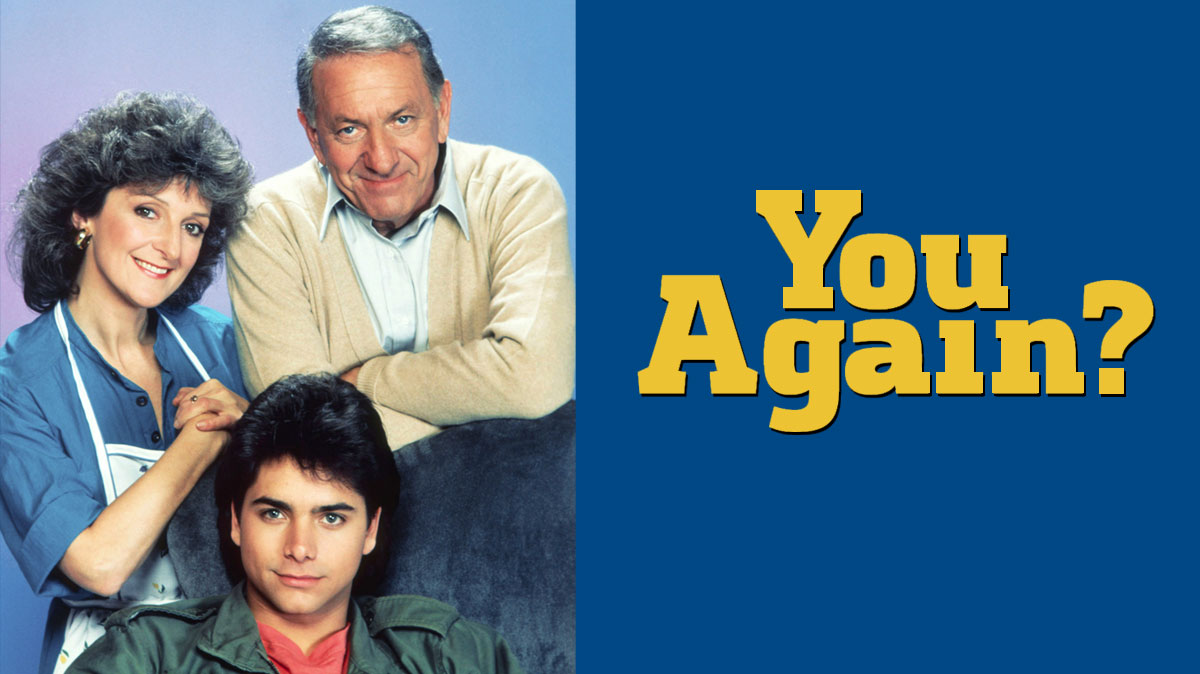
Television history is littered with shows that had every reason to succeed but somehow just... didn't. Most people remember Jack Klugman as the messy half of The Odd Couple or the crusading medical examiner in Quincy, M.E. But if you mention the You Again tv show to even the most dedicated sitcom fan, you’re usually met with a blank stare. It’s a weird anomaly. You have a massive TV icon coming off an eight-season run of a hit drama, paired with a burgeoning young talent, and yet the show barely lasted two seasons on NBC.
Honestly, the premise was classic 1980s comfort food. It was based on the British sitcom Home to Roost, which worked brilliantly in the UK. The American version follows Henry Willows (Klugman), a grumpy, divorced man living a quiet life until his teenage son, Matt—played by a very young John Stamos—shows up on his doorstep after seven years of being apart.
It was the ultimate generational clash.
The Weird Chemistry of Klugman and Stamos
The heart of the You Again tv show was the friction between Henry’s rigid, old-school cynicism and Matt’s "cool guy" 80s persona. Klugman was basically playing a variation of Oscar Madison if Oscar had never met Felix and had spent ten years stewing in his own grumpiness. Then you have Stamos. This was post-General Hospital but pre-Full House. He was the heartthrob, the kid with the leather jacket and the perfect hair, trying to navigate a relationship with a father who didn't really know how to be a dad.
What’s fascinating about their dynamic is how much it relied on Klugman’s ability to be likably unlikable.
He had this raspy, lived-in voice—the result of his well-documented battle with throat cancer that would later change his career significantly—and a face that looked like a crumpled paper bag. In many ways, he was the perfect foil for Stamos’s polished, upbeat energy. While the scripts often leaned into standard sitcom tropes, the genuine moments of connection between the two kept the show grounded. You could tell they actually liked each other.
A Supporting Cast That Deserved More
The show didn't just rely on the two leads. It had a secret weapon in Elizabeth Bennett, who played Enid, Henry’s sarcastic housekeeper. Here is a fun bit of trivia: Bennett actually played the same exact role in the British original, Home to Roost. She was the bridge between the two versions, bringing a dry, biting wit that often outshone the main conflict.
Then there was Maggie, Henry’s ex-wife, played by Barbara Barrie. The show used her sparingly, but she provided the necessary context for why Henry was so bitter.
Why the You Again TV Show Struggled to Stick
If you look at the ratings, the first season actually did okay. It premiered in early 1986 and held its own. But television in the mid-80s was a bloodbath. NBC was the king of the "Must See TV" era, and expectations were sky-high. Shows like The Cosby Show, Family Ties, and Cheers were setting the bar for what a sitcom should be.
Compared to those heavy hitters, You Again felt a bit traditional. Maybe even a bit dated.
It was a multi-cam sitcom with a laugh track that sometimes felt like it was trying too hard to bridge the gap between the 1970s style of comedy and the slicker 80s aesthetic. By the time the second season rolled around, the network moved it around the schedule, which is usually the "kiss of death" for any series trying to find a stable audience.
- The move to Wednesday nights killed the momentum.
- It was competing against established hits on other networks.
- The "Odd Couple" vibe felt like a retread for Klugman fans.
The show was eventually canceled in 1987. Stamos, of course, hopped almost immediately onto Full House, where he became Uncle Jesse and a household name. Klugman retreated from the sitcom world for a while, eventually focusing on his health and returns to the stage.
The Cultural Footprint of a Forgotten Series
Does anyone actually talk about the You Again tv show today? Not really. It hasn't had a massive DVD release, and it’s rarely found on major streaming platforms like Netflix or Hulu. You might find some grainy bootleg episodes on YouTube if you look hard enough, but for the most part, it has faded into the "where are they now" category of television.
However, for students of TV history, it serves as an important bridge. It represents the era when networks were desperately trying to figure out how to transition 70s stars into the glossy 80s landscape. It also proved that John Stamos was a legitimate leading man who could hold his own against an Emmy-winning powerhouse like Klugman.
The show's failure wasn't about a lack of talent. It was about timing.
What You Can Learn From It
If you’re a fan of classic television, there’s a certain charm in watching these short-lived experiments. They often have more heart than the massive hits because they were still trying to find their voice.
If you want to track down the series or understand its impact, here are the best ways to engage with that era of television history:
- Compare it to Home to Roost: If you can find the British original on streaming or YouTube, watch them side-by-side. It’s a masterclass in how American networks "sanitize" or "brighten" darker British humor for a domestic audience.
- Watch for the Stamos Evolution: Look at his performance in the You Again tv show and then watch the first season of Full House. You can see him refining the "cool uncle/son" archetype that would define his career for the next three decades.
- Appreciate Klugman’s Range: Despite his physical health challenges during this time, his comedic timing remained sharp. It’s a testament to his craft that he could carry a show that, on paper, was fairly thin.
The reality is that not every show needs to run for ten years to be worth remembering. Sometimes, a two-season run is just a snapshot of a specific moment in pop culture history—a moment where a legend and a future star shared a living room set for a year and a half. It’s a footnote, sure, but it’s a fascinating one.



