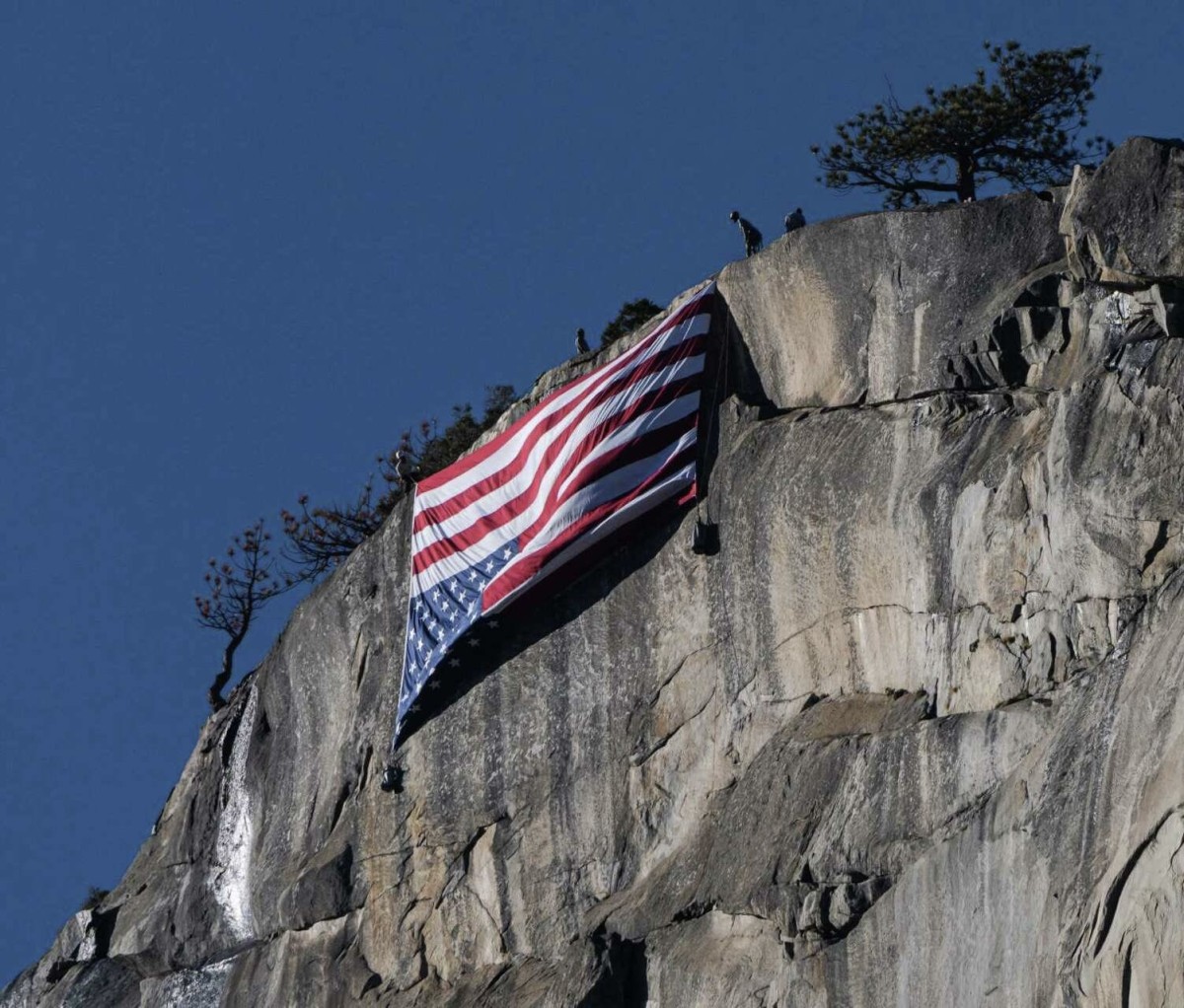
You’re standing at the base of El Capitan, looking up through the mist, and you see it. A massive American flag, hanging thousands of feet up, but something is wrong. It’s upside down.
In the world of maritime tradition and the U.S. Flag Code, that’s a universal cry for help. It means "dire distress." But if you saw this in Yosemite National Park recently—specifically in early 2025—you weren't looking at a climber dangling from a ledge or a medical emergency. You were looking at a protest.
The Yosemite National Park distress flag has become one of the most misunderstood and controversial symbols in the Sierra Nevada. What started as a specific signal for life-or-death help has morphed into a high-stakes political statement, leading to massive fines, new federal bans, and a lot of confused hikers. Honestly, it's a mess.
If you're heading to the park, you need to know the difference between a political "distress" signal and a real one. Because if you get them mixed up, or try to fly one yourself, you might end up in a federal courtroom.
The El Capitan Incident: Protest or Emergency?
In February 2025, a group of current and former National Park Service employees did something wild. They rigged a 30-by-50-foot American flag and draped it off the headwall near Horsetail Falls.
It was upside down.
The timing was intentional. It was "Firefall" season, that week in February where the setting sun hits the water just right and makes it look like molten lava. Thousands of photographers were already there with their lenses aimed exactly where the flag was hanging.
The "distress" wasn't about a physical injury. It was a response to the Department of Government Efficiency (DOGE) and the mass layoffs of roughly 1,000 National Park employees. The riggers, including people like former Yosemite locksmith Nate Vince, wanted to broadcast that the public lands themselves were in a state of emergency.
The Park Service didn't find it poetic.
Rangers hauled the flag down within hours. The group released a statement through the San Francisco Chronicle saying the goal was to "disrupt without violence." But for the Search and Rescue (SAR) teams, an upside-down flag on a vertical wall is a nightmare. It forces them to treat the situation as a potential life-safety event until proven otherwise.
Why Yosemite Just Banned Large Flags
If you think you can just hike up to Half Dome and unfurl a giant banner, think again. The 2025 Superintendent’s Compendium—basically the rulebook for Yosemite—was updated specifically because of these "distress" displays.
Acting Superintendent Raymond McPadden signed a new regulation that prohibits hanging or affixing any flag, banner, or sign larger than 15 square feet (roughly the size of a large beach towel) to any natural feature in the wilderness.
This wasn't just about the upside-down American flag. It was also a reaction to:
- A massive "Stop the Genocide" banner hung in June 2024.
- The largest Trans Pride flag ever displayed on El Capitan, rigged just days before the ban was formalized.
The logic from the NPS is pretty straightforward. These displays "interfere with the wilderness character" and, more importantly, create safety hazards. Imagine a climber halfway up a pitch of The Nose suddenly having a 50-foot sheet of nylon blow over their head. Not exactly ideal.
If you break this rule now? You’re looking at up to six months in jail and a $5,000 fine. For groups, that fine can double.
The Real Distress Signals You Actually Need to Know
Let’s get away from the politics for a second. What if you actually are in trouble?
If you're stuck on a ledge in Yosemite, an upside-down flag is probably the worst way to ask for help. It’s hard to see, it’s heavy, and as we’ve seen, it might be mistaken for a protest.
In the Yosemite backcountry, SAR teams look for the Rule of Three.
- Three of anything: Three whistle blasts, three flashes of a mirror, or three piles of rocks (though don't build cairns for fun).
- Signal Mirrors: This is the gold standard. A flash from a signal mirror can be seen for miles by a pilot or a ranger on a distant ridge.
- Ground-to-Air Signals: If a helicopter is overhead, you don't wave with one hand (that just looks like "hi!"). You stand with both arms up in a "V" shape for "Yes, I need help."
Most "distress flags" used by actual survivors are just high-visibility orange panels. They don't look like American flags; they look like a neon "look at me" sign.
The Confusion Factor: Is it Free Speech?
There’s a lot of debate about whether the Yosemite National Park distress flag ban violates the First Amendment. The Supreme Court has historically protected the right to fly an American flag upside down as a form of symbolic speech.
But national parks are a bit different. They have the authority to regulate the manner of speech to protect the environment. You can say what you want, but you can't say it with a 50-foot banner that might drop 3,000 feet onto a tourist's head or damage the granite.
Most people you talk to in the valley are split. Some climbers think the walls should be a "billboard for activism," while others just want to look at the rock without seeing a political slogan.
How to Stay Out of Trouble
If you’re visiting Yosemite and want to express yourself, the rules are actually pretty specific.
You can still carry a flag on your backpack. You can still hold a sign for a photo at Tunnel View. The "ban" is specifically about attaching things to the park's natural features.
Basically, if it’s bigger than a towel and you’re tying it to a tree or a rock, you’re asking for a ranger to write you a very expensive ticket.
Actionable Insights for Your Next Trip:
- Check the Compendium: Before you plan any kind of organized group activity, read the latest Yosemite Superintendent's Compendium. Regulations change fast, especially regarding "special park uses."
- Carry a PLB: If you are worried about distress, don't rely on flags. Carry a Personal Locator Beacon (PLB) or a satellite messenger like a Garmin inReach. These send a digital "distress flag" directly to the GEOS International Emergency Response Coordination Center.
- Signal Mirror Practice: If you carry a signal mirror, actually learn how to aim it using the "sight hole" or your fingers. A random flash is easy to miss; a targeted one gets a helicopter's attention.
- Respect the "No Trace" Rule: Even if you feel strongly about a cause, remember that the Wilderness Act is designed to keep these places "untrammeled by man." That includes your banners.
Ultimately, the Yosemite National Park distress flag has become a symbol of a park in transition. Whether you see it as a legitimate cry for the protection of public lands or a dangerous stunt that puts SAR teams at risk, one thing is certain: the era of giant banners on El Capitan is over.
If you see something hanging from the cliffs today, it’s probably not a protest. It’s likely a gear haul bag or a portaledge. And if you see three flashes of light from the tree line? That’s the signal you actually need to care about.