So, you’re thinking about heading up to Yosemite Lakes Park. Maybe you’re moving there, or maybe you just found a killer Airbnb and want to know if you should pack a parka or a swimsuit. Most people hear the name and immediately picture the granite cliffs of Yosemite Valley.
Hold on.
Yosemite Lakes Park—or YLP if you want to sound like a local—is actually a sprawling residential community in Coarsegold, nestled in the Sierra foothills. It’s about 30 miles south of the actual National Park entrance. That distinction is huge for one reason: the Yosemite Lakes Park weather is a completely different beast than the high-altitude conditions of the Yosemite backcountry.
In the Valley, you’re dealing with 4,000-foot elevations and massive shadows from El Capitan. In YLP, you’re sitting at around 1,200 to 1,800 feet. That means while Half Dome is getting dumped on with snow, you might just be dealing with a chilly rain and a light sweater.
The Summer Sizzle is Real
Honestly, if you come here in July expecting "mountain cool," you’re going to be disappointed. It gets hot. Like, "don't touch your car door handle" hot.
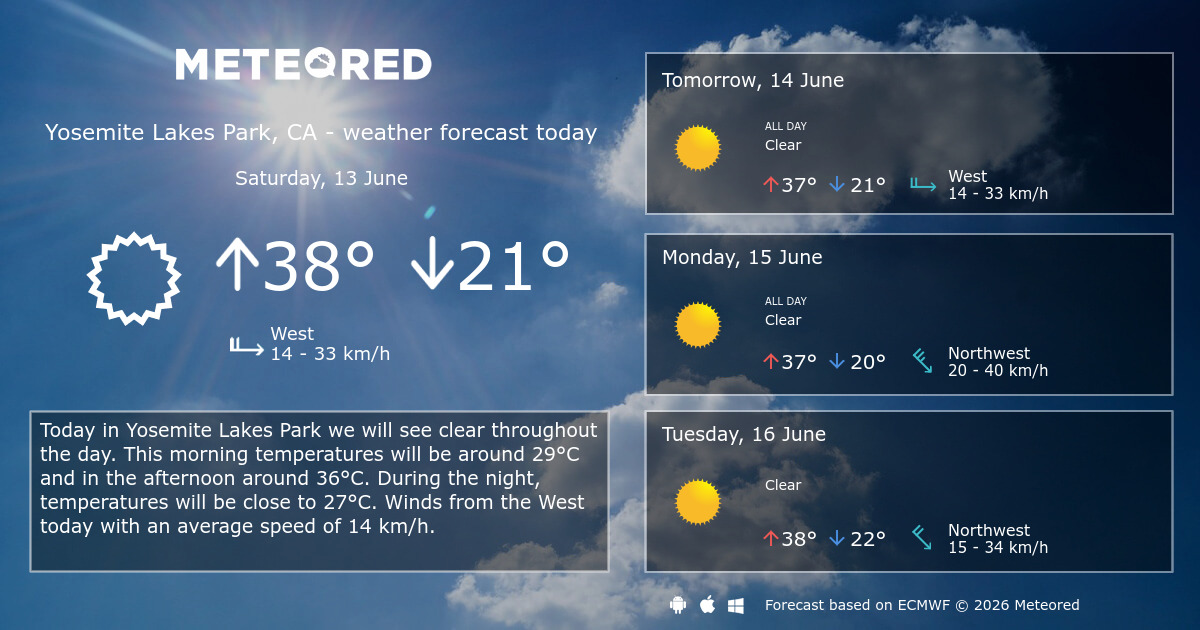
From June through September, the thermometer regularly climbs into the 90s. It’s not uncommon to hit 100°F during a heatwave. Since YLP is in the foothills, it lacks the dense canopy cover of the higher forests, meaning the sun beats down on those rolling golden hills with some serious intensity.
The air is arid. Bone dry. You’ll feel it in your skin and your throat. But there is a silver lining: the evenings. Once that sun dips behind the ridges, the temperature drops fast. You can go from 95°F at 4:00 PM to a crisp 65°F by 9:00 PM. It’s the kind of weather where you spend the day in the pool and the night on the deck with a glass of wine, finally able to breathe again.
Winter: The Snow Question
Does it snow in Yosemite Lakes Park?
Kinda. Sometimes.
Because of the lower elevation, YLP is right on the "snow line." This means in a typical winter storm, the rain-to-snow transition often happens just a few hundred feet above the community. You’ll see the peaks of Deadwood Mountain or the higher parts of Coarsegold turning white while YLP stays wet and gray.
When it does snow—maybe once or twice a year—it’s usually a dusting or an inch or two that vanishes by lunchtime. It's beautiful, sure. The black oaks look incredible with a coating of white. But don't expect to go sledding in your backyard for a week straight.
The real winter story here is the rain.
Most of the 23 inches of annual precipitation falls between November and March. When atmospheric rivers hit California, YLP gets soaked. The "Lakes" in the park’s name actually serve a purpose here, catching the runoff from the foothills. It’s a damp, cool season with daytime highs in the mid-50s and lows hovering just above freezing.
Why the Shoulder Seasons are the Secret
If you want the best of Yosemite Lakes Park weather, you have to aim for the sweet spots.
April and May are spectacular. The hills turn a vibrant, almost neon green that looks like a Windows screensaver. Wildflowers like lupine and California poppies start popping up everywhere. The temperature is basically perfect—high 60s to mid-70s. You can hike the local trails without dripping sweat or shivering.
Then there’s October.
Once the summer heat finally breaks, usually mid-to-late September, the air gets clear. The haze from the Central Valley often clears out, and you get these incredibly sharp views of the High Sierra peaks in the distance. It stays warm enough for t-shirts during the day, but you definitely need a jacket once the sun goes down.
Wildfire Season: The Unfiltered Truth
We have to talk about the smoke.
Being in the Sierra foothills means you are in a fire-prone ecosystem. Fire season usually ramps up in August and can last until the first big rain in November. Even if there isn't a fire right in Coarsegold, the geography of the foothills tends to trap smoke from fires elsewhere in the state or the National Park.
On bad days, the Air Quality Index (AQI) can spike. It turns the sun a weird, apocalyptic orange and makes the air smell like a campfire that won't go out. If you’re planning a trip during this window, always check the PurpleAir or AirNow sensors. Most years are fine, but when a big fire hits the region, the weather becomes less about temperature and more about visibility and lung health.
Microclimates and Elevation Shifts
One of the weirdest things about YLP is how much the weather changes just by driving five minutes.
Because the community is built on ridges and valleys, there are distinct microclimates. The houses down by Blue Heron Lake often deal with "cold air drainage." At night, the cold air sinks into the low spots, meaning it might be 34°F at the bottom of the hill and 40°F at the top.
If you decide to drive up Highway 41 toward the park, the weather shifts rapidly. For every 1,000 feet you climb, you typically lose about 3.5°F. By the time you hit Fish Camp (5,000 feet), it could be snowing while it’s 50°F and raining back at the YLP clubhouse.
Practical Steps for Your Visit
- Layer like a pro. Even in summer, bring a light hoodie. The 30-degree temperature swings between day and night are no joke.
- Download the Offline Maps. Cell service can get spotty when storms roll through the foothills, and you don't want to be guessing where the nearest gas station is when the rain is coming down sideways.
- Hydrate way more than you think. The dry air in the foothills wicks moisture off you fast. If you're hiking the YLP trails, double your water intake.
- Monitor the "Snow Line." If you're visiting in winter and want to see snow, keep an eye on the 3,000-foot level. If the forecast says snow at 3,000, YLP will be rainy, but a 15-minute drive up the road will put you in a winter wonderland.
- Check the YLP Webcams. The community often has local cameras near the entrance or the hardware store. It’s the fastest way to see if the "dusting" of snow actually stuck to the ground before you head out.
Yosemite Lakes Park is a bridge between the scorching Central Valley and the frigid High Sierra. It’s a place of transition. You get the best of both worlds—sun-drenched summers and crisp, green winters—as long as you know exactly what you’re signing up for.