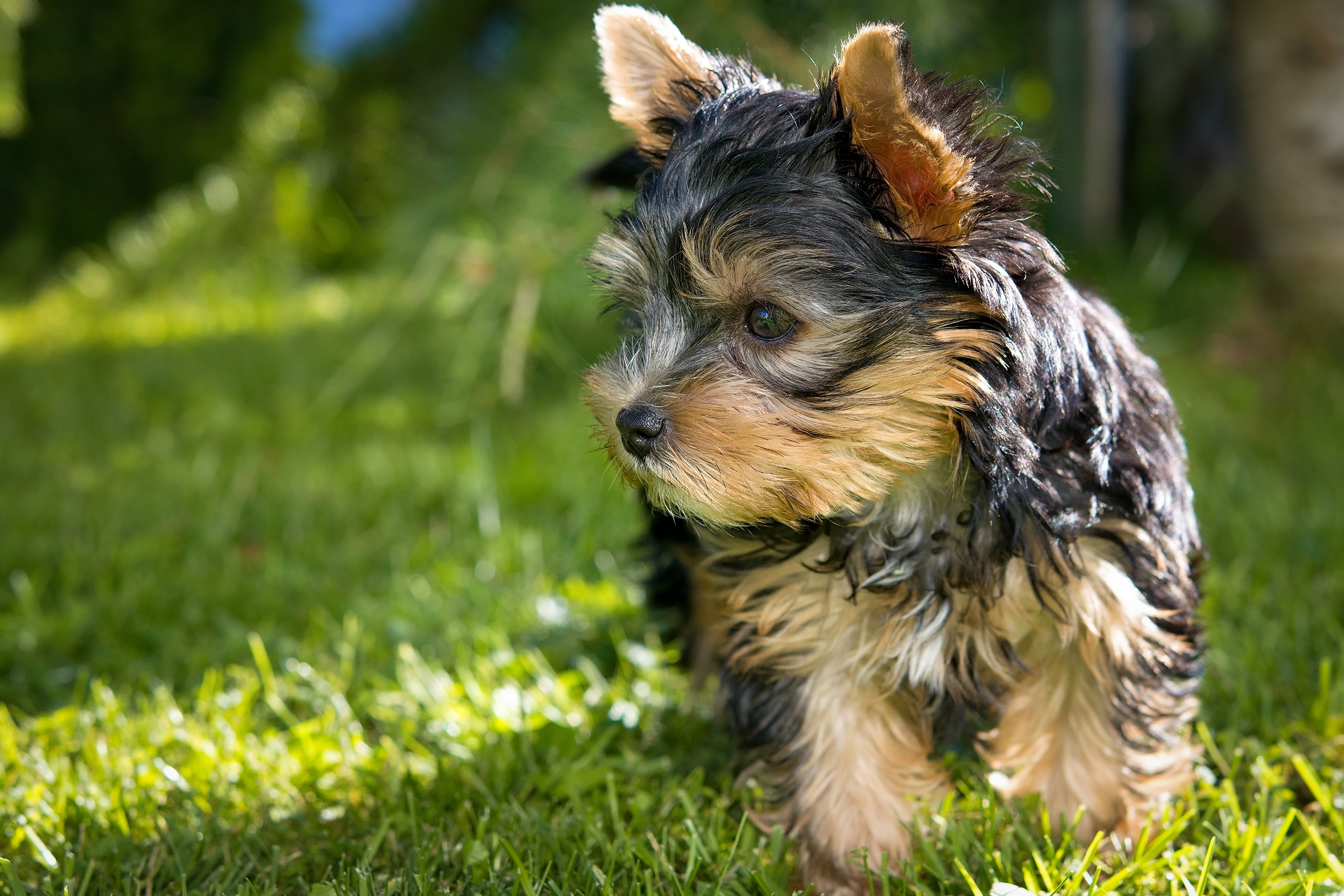
You’ve seen them. Those tiny, feisty sparks of energy darting around the park with coats that shimmer like polished metal. If you’re looking at a puppy, you’re almost certainly seeing a Yorkshire Terrier black and tan coat. But here is the kicker: that color probably won't stay that way. Most new owners get a bit of a shock when their "black" dog starts turning a ghostly shade of blue-gray. It’s not a health crisis. It’s not a mistake. It’s just how Yorkies work.
The American Kennel Club (AKC) is pretty strict about this. They recognize four official color combinations for the breed, and the black and tan variety is basically the starting block for the vast majority of these dogs. If you buy a puppy and it’s already silver or gold at eight weeks old, something is actually a bit weird.
The Genetics of the "Fading" Coat
Let’s talk about the "G" locus. This is the greying gene. Almost every purebred Yorkie carries it. It’s what transforms a jet-black puppy into a "steel blue" adult. Think of it like a slow-motion magic trick.
When a Yorkshire Terrier black and tan puppy is born, the black is deep. It’s saturated. The tan markings usually appear over the eyes, on the muzzle, and on the paws. As the dog hits the six-month mark, you’ll start to see a "clearing" process. The roots of the hair on the head start to turn a pale gold. The black on the back begins to soften. By the time the dog is two or three years old, that black has often shifted into a beautiful, shimmering blue.
But wait. There’s a catch.
Not all of them change. Some Yorkies lack the dominant greying gene, or they have a specific genetic makeup that keeps them dark. These are often referred to as "black-backed" Yorkies. While they look striking, their fur texture is usually different. It’s thicker, woollier, and lacks that signature "human hair" silkiness that the breed is famous for. If you want a dog that looks like a show champion, you actually want that black to fade.
Why Texture Matters More Than You Think
Honestly, the color is just the surface. The real indicator of a high-quality Yorkie coat is the feel. A traditional Yorkshire Terrier black and tan coat should be glossy. It should feel like cool silk against your palm.
If the coat stays deep black and feels like cotton candy, you’re going to have a nightmare with matting. Cottony coats trap dirt. They tangle if you even look at them wrong. Silk coats, which are more common in the dogs that transition to blue and tan, actually shed dirt. You can almost see the dust slide off them.
Joan Gordon and Janet Bennett, legendary figures in the Yorkie world (look up the Wildweir kennel if you want a history lesson), spent decades obsessing over this. They noted that the darkest puppies often ended up with the most prolific, heavy coats, but those coats were the hardest to maintain.
Common Misconceptions About the Tan
People focus on the black, but the tan is just as tricky. In a perfect world, the tan is "deep and rich." It shouldn't be soot-colored or mixed with black hairs.
- The "Smutty" Tan: This is when black hairs are peppered into the tan sections. It’s super common in pet-quality dogs.
- The "Pale" Tan: Sometimes the tan is so light it looks like cream or white. This is often a sign of a dilute gene.
- The "Deep Red": This is the holy grail. A tan so rich it almost looks like a copper penny.
You’ve got to be careful with the "black and tan" label on sites like Craigslist or cheap marketplaces. Sometimes, breeders use it to describe a "Biewer" or a "Parti" Yorkie that has too much black. A true Yorkie shouldn't have white patches. If it does, it's a different sub-type entirely.
Health and the Color Connection
Does color affect health? Usually, no. Not in Yorkies.
However, there is a condition called Color Dilution Alopecia (CDA). It’s rare in Yorkies compared to Dobermans or Great Danes, but it can happen if the "black" is actually a diluted "blue" from birth. If your Yorkshire Terrier black and tan starts losing hair in patches or has chronically itchy skin, it’s worth a vet visit.
Generally speaking, these dogs are hardy little athletes. They live forever. Fourteen, fifteen, even eighteen years isn't unheard of. But they are prone to luxating patellas (wobbly knees) and dental issues. Because their mouths are so small, their teeth get crowded. This leads to plaque buildup faster than you can say "doggy breath."
The Grooming Reality Check
Let's be real for a second. If you keep your Yorkie in a "show coat"—meaning the hair touches the floor—you are signing up for a part-time job. You'll be brushing that dog every single day. Most people opt for the "puppy cut." It’s shorter, easier, and keeps the dog looking like a forever-puppy.
Even with a short cut, the black and tan areas need care. The tan hair around the eyes tends to stain from tears. The black hair on the back can get "sunburned" and turn a rusty brownish color if the dog spends too much time outside in the direct sun.
Buying Tips for the Skeptical Owner
Don't just take the breeder's word for it. Look at the parents.
If the mom and dad are both three years old and still jet black, your puppy will likely stay jet black. If the parents are a beautiful metallic blue and gold, your puppy will change.
Ask about the "clearing" history. A good breeder knows exactly when their lines typically start to change color. They should be able to show you photos of previous litters as adults.
Also, watch out for "Teacup" labels. There is no such thing as a "Teacup Yorkshire Terrier." It’s a marketing term used to sell undersized, often sickly dogs. A healthy Yorkshire Terrier black and tan should weigh between four and seven pounds. Anything under three pounds is a red flag for heart issues and hypoglycemia.
The Social Dynamics of the Yorkie
They think they are Rottweilers. Seriously.
The black and tan Yorkie was originally bred for catching rats in clothing mills in Northern England. They are terriers to the core. This means they have a "prey drive." They will chase a squirrel. They will bark at the mailman. They will try to fight a Great Dane.
Training is non-negotiable. Because they are cute, people let them get away with "Small Dog Syndrome." Don't do that. Treat them like a big dog. Teach them to sit, stay, and come. They are incredibly smart and actually enjoy the mental challenge of learning tricks.
Actionable Steps for New and Prospective Owners
If you're serious about bringing one of these tiny titans into your home, stop scrolling and do these three things:
- Check the Lineage: Ask for the AKC registration of the parents. Specifically, look for the color codes. Black and tan is code 018. If the parents are listed as something else, your puppy's adult coat is a gamble.
- Invest in a High-Quality Pin Brush: Do not buy a cheap plastic brush from a big-box store. A metal pin brush without the little balls on the end is essential for a silk coat. The balls on the end of cheap brushes actually snag and break the hair.
- Find a Groomer Before You Get the Dog: Good groomers are booked weeks in advance. Find someone who specifically knows how to handle Yorkies. A bad "schnauzer cut" on a Yorkie is a tragedy you don't want to witness.
- Schedule a Dental Exam: Since Yorkies are notorious for bad teeth, start them on a dental-friendly diet or get them used to having their teeth brushed while they are still puppies. It saves you thousands in vet bills later.
The Yorkshire Terrier black and tan is a classic for a reason. They are loyal, portable, and filled with more personality than most dogs ten times their size. Just remember that the dog you buy today won't be the same color as the dog you have in two years—and that's exactly how it's supposed to be.



