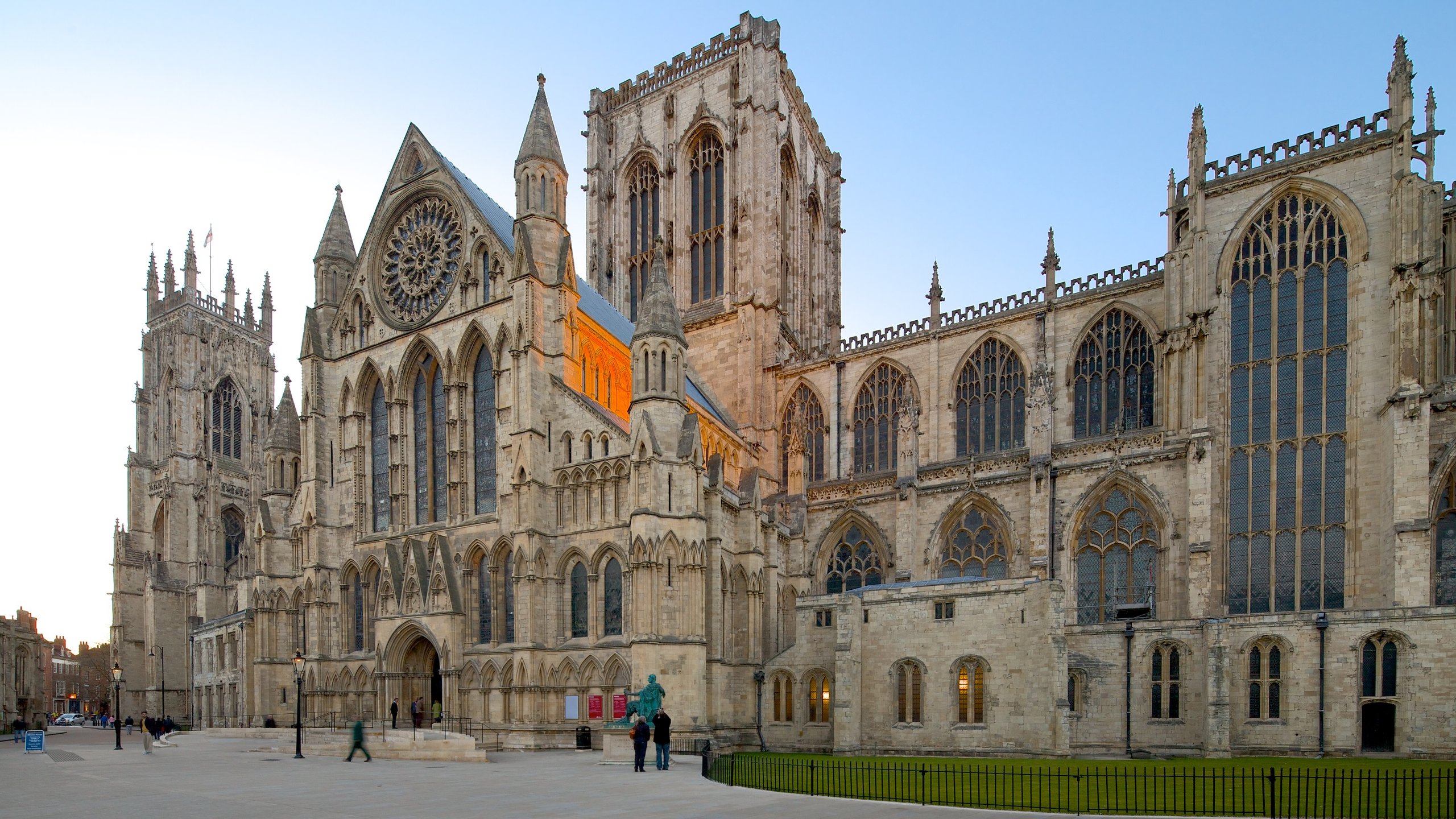
You’re standing in the middle of York, looking up at the Great East Window. It’s the size of a tennis court. Honestly, it’s hard to wrap your head around how people in the 1400s managed to produce 311 panes of stained glass that still look this vibrant today. York Minster isn’t just a church. It’s a 2,000-year-old layers-of-history cake. If you dig deep enough under the floor—and archaeologists actually did this in the 1960s—you find a Roman fortress. It's wild.
People call it a "Cathedral," but its formal name is the Cathedral and Metropolitical Church of Saint Peter in York. It’s the seat of the Archbishop of York, the second-highest office in the Church of England. But labels aside, the building is basically a miracle of medieval engineering that has survived fires, Viking raids, and the occasional lightning strike.
Why York Minster Still Dominates the Skyline
The current Gothic structure we see today took about 250 years to build, starting around 1220. That is a massive amount of time. Generations of masons lived and died without ever seeing the finished product. If you look closely at the stone, you’ll see "mason marks," little signatures carved by individual workers so they could get paid for their specific blocks. It’s the medieval version of a punch clock.
Most people think of Gothic architecture as just "pointy buildings," but the Minster is a masterclass in the shift from the heavy, chunky Early English style to the fancy, "look at me" Perpendicular style. The Chapter House is where things get really interesting. It’s octagonal. There’s no central pillar holding up the roof. In the 13th century, this was basically the equivalent of building a skyscraper without a core. It was a massive architectural flex.
The Glass That Should Have Been Destroyed
York Minster holds the largest collection of medieval stained glass in the country. It shouldn't be here. During the English Civil War, when Oliver Cromwell’s troops were busy smashing "idolatrous" art across England, York’s governor, Thomas Fairfax, stepped in. He loved the city and basically told the soldiers to keep their hammers away from the Minster’s windows.
The Great East Window, created by John Thornton of Coventry between 1405 and 1408, depicts the beginning and the end of the world. It’s the Book of Revelation in glass. They recently finished an 11-year restoration on it. Experts used tiny bits of lead and modern protective glazing to make sure it lasts another 600 years. If you go on a sunny day, the colors on the stone floor are hallucinogenic.
Fire, Lightning, and the 1984 Disaster
The Minster is surprisingly fragile for something made of stone. On the night of July 9, 1984, a bolt of lightning hit the South Transept. The resulting fire was a nightmare. The roof collapsed. The heat was so intense that the 16th-century Rose Window cracked into about 40,000 pieces.
But here is the cool part: the glass didn't fall out. The lead holding the pieces together was so thick that it melted slightly and held the shattered glass in place like a giant jigsaw puzzle. It took years to fix, but today you can’t even tell it happened. Unless you know where to look. Some of the roof bosses in the South Transept were designed by kids who won a BBC "Blue Peter" competition after the fire. One of them even depicts the moon landing.
The Under Croft: A Roman Secret
If you have a bit of claustrophobia, maybe skip the basement. But for everyone else, the Undercroft Museum is the best part of York Minster. When the building started sinking in the late 1960s because the central tower was too heavy for the soft soil, engineers had to dig deep to reinforce the foundations with concrete.
They found the remains of the Roman Eboracum. You can literally see the painted plaster from a Roman barracks right beneath the medieval stone. You're standing where Constantine the Great was proclaimed Emperor in 306 AD. It’s a literal timeline of British history stacked on top of itself.
The Reality of Visiting York Minster Today
Let's talk logistics because most guides make this sound way too simple. It’s expensive. A ticket for an adult is around £18-£22 depending on whether you include the tower climb. But that ticket is actually an annual pass. You can go back as many times as you want for a year.
What to skip and what to prioritize:
- The Tower Climb: It’s 275 steps. The stairs are narrow, winding, and will make your calves scream. If it’s a rainy or misty day, don't bother. You won’t see anything. If it’s clear, you can see all the way to the White Horse of Kilburn.
- The Quire: This is the heart of the church. The wood carvings are incredible. Look for the "misericords"—tiny wooden shelves on the underside of folding seats. They have carvings of monsters and everyday life meant to support tired monks during long services.
- Evensong: This is the pro tip. If you don't want to pay the entry fee, go for the Evensong service (usually around 5:15 PM). You get to hear the world-class choir and see the interior for free. Just remember it's a religious service, not a photo op. Put the phone away.
Misconceptions About the Stone
Most people think the Minster is white or gray. It’s actually Tadcaster Lime Stone. It’s a creamy, buttery color, but it’s incredibly porous. Because York was a coal-heavy industrial city for a long time, the building used to be covered in black soot. Acid rain literally ate the faces off the statues.
The restoration is never-ending. There is a permanent team of stonemasons on-site. They use traditional hand tools—mallets and chisels—to replicate the medieval carvings. Sometimes they get a little creative. On the exterior, you can find modern carvings of characters that definitely weren't around in the 1300s.
The Best Way to Experience the Minster
To truly get York Minster, you have to see it from a distance first. Walk the city walls. The section of the walls from Bootham Bar to Monk Bar gives you the classic "postcard" view. It’s where you realize just how much this building dwarfs the rest of the city.
Inside, don't just look at the big stuff. Look at the Astronomical Clock in the North Transept. It’s a memorial to the airmen who died in World War II. It shows the positions of the sun and stars as seen from York. It’s a quiet, somber contrast to the grandiosity of the nave.
Practical Steps for Your Visit
- Book the Tower separately: You have to get a specific time slot. They sell out fast, especially on weekends.
- Check the schedule: The Minster is a working church. Sometimes the whole place closes for graduations or special services. Check the official website before you trek over there.
- The Chapter House floor: Look down. The tiles are Victorian copies of medieval designs, but they are stunning.
- Visit the Treasurer's House next door: It’s a National Trust property right behind the Minster. It gives you a great perspective on the "Minster Precinct" and how the high-ranking clergy used to live.
- Eat at the Minster Refectory: It’s relatively new and actually good. It's not your typical dusty cathedral cafe; the food is legit.
When you leave, walk around to the statue of Constantine the Great sitting outside the South Transept. Look at his sword. It’s often broken or has a lucky penny tucked into it by locals. It’s a reminder that while the Minster is a monument, it’s also a living part of a city that has been through everything from the Romans to the Vikings to the 21st century.
Stop by the stone yard if the gate is open. You can often see the masons at work, turning giant blocks of Tadcaster stone into delicate tracery. It’s the best way to appreciate the scale of the labor required to keep this place standing. Don't rush it. You can't see 2,000 years of history in twenty minutes.