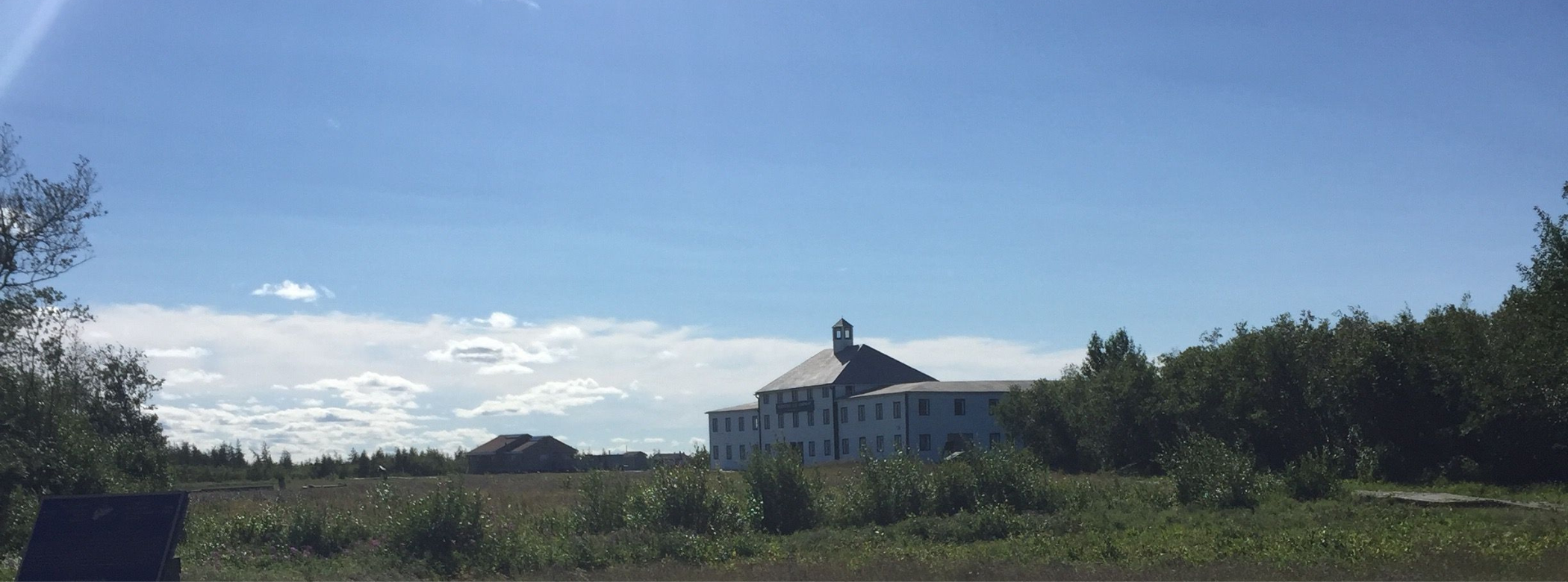
You’ve probably never been there. Honestly, most Canadians haven't either. To get to York Factory Manitoba Canada, you have to really want it. It isn’t a weekend road trip from Winnipeg. It’s a remote outpost on the edge of the world, sitting where the Hayes and Nelson Rivers dump their silt into the frigid, gray expanse of Hudson Bay.
It's wild. It’s lonely.
For nearly three centuries, this place was the literal heartbeat of North American commerce. If you bought a blanket, fired a gun, or trapped a beaver in the 1700s, the paperwork likely flowed through York Factory. It was the headquarters of the Northern Department of the Hudson’s Bay Company (HBC). It was the gateway to a continent. But today? It’s a silent, massive white building standing guard over a thawing riverbank that is slowly, inevitably, being reclaimed by the earth.
The Real Powerhouse of the North
People tend to think of the fur trade as a few guys in canoes wandering around the woods. It wasn't that. It was a massive, global corporate machine. York Factory Manitoba Canada was the hub. Think of it as the Amazon fulfillment center of the 18th century, but with more scurvy and polar bears.
The sheer scale of the Depot building is what hits you first if you’re lucky enough to land a charter plane or take a grueling canoe trip there. It’s a huge, H-shaped wooden structure. Built in the 1830s to replace earlier versions, it’s the oldest building sitting on permafrost in the country. It was designed to hold everything: beads, flour, gunpowder, and thousands upon thousands of pelts.
Life there was brutal.
Men were contracted from the Orkney Islands in Scotland because they were thought to be "hardy" enough to survive the swampy, bug-infested summers and the soul-crushing winters where the mercury would drop so low the wood in the walls would crack like a pistol shot. You weren't just a trader; you were a survivalist. The "Gentlemen" of the HBC lived in relative comfort compared to the laborers, but even they had to deal with the reality that the next ship from England was a year away. If the ship didn't come, you starved. Simple as that.
Why York Factory Manitoba Canada Was the Strategic Prize
Why here? Why this marshy, mosquito-ridden point of land?
Geography is the short answer. The Hayes River was the "main street" of the fur trade. It provided the most direct route from the interior of the continent—places like Lake Winnipeg and the Red River Settlement—to the sea. The HBC needed a spot where deep-sea ships could unload goods and reload with furs for the London markets.
The French knew this too. They fought the English for this patch of mud for decades.
Between 1694 and 1713, the fort changed hands multiple times. In 1697, a French naval commander named Pierre Le Moyne d'Iberville pulled off one of the most lopsided naval victories in history right in the waters off York Factory. His single ship, the Pélican, took on three British merchant-warships. He sank one, captured another, and sent the third running. He won the fort, though the British eventually got it back via the Treaty of Utrecht.
The Shifting Ground
Everything in York Factory Manitoba Canada is temporary because of the soil.
The ground is permafrost, which sounds solid until it starts to melt. The current Depot is actually the third "York Factory." The previous ones were moved or rebuilt because the riverbank kept eroding. This is still a massive problem for Parks Canada today. The Hayes River is a hungry beast. It eats the bank at a rate of several centimeters to a meter a year in some spots.
When you walk the site now, you’re walking over history that is literally falling into the water. Archaeologists have had to do "salvage archaeology" for years, racing to dig up artifacts—clay pipes, glass beads, bones—before they are washed out into Hudson Bay. It's a race against time that the river is winning.
The Indigenous Backbone of the Trade
Let’s be real: York Factory wouldn't have lasted a single winter without the Cree.
The "Home Guard" Cree were the local bands who settled near the fort. They were the ones who provided the meat—thousands of geese and caribou—that kept the HBC employees from dying of malnutrition. They were the middlemen, the guides, and the primary hunters.
The relationship wasn't just "business." It was social. Families were formed. The "Country Born" or Métis populations grew out of these interactions, creating a new cultural fabric that defines Western Canada today. It’s a mistake to view York Factory as just a British outpost; it was a collaborative, albeit often exploitative, crossroads of cultures.
The Cree brought furs from deep in the interior, navigating the complex river systems with a skill the Europeans couldn't hope to match for a century. They traded for iron kettles, knives, and textiles. By the time the 1800s rolled around, the economy of the entire region was completely intertwined with the arrival of the annual "supply ship" at the Factory.
The Slow Decline and Abandonment
So, what happened? Why isn't York Factory a bustling city like Churchill or Winnipeg?
- The Railway: In the late 1800s and early 1900s, the Canadian Pacific Railway changed the game. You didn't need to paddle a canoe for months to get to the ocean anymore. You could just put your grain or furs on a train and head east or west.
- The Hudson Bay Railway: When the tracks finally reached Churchill in 1929, York Factory became obsolete. Churchill had a deep-water port and a rail link. York Factory had a shallow estuary and a lot of mud.
- The Move: The HBC officially closed its doors at York Factory in 1957. The last of the Cree residents were relocated, many of them moved to York Landing, hundreds of miles away. It was a traumatic shift that severed a centuries-old connection to the land.
When the last post manager locked the door, a library of history was left behind. The site was eventually handed over to the Canadian government. It became a National Historic Site in 1936, even before it fully closed, because people recognized its importance even then.
Visiting York Factory Today: What You Need to Know
Going to York Factory Manitoba Canada isn't like going to a museum in the city. There are no gift shops. No Starbucks. No paved roads.
Getting There
You generally have two options. You can fly in via bush plane—usually from Churchill or Gillam. It’s expensive. Or, you can do the "traditional" route: a multi-week canoe expedition down the Hayes River. If you choose the latter, you need to be an expert paddler. The Hayes is a Canadian Heritage River, beautiful but dangerous, with remote rapids and zero cell service.
The Polar Bear Factor
This is polar bear country. Serious polar bear country.
Unlike Churchill, where you might be in a reinforced Tundra Buggy, at York Factory, you are on the ground. Parks Canada usually keeps staff on-site during the summer months (July and August), and they have a "bear fence" around the living quarters. You don't wander off alone. You stay alert. The bears here are big, hungry, and very curious about the humans visiting their territory.
The Experience
What you get is a haunting silence. You can walk through the Depot and see the graffiti carved into the wood by bored clerks 150 years ago. You see the massive scales used to weigh fur bundles. You see the graveyard, where the headstones lean at odd angles because of the shifting permafrost, telling stories of young men who died far from their homes in Scotland.
It’s a place that makes you feel small. It reminds you that empires are built on grit, but nature always has the last word.
Actionable Insights for the History Traveler
If you’re actually planning to engage with the history of York Factory Manitoba Canada, don't just read a Wikipedia page. Start with these steps:
- Check the Parks Canada Status: The site is not always open to the public. Erosion and staffing issues mean access can be restricted. Always check the official Parks Canada York Factory site before even thinking about booking a flight.
- Read the Journals: If you want to know what it was really like, look up the Hudson’s Bay Company Archives (available through the Archives of Manitoba). Reading the daily logs of a factor from 1820 gives you a visceral sense of the isolation.
- Support Local Guides: If you go, try to hire Indigenous guides from the York Factory First Nation. They offer a perspective on the land and the history that you won't get from a government plaque.
- Gear Up: If you’re doing the Hayes River route, your gear needs to be top-tier. Waterproofing isn't a suggestion; it’s a survival requirement. The weather on Hudson Bay can turn from a sunny 20°C to a freezing sleet-storm in about twenty minutes.
- Watch the Tides: If you are arriving by boat at the site, the tides in Hudson Bay are massive. You can easily get stranded on a mudflat for twelve hours if you miscalculate your arrival at the Factory wharf.
York Factory is a reminder of how Canada was built—not just through politics, but through a grueling, messy, and often violent trade in the middle of a wilderness that didn't care if you lived or died. It’s a relic of a time when the world was much larger than it is today. Even as the river slowly claims the last of its timbers, the story of York Factory Manitoba Canada remains a foundational piece of the North American identity.